

Most agency knowledge doesn't live in a system. It lives in Maria's head, in the Slack message she sent eight months ago, and in the way she "just knows" that one commercial auto carrier wants the loss runs attached as a separate PDF, not merged into the application.
Then Maria gives her two weeks' notice.
Suddenly the agency realizes that twelve years of workarounds, carrier quirks, and "the way we handle that" went undocumented. The new CSR hired to replace her spends the first three months asking questions nobody has time to answer, re-discovering problems that were solved a decade ago, and making the exact mistakes Maria stopped making in 2015.
That's the problem this playbook solves. Not "write some SOPs" — that advice is useless because every owner already knows they should. The real problem is that SOP projects die. They turn into a 90-page Google Doc nobody opens, or a SharePoint graveyard of half-finished procedures. The fix isn't more documentation — it's a tight, time-boxed capture sprint that produces a minimum viable knowledge base and wires it directly into the work people already do.
Why SOP projects die (and why "write it all down" never works)
The standard failure looks like this: an owner reads a book on systems, gets fired up, announces that everyone will document their role. People start writing exhaustive procedures. Three weeks in, enthusiasm fades because nobody budgeted actual time for it, the documents live somewhere disconnected from daily work, and there's no owner assigned to keep them current.
Six months later those SOPs are wrong. A carrier changed its binding rules, the AMS got a new field, the renewal workflow shifted — and the document still describes the old way. Now you have something worse than no SOP: a confidently wrong one that new hires trust.
Agencies that succeed don't try to document everything. They capture the 20-ish procedures that actually cause ramp delays and errors, keep each one deliberately short, assign a human owner, and embed the link where the work happens — inside the ticket, inside the task, inside the AMS activity note. Everything else waits.
The sprint structure below is built around that principle. Scope is the enemy. Speed and placement are the point.
The minimum viable KB template
Before any sprinting, you need a template so rigid that writing an SOP takes 15 minutes, not 2 hours. The biggest reason capture stalls is that people don't know how long or detailed a procedure should be, so they over-engineer it.
Eliminate paperwork bottlenecks and missed deadlines.
Covixly helps you track, manage, and close every policy and claim with confidence and speed.
- Unified policy & claims management
- Automated client notifications
- Agent task coordination
No credit card required
-
Title — written as a task, not a topic. "Issue a certificate for an additional insured" beats "Certificates."
-
Trigger — what event starts this? A ticket type, an email, a renewal date, a carrier request.
-
Owner role — which seat is responsible when this happens (not a person's name — a role).
-
Steps — 5 to 12 numbered steps, max. If it needs more, it's two SOPs.
-
System of record — which screen in the AMS, which carrier portal, which folder.
-
Gotchas — the 2–3 things that break it. This is the tribal knowledge. This is the whole point.
-
Last verified — a date and the initials of whoever confirmed it's still accurate.
That "Gotchas" field is where the real value hides. The steps are usually obvious. The reason a task takes a veteran 4 minutes and a new hire 40 minutes is the gotchas — the carrier that rejects certificates issued before noon, the endorsement that needs a signed acord even though the system doesn't force it, the renewal that must be re-rated before you touch the policy.
If your SOPs only capture steps and skip gotchas, you've documented the easy 80% and left out the part that actually causes ramp pain.
Ownership rules: the thing that keeps SOPs from rotting
An SOP without a named owner will be wrong within a quarter. The ownership rule to enforce is simple and non-negotiable: every SOP has exactly one owner role, and that role reviews it on a set cadence.
Not a committee. One role. If the certificate SOP is owned by the Commercial Lines CSR seat, then whoever sits in that seat owns accuracy. When a carrier changes a rule, that person updates the SOP — it's part of the job, not a side project.
Put SOP ownership into the role's regular responsibilities so reviews happen during normal work, not as a separate task.
Agencies that assign ownership to people instead of roles lose their SOPs the moment that person leaves. Tie ownership to the seat, and the knowledge survives turnover. This connects directly to how clean role definitions work in your policy lifecycle operational blueprint — ownership of procedures should mirror ownership of the actual workflow stages.
One more thing worth clarifying: the owner is not necessarily the author. Your best senior CSR might write the first draft of fifteen SOPs, but ownership transfers to whoever holds that seat going forward. Authorship is a one-time act. Ownership is permanent.
The change log nobody wants but everyone needs
A small discipline that pays off disproportionately: a lightweight change log on every SOP.
Not a full version-control system. Just three columns at the bottom of each document:
| Date | What changed | Who |
|---|---|---|
| 03/12 | Carrier X now requires loss runs as separate PDF | JR |
| 05/01 | Added step 7 — re-rate before endorsement | MK |
| 07/22 | Verified accurate, no changes | JR |
When a new hire makes an error and says "but the SOP said to do it this way," the change log tells you whether the SOP was recently updated, who touched it, and whether the error came from a stale step. It also builds a quiet accountability loop — people update procedures more carefully when their initials go next to the change.
The "verified, no changes" entry matters too. An SOP that hasn't been touched in a year isn't necessarily correct — it might just be ignored. A quarterly "still accurate" check proves someone actually looked.
Embedding SOP links into tickets and task flows
This is the step that separates a living knowledge base from a dead document folder, and it's the one most agencies skip.
A standalone KB fails because of friction. If a CSR has to stop what they're doing, open a separate system, search for the right procedure, and figure out which of three similarly-named documents is current — they won't. They'll guess, or they'll interrupt a colleague. Which is exactly the tribal-knowledge dependency you're trying to eliminate.
The fix: the SOP link travels to the work. Concretely:
-
Ticket templates carry the link. When a "New Certificate Request" ticket is created, the SOP link auto-populates in the ticket body or a custom field. The person working the ticket doesn't search — the procedure is right there.
-
Task flows reference the SOP at the step. In your onboarding or renewal task list, each task line includes the relevant SOP link next to it.
-
AMS activity notes link out. When a workflow kicks off a standard activity, the note template includes the SOP reference.
Modern AMS and ticketing platforms support custom fields and templated ticket bodies, which means this embedding can be set up once per ticket type and then run automatically. AI-assisted workflow tooling earns its keep quietly here: instead of a human remembering to paste the right link, the system matches the ticket type to the correct current SOP and drops it in. The value isn't the automation for its own sake — it's that the right knowledge shows up at the exact moment someone needs it, without anyone having to remember.
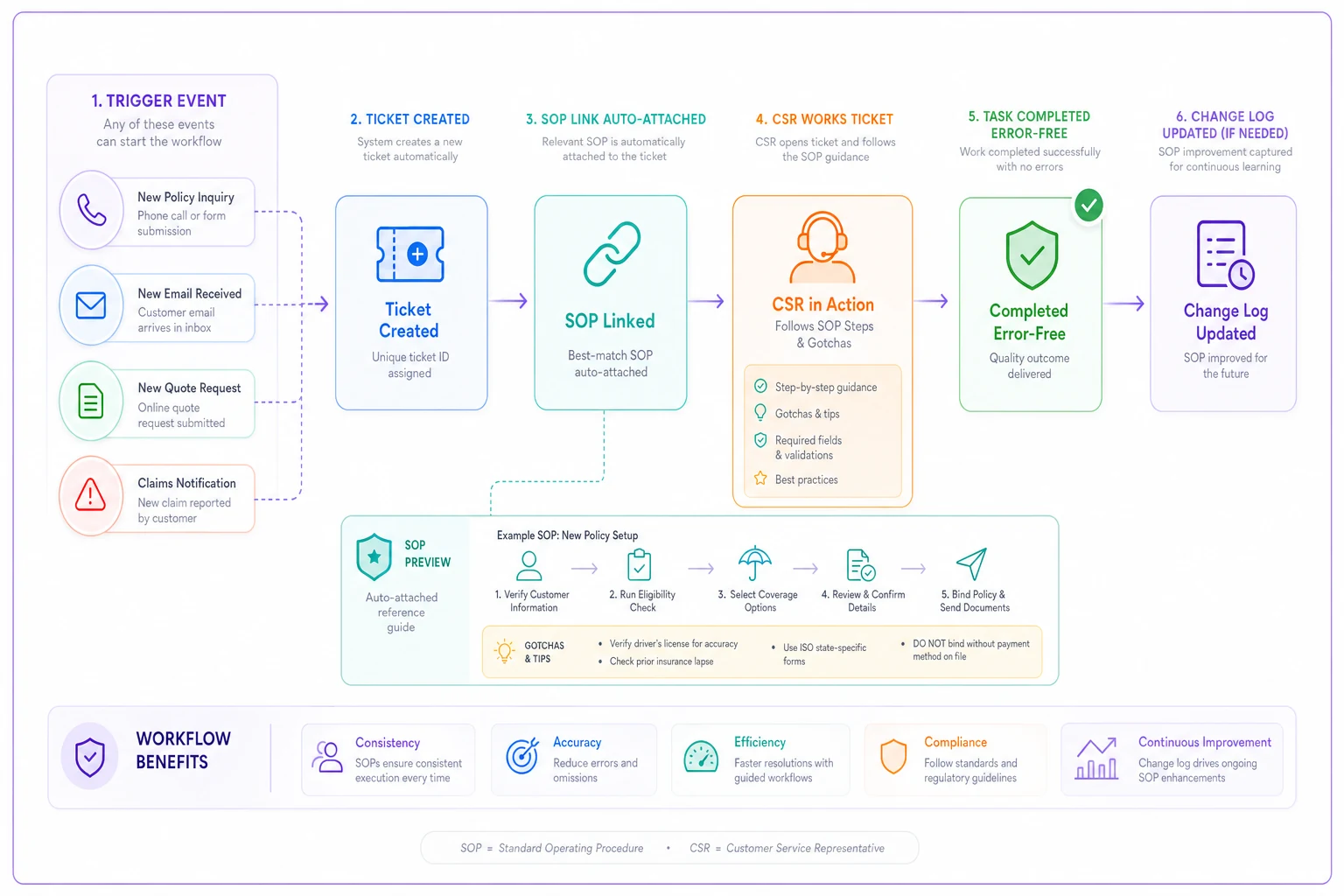
A workflow example, start to finish: a commercial client emails requesting a COI. Your intake rule creates a "Certificate Request" ticket. The ticket template auto-attaches the certificate SOP link in a "Reference" field. The new CSR opens the ticket, sees the link, reads the five steps plus the two gotchas (issue after noon, confirm additional insured wording matches the contract), completes the task correctly, and never pings a senior colleague. That's ramp time collapsing in real time.
This diagram summarizes the capture-and-embed flow.
That's ramp time collapsing in real time.
The 30/60/90 capture sprint
The reason this is time-boxed into three phases is that open-ended documentation projects never finish. A deadline with a defined scope does.
Days 1–30: Capture the ramp-killers
The goal of the first 30 days is not completeness. It's to capture the 15–25 procedures that cause the most new-hire confusion and the most repeat errors. Pick them by asking two questions:
-
What does every new hire ask about in their first month?
-
What errors do we keep fixing over and over?
Those two lists overlap heavily, and that overlap is your first sprint backlog. Common entries: certificate issuance, endorsement processing, carrier-specific binding quirks, renewal re-rating steps, the handoff when a policy moves between producers.
The sprint checklist for Phase 1:
-
[ ] List the top 20 ramp-blocking procedures
-
[ ] Assign each an owner role
-
[ ] Draft each using the minimum viable template (15 min each, strictly)
-
[ ] Fill the Gotchas field — this is mandatory, not optional
-
[ ] Store all SOPs in one location with consistent naming
-
[ ] Dated "last verified" stamp on each
Twenty SOPs at 15 minutes each is five hours of focused work. Spread across three or four people over a month, that's trivial — which is exactly why the tight template matters. The failure mode is letting each SOP balloon into an hour-long project.
Days 31–60: Embed and connect
Phase 2 is about placement. The SOPs exist; now they need to live inside the work.
-
[ ] Map each SOP to the ticket type or task that triggers it
-
[ ] Add SOP link fields to ticket templates
-
[ ] Insert SOP references into onboarding task flows
-
[ ] Add links to AMS activity note templates
-
[ ] Test with one new or junior staff member — can they complete the task using only the SOP?
That last test is the real quality check. If a junior CSR can complete a certificate request start to finish using only the linked SOP, with zero questions, the SOP works. If they get stuck, you've found a missing gotcha. Fix it, note it in the change log, move on.
This phase pairs naturally with a structured day-by-day agent onboarding plan — the SOPs become the backbone of the onboarding workflow instead of a separate reference pile nobody opens.
Days 61–90: Verify, close gaps, set the cadence
Phase 3 is where you make it permanent. The first 20 SOPs are live and embedded. Now:
-
[ ] Review every SOP touched in the last 60 days for accuracy
-
[ ] Add the 5–10 procedures the sprint revealed were missing
-
[ ] Confirm every SOP has an owner and a verification date
-
[ ] Establish the ongoing review cadence (below)
-
[ ] Run a second new-hire test across the full set
By day 90 you don't have a finished encyclopedia. You have roughly 25–30 live, embedded, owned procedures covering the highest-friction parts of the job — and a system that keeps them current. That's worth more than a 200-page manual nobody maintains.
Manager review cadence
The sprint creates the KB. The cadence keeps it alive. Without a recurring review rhythm, even a well-built knowledge base rots within two quarters.
A workable cadence by SOP risk level:
| SOP type | Review cadence | Who reviews |
|---|---|---|
| Carrier-specific rules (change often) | Monthly | Owner role |
| Core workflows (certs, endorsements) | Quarterly | Owner + manager spot-check |
| Stable procedures (internal admin) | Twice yearly | Owner |
| Any SOP tied to an error incident | Immediately | Owner + manager |
That last row matters most. Every time an error traces back to a procedure, the SOP gets reviewed that week — not at the next scheduled cadence. Errors are the best signal that a procedure is unclear or outdated. Reviewing SOPs only on a calendar while ignoring error signals means you'll keep making the same mistakes between cycles.
A manager's review doesn't need to be heavy. Fifteen minutes a month scanning the change logs, confirming carrier-rule SOPs got updated, checking that any error-triggered reviews actually happened. The point is to make "is our knowledge current" a visible, recurring question instead of something that only surfaces when someone quits.
This cadence also plugs into any SLA framework you've built for agents and CSRs — if a task has an SLA, the SOP governing it should be on a review schedule, because an outdated procedure is a direct cause of blown service times.
A real scenario
A mid-sized commercial agency, around 14 staff, lost a senior CSR who'd handled certificates and endorsements for nine years. Her replacement took close to three months to reach acceptable speed, and during that stretch the agency logged a noticeable spike in certificate errors — wrong additional-insured wording, certs issued without required endorsements, a couple of E&O near-misses.
They ran a capture sprint focused narrowly on commercial lines workflows. Not everything — just certificates, endorsements, and carrier-specific binding rules. About 22 SOPs in the first month, each with the gotchas field filled in by remaining senior staff, then embedded into their ticketing templates so the right procedure auto-appeared on the right ticket type.
The next hire they onboarded reached functional speed in roughly five to six weeks instead of twelve. Certificate errors dropped back to near their old baseline within the first month. And the constant "quick question" interruptions to senior staff — the ones that quietly eat an hour a day — fell off sharply because the answers were sitting inside the tickets.
Nothing about that outcome required a massive documentation effort. It required capturing the right 22 procedures, putting the gotchas on paper, and placing them where the work happens.
When this sprint makes sense — and when it doesn't
This works best when you have at least one tenured person who still holds critical knowledge in their head. The sprint is a race to extract it before they leave. If you're staring down a known departure, start this week.
It also makes sense right before a growth phase. If you're about to hire two or three new CSRs, capturing SOPs first means each new hire ramps against a documented standard instead of against whoever happens to be free to answer questions.
When it's a bad idea: if you try to document everything at once. The agencies that fail are the ones that can't resist scope creep — they start with certificates and endorsements, then decide they'll also document every carrier, every niche class of business, every edge case, and the sprint collapses under its own weight. Keep it to the ramp-killers. Expand later, or not at all.
Who should probably skip the full 90-day structure: a two- or three-person agency where everyone already knows everything. At that size, a short shared doc of carrier gotchas is enough. The sprint pays off when you have handoffs, turnover risk, and new hires — not when three people sit in the same room all day.
The takeaway
The agencies that stop bleeding tribal knowledge aren't the ones with the biggest manuals. They're the ones who captured the handful of procedures that actually cause ramp delays, wrote down the gotchas instead of just the steps, assigned a real owner to each, and put the links where the work lives.
Run a focused 90-day sprint, keep a cadence that treats errors as review triggers, and the next time someone gives notice, their knowledge stays behind — because you already pulled it out of their head before they packed up their desk.
Ready to transform your insurance agency operations?
Join 500+ agencies using Covixly to reduce manual work, improve client service, and grow their book of business.