


Most agencies onboard new agents one of two ways: throw them at the phones on day three and hope they figure it out, or bury them in carrier training portals for two weeks until their eyes glaze over. Both produce the same result — a new hire who technically "started" a month ago but still can't quote a BOP without pulling a senior agent off their own book to babysit.
The gap isn't knowledge. New agents pick up product info fast. The gap is workflow competency — knowing where things live in your management system, who to hand off to, what your agency's actual quote-to-bind process looks like, and how not to blow up a renewal because they didn't know your endorsement naming convention.
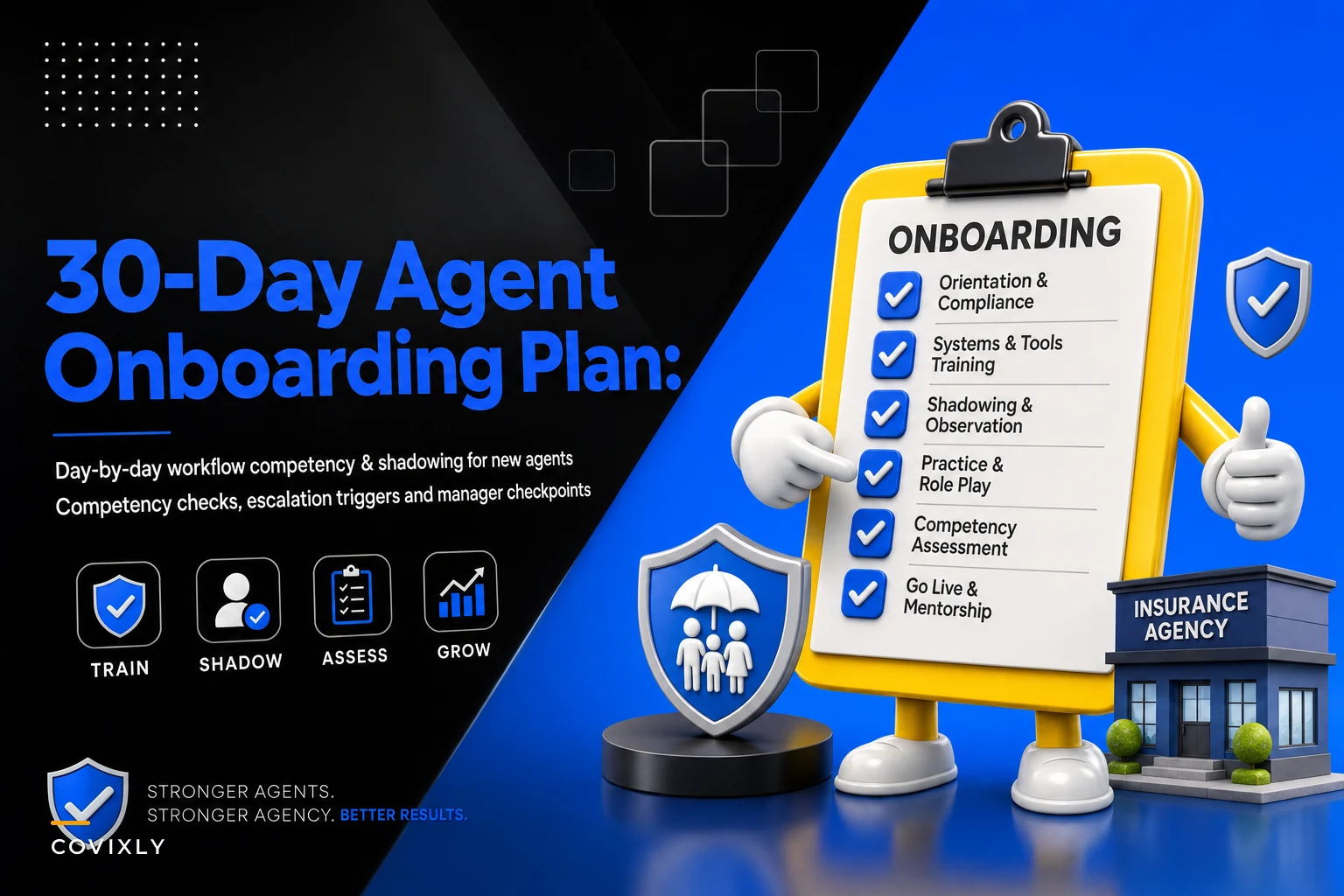
This is a day-by-day breakdown for a proper 30 day agent onboarding insurance agency program, built around three things that actually move the needle: shadowing with intent, competency checks that measure real tasks, and manager checkpoints that catch problems before they compound. No fluff weeks. No "review the handbook" filler days.
Why most 30-day plans quietly fail
The typical onboarding calendar looks fine on paper. Week one is orientation, week two is product, week three is systems, week four is "start taking accounts." The problem is it treats knowledge and competency as the same thing. They aren't.
A new agent can watch you quote a commercial auto policy on Tuesday and be completely lost when they try it Thursday, because watching is passive. They saw you navigate the management system at muscle-memory speed, but they never had to find the "add driver" screen themselves, never hit the validation error you instinctively avoid, never dealt with the carrier portal timing out mid-quote.
The failure point is almost always in the handoff between shadowing and doing. There's no bridge. The plan below builds that bridge into specific days with specific checks.
The other quiet failure: no manager checkpoints with teeth. A "how's it going?" coffee chat on day 15 is not a checkpoint. A checkpoint is when the manager watches the new agent complete a defined task unassisted and scores it against a rubric. Without that, you don't actually know if your new agent is on track — you're guessing based on vibe.
The three-phase structure
Before the day-by-day, here's the shape of the 30 days. Each phase has a different center of gravity.
Eliminate paperwork bottlenecks and missed deadlines.
Covixly helps you track, manage, and close every policy and claim with confidence and speed.
- Unified policy & claims management
- Automated client notifications
- Agent task coordination
No credit card required
| Phase | Days | Center of gravity | New agent is mostly... |
|---|---|---|---|
| Foundation | 1–8 | Systems + workflow map | Watching, navigating, doing low-stakes tasks |
| Supervised production | 9–20 | Real tasks with a net | Quoting, servicing, handling accounts under review |
| Controlled independence | 21–30 | Owning small accounts | Working live, escalating on defined triggers |
Product training isn't its own phase. It's woven through all three, because agents learn products faster when they're attached to a real task than when they're staring at a carrier's e-learning module in isolation.
Days 1–8: Foundation (systems and workflow, not sales)
The single biggest mistake in the first week is starting with sales scripts. Your new agent can't sell anything if they don't know how your agency actually processes work. Front-load the operational reality.
Day 1 — The map. Not the handbook. Sit them down and walk through your agency's actual workflow end to end: lead comes in → gets logged where → gets assigned how → quoted in what system → bound how → serviced by whom. Draw it. This is the single most valuable hour of the whole month because it gives them a mental model to hang everything else on. If your workflow is undocumented, that's your first problem to fix — it's the reference they'll come back to constantly.
Day 2 — Management system navigation drills. Have them find things. Pull up a specific client. Find the last endorsement. Locate a document in the file. Add an activity note. This sounds trivial until you watch a new hire spend four minutes hunting for a client's declaration page.
Day 3 — Shadow: intake and logging. They sit with whoever handles new business intake. Their only job today is understanding how a lead becomes a record, and every field that has to be right.
Day 4 — Reverse shadow: intake. Now the new agent does the logging while the experienced person watches. This is the bridge most plans skip. Same task, roles flipped, on the same day's real work.
Day 5 — Product block: your top 3 lines. Whatever you write most — personal auto, homeowners, BOP, whatever. Not all products. The three that make up the bulk of your volume.
Day 6 — Shadow: quoting. Watch a senior agent quote those exact three lines. Have the new agent take notes on the sequence, not the product details.
Day 7 — Reverse shadow: quoting (test cases). Give them three pre-built practice scenarios and have them quote each. These aren't live clients — they're fake accounts designed to hit the common snags.
Day 8 — First manager checkpoint.
Checkpoint 1 template (end of Day 8)
-
Log a new lead correctly with all required fields
-
Locate a specific document in an existing client file in under 90 seconds
-
Add a properly formatted activity note
-
Quote one of the top-3 lines from a test scenario without prompting
-
Correctly name and attach a document per agency convention
-
Explain the full intake-to-bind workflow out loud
If more than two land in "not-ready," slow down. Don't push into Phase 2 on a schedule when the foundation's cracked. That's how you get agents who look busy for three weeks and then blow up a real account.
Days 9–20: Supervised production
This is where the plan spends most of its energy, and rightly so. The new agent starts touching real work, but with a net underneath every task.
The mistake here is going too fast. Agencies that had a rough day-8 checkpoint often try to "make up time" in this phase by handing over accounts too quickly. That backfires. The whole point of supervised production is that a mistake gets caught before it hits the carrier or the client.
Days 9–10 — Live quoting, reviewed before send. The new agent quotes real prospects, but nothing leaves the agency until a senior agent reviews it. Track how many corrections are needed. A new agent might need corrections on 6 or 7 out of 10 quotes early in this stretch. By day 13 or so, you want that dropping toward 2 or 3. If it's not dropping, the reviews aren't teaching — they're just fixing.
Days 11–12 — Servicing tasks: endorsements and COIs. Small changes, certificate requests, ID card reissues. Low-risk, high-volume work that builds system fluency fast. This is also where a solid client onboarding playbook earns its keep — the new agent follows the same checklist your team already uses, so they're building the right habits from day one.
Days 13–14 — Renewal exposure. Renewals are where new agents cause the most expensive damage, usually during handoffs. Have them shadow a full renewal cycle, then walk through your renewal transfer protocol so they understand exactly why the handoff steps exist and what breaks when they're skipped.
Days 15–16 — Handling inbound service calls (monitored). They take real calls, but a senior agent is listening or immediately available. Debrief after each call: what went well, what to say differently.
Day 17 — Second manager checkpoint.
Days 18–20 — Wider product exposure + first solo-ish accounts. Introduce the next tier of products you write, and let them own a couple of genuinely simple accounts start to finish, with review only at bind.
Checkpoint 2 template (Day 17)
-
Quote correction rate has dropped to 3 or fewer per 10
-
Completed at least 5 endorsements with no rework
-
Issued COIs correctly without escalation
-
Handled 3+ inbound service calls rated acceptable or better
-
Can explain the renewal handoff steps and why each matters
-
Knows the agency's escalation triggers — when to stop and ask
That last one is underrated. A huge part of competency is knowing the edge of your competency. An agent who escalates the right things is far safer than one who confidently handles everything.
Days 21–30: Controlled independence
The final stretch isn't "you're on your own now." It's "you own the work, and you escalate on defined triggers." The difference matters. Total independence on day 21 is how new agents drown quietly and you don't find out until a client complains.
Days 21–24 — Own a small book of live accounts. Real clients, real quotes, real binds. The new agent works independently but has a written list of escalation triggers: any commercial account over a set premium threshold, anything with a prior claims history flag, any policy involving a line they've had less than a week of exposure to.
Days 25–27 — Volume + service load. Increase the number of accounts and add ongoing servicing so they experience a realistic daily workload. This is where you find out if their system habits hold up under pressure or fall apart. What usually breaks first is documentation — activity notes get skipped when things get busy. Watch for it.
Days 28–29 — Error review and cleanup. Go back through everything they touched in the last ten days. Not to punish — to teach. Find the patterns. If they consistently miss the same field or skip the same step, that's a training gap, not a character flaw.
Day 30 — Final manager checkpoint and graduation.
The escalation-trigger workflow they need to internalize
``
Task comes in
→ Have I done this exact type of task successfully before, under review?
   → No → Escalate
   → Yes → Does this account hit any escalation triggers?
              (premium size / claims flag / unfamiliar line)
      → Yes → Flag for senior agent before proceeding
      → No  → Proceed, document as you go, note anything unusual for daily debrief
``
That loop, running automatically, is the real deliverable of a 30-day plan. Not "they finished training." It's that they've internalized when to trust themselves and when to stop.
This is also one of the few places where AI-powered operational software earns its keep during onboarding. Platforms that centralize your workflow steps, flag missing documentation, or surface escalation triggers automatically take some of the cognitive load off a new agent still building their instincts. They're not replacing judgment — they're giving a new hire guardrails while the judgment develops.
Checkpoint 3 template (Day 30)
-
Independently managed a small book with no carrier-facing errors
-
Documentation stayed complete even under increased volume
-
Escalated appropriately — not too much, not too little
-
Can quote and bind top-tier lines start to finish, unassisted
-
Handled at least one non-standard situation reasonably
-
Ready for a defined production target next month
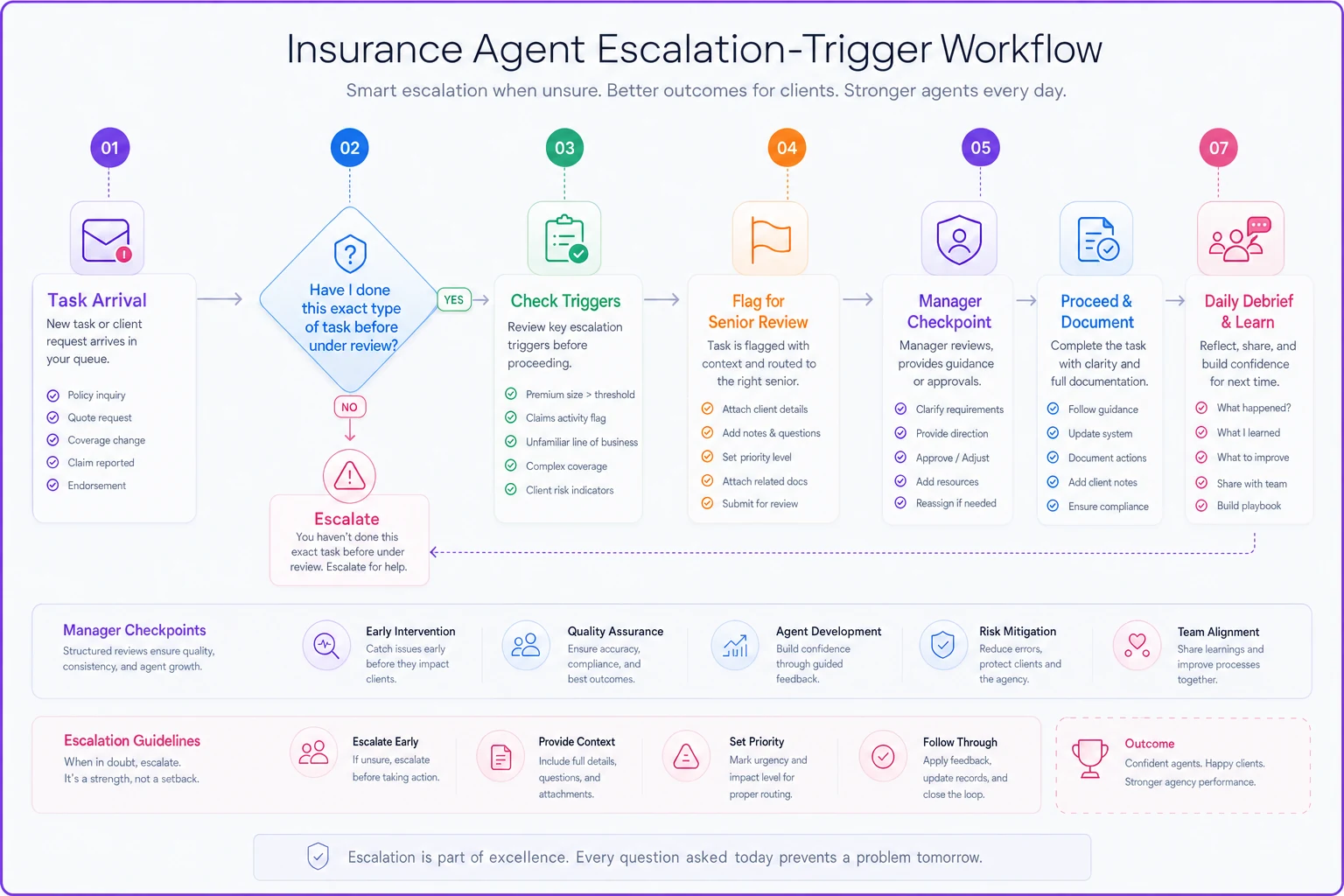
The image above maps the decision points new agents should run automatically and the checkpoints that catch risky handoffs.
A real scenario
A mid-sized personal and commercial lines agency — around 11 people, mostly writing auto, home, and small BOP — kept losing new hires around the 60-day mark. Not because they quit. Because they were still leaning on senior agents so heavily that management eventually concluded they'd never ramp, and either let them go or shuffled them into pure service roles.
The actual problem showed up when they mapped it out: their onboarding was two weeks of product training followed by "sit next to Dave." No reverse shadowing, no competency checks, no defined checkpoints. Dave was a great agent and a terrible teacher, and every new hire's ramp speed basically depended on how patient Dave felt that week.
They rebuilt onboarding around a day-by-day structure close to the one above — reverse shadowing on the same day as shadowing, three hard checkpoints, written escalation triggers. The first new hire through the new plan was handling a small independent book by roughly day 24. Quote correction rates dropped from something like 7-in-10 early to about 2-in-10 by the third week. And the senior agents got their time back, because the new hire escalated deliberately instead of interrupting constantly out of uncertainty.
Nothing exotic happened. They just stopped confusing "watched someone do it" with "can do it," and they measured competency on specific tasks instead of guessing.
Where onboarding quietly breaks even with a good plan
Even a well-designed 30-day plan leaks in a predictable spot: consistency. If your senior agents each run the shadowing differently, teach different shortcuts, and enforce different documentation standards, the new agent inherits the inconsistency. Two new hires who "went through the same plan" come out with different habits depending on who they sat with.
This is where centralizing your actual workflows matters more than the calendar. When your intake steps, quoting sequence, documentation conventions, and escalation rules live in one place your whole team follows — rather than in each senior agent's head — onboarding stops depending on which Dave you got. Agencies running their operations on a shared workflow platform, where the process is the same regardless of who's teaching it, see far less of this drift. The new agent learns the agency's way, not one person's way.
The manager checkpoints do something similar. When competency is scored against a written rubric instead of a manager's gut feeling, you get an honest signal about whether someone's ready — and you can compare across hires. Tying that back to your broader KPI tracking means ramp time becomes a tracked number, not a mystery.
When this level of structure makes sense — and when it doesn't
This plan is built for agencies hiring agents who'll touch real accounts. If you're onboarding a pure service CSR who'll only ever process endorsements, you can compress it heavily — most of the quoting and independence phases don't apply. Lean instead on clearly defined SLA standards to set what "good" looks like for their role.
It's overkill if you're a two-person shop hiring your first help and you'll be sitting beside them every day anyway. The checkpoints still help, but the day-by-day granularity is more than you need when you're literally in the same room watching everything.
And it's a bad idea to run this rigidly if your new hire is a seasoned agent coming from another agency. Forcing an experienced producer through eight days of foundation drills insults them and wastes everyone's time. Keep the checkpoints — you still need to verify they know your systems and conventions — but collapse the shadowing phases hard. Competency checks matter for everyone. The hand-holding doesn't.
Bringing it together
The reason a 30 day agent onboarding insurance agency program works isn't the 30 days. It's the structure inside them — the reverse shadowing that turns watching into doing, the checkpoints that measure real tasks instead of feelings, and the escalation triggers that teach a new agent the edge of their own competency.
Skip those and you've got a fancy calendar. Build them in and you get agents who are genuinely productive by week four instead of dependent for two months. Start by writing down your actual workflow, run the reverse shadows on the same day as the shadows, and score competency against something real. The rest follows from there.
Ready to transform your insurance agency operations?
Join 500+ agencies using Covixly to reduce manual work, improve client service, and grow their book of business.