


Most insurance agencies operate on hope. Hope that quotes get done. Hope that renewals happen on time. Hope that claims get filed correctly. When you run a 12-person agency writing $4.2M in premium, hope isn't a business strategy.
Service level agreements sound corporate, but they're really just promises with consequences. Most agencies either have zero SLAs (chaos) or they copy some Fortune 500 template that requires three people just to track compliance (bureaucracy). Neither works when you're trying to manage personal lines agents juggling 400 policies each while your commercial team handles complex accounts that can take weeks to quote properly.
The real challenge isn't creating SLAs. It's creating ones that actually get followed without turning your agency into a police state.
Why Traditional SLA Templates Break in Insurance Agencies
Insurance agencies aren't customer service centers. Your CSR isn't just answering phones — they're processing endorsements, chasing down dec pages, and explaining why flood insurance doesn't cover basement seepage for the eighth time today. Your underwriter isn't just reviewing applications — they're negotiating with carriers, restructuring coverage to hit target premiums, and sometimes completely rebuilding submissions because the agent grabbed the wrong class code.
Generic SLA templates assume predictable work. They assume every task takes roughly the same time. Insurance agencies have none of these luxuries.
A personal lines quote might take 15 minutes or 3 hours depending on whether the client has a DUI from 2019 that they "forgot" to mention. A commercial renewal might be automatic or might require complete remarketing because the incumbent carrier decided to exit restaurant business in your state. Your newest agent might take two days to do what your senior agent handles in two hours.
This complexity kills rigid SLA structures. You end up with either meaningless averages that nobody hits or so many exceptions that the SLA becomes worthless.
The Three-Tier System That Actually Works
The agencies that succeed separate routine work from complex work from crisis work. Not every task deserves the same urgency, and pretending otherwise just creates false emergencies.
Eliminate paperwork bottlenecks and missed deadlines.
Covixly helps you track, manage, and close every policy and claim with confidence and speed.
- Unified policy & claims management
- Automated client notifications
- Agent task coordination
No credit card required
Tier 1: Routine Operations
These are your bread and butter tasks. Certificate requests, simple endorsements, payment questions, ID card reissues. The stuff that keeps the lights on but doesn't require deep thinking.
For a typical personal lines CSR handling 350-400 accounts:
-
Certificate requests
4 business hours
-
Simple endorsements (vehicle swaps, address changes)
Same business day if received before 2 PM
-
Payment inquiries
2 business hours
-
ID cards and dec pages
30 minutes for existing policies
-
Renewal reviews (no changes)
48 hours before renewal date
For commercial lines agents with 80-120 accounts:
-
Certificates (standard)
Same business day
-
Certificates (additional insured)
24 business hours
-
Simple endorsements
24 business hours
-
Audit assistance
48 business hours
-
Renewal questionnaires sent
90 days before renewal
These timeframes assume normal circumstances. A certificate request that requires carrier approval because of unusual wording automatically bumps to Tier 2.
Tier 2: Complex Work
This covers new business quotes, coverage redesigns, claims assistance, and anything requiring actual analysis or negotiation.
Personal lines:
-
New business quotes (auto/home)
24 business hours
-
Multi-policy quotes
48 business hours
-
Claims filing assistance
4 business hours during business days
-
Coverage reviews (requested)
5 business days
-
Non-standard or high-risk quotes
3 business days
Commercial lines:
-
Small commercial quotes (BOP, simple GL)
3 business days
-
Complex commercial quotes
5-7 business days
-
Submission to carrier after client approval
24 business hours
-
Claims coordination (non-emergency)
24 business hours
-
Policy restructuring proposals
5 business days
These timeframes are longer but still concrete. "I'll get back to you soon" isn't an SLA. "You'll have a quote within three business days" is.
Tier 3: Crisis Response
Some things can't wait. Major claims, coverage gaps discovered at renewal, binding requirements for loans closing tomorrow. These trump everything else.
Universal crisis triggers:
-
Active claim with immediate coverage questions
1 hour
-
Mortgage closing requirements
Same day
-
Coverage lapse prevention
Same day
-
Discovered errors affecting coverage
4 hours
-
Regulatory compliance issues
24 hours
-
Large commercial claim coordination
2 hours
The trick with crisis work is defining what actually qualifies. "Client is upset" isn't a crisis. "Client's mortgage closes tomorrow and needs evidence of insurance" is.
Enforcement Without Being a Jerk
SLAs without consequences are suggestions. But harsh enforcement in a small agency creates a culture of fear that drives away good people. Agencies that make this work use progressive enforcement that assumes people want to do good work but sometimes need structure.
Stage 1: Tracking and Transparency
Start by just measuring. No consequences, just visibility. Create a simple tracker (even a shared spreadsheet works) where everyone logs:
-
Request received
-
Type and tier
-
Target completion
-
Actual completion
Run this for 30 days without any enforcement. You're establishing baseline performance and letting people see their own patterns. Most agents don't realize they're consistently late on certain tasks until they see the data.
Stage 2: Team Accountability
After the baseline period, start weekly team reviews. Not individual callouts, but aggregate performance. "We hit 78% of our Tier 1 SLAs last week. The main miss was certificate requests. What's creating the bottleneck?"
Stage 3: Individual Coaching
Only after 90 days of data do you start individual conversations. And these start as coaching, not discipline. "I noticed your Tier 2 quotes are consistently taking 5 days instead of 3. What's making these take longer? Do you need different carrier access? Is our quoting system slowing you down?"
Often you'll discover system problems, not people problems. Maybe your commercial agent is delayed because they're waiting for carrier responses. Maybe your CSR can't hit endorsement deadlines because the personal lines carriers have brutal online systems.
Stage 4: Formal Consequences
Only after coaching fails do you implement formal consequences. These should be graduated:
-
Written coaching plan with specific improvement targets
-
Temporary reduction in new business assignments
-
Removal from bonus eligibility
-
Formal performance improvement plan
-
Termination
Most agencies never get past Stage 3 because the visibility and coaching solve 90% of issues.
The Monitoring System You'll Actually Maintain
Complex tracking systems die in small agencies. You don't have time to update seventeen spreadsheets and run weekly analytics. The monitoring has to be simple enough that it happens automatically.
The Daily Snapshot
Each morning, everyone spends 5 minutes updating a simple table:
| Tasks | Due Today | Overdue | At Risk (Due Tomorrow) |
|---|---|---|---|
| Tier 1 | Number | Number | Number |
| Tier 2 | Number | Number | Number |
| Tier 3 | Number | Number | Number |
That's it. Takes literally 5 minutes. Post it in your team chat or shared document. Everyone sees everyone's load.
The Weekly Review
Every Friday afternoon, pull the one metric that matters: SLA achievement rate by tier.
Week of [Date]:
-
Tier 1
87% on time (174 of 200)
-
Tier 2
72% on time (28 of 39)
-
Tier 3
100% on time (3 of 3)
Look for patterns. If Tier 1 is consistently below 85%, you have a capacity problem. If Tier 2 is below 70%, you have a complexity problem. If Tier 3 ever drops below 100%, you have a prioritization problem.
The Monthly Analysis
Once a month, dig deeper. Which specific task types miss SLAs most often? Which team members consistently hit or miss? What external factors (carrier delays, system outages, unusual claim volume) affected performance?
This isn't about creating reports nobody reads. It's about identifying the 2-3 things that would most improve next month's performance.
A quick workflow diagram helps teams keep the monitoring routine.
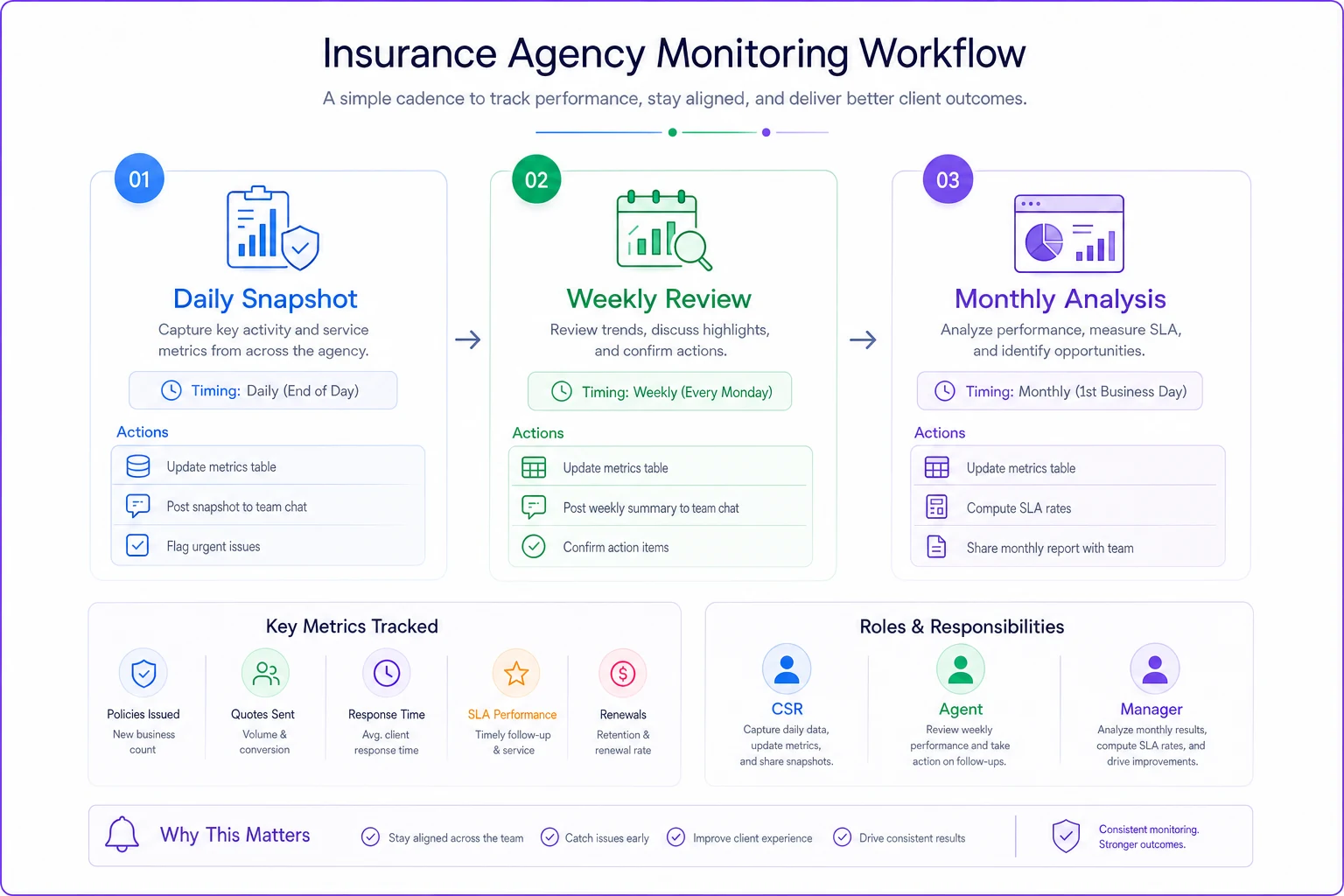
Keep the daily snapshot to 5 minutes so it doesn't become a burden and actually gets done.
This isn't about creating reports nobody reads. It's about identifying the 2-3 things that would most improve next month's performance.
Adapting SLAs to Your Reality
A 5-person personal lines agency has different needs than a 30-person commercial agency. Your SLAs should reflect your reality, not some template you downloaded.
For Small Personal Lines Agencies (Under 10 People)
Keep it simple. Maybe you only track 5-6 task types total:
-
Quotes
-
Service requests
-
Certificates
-
Claims assistance
-
Renewal processing
Your SLAs might be longer but more consistent. Everything Tier 1 gets 24 hours. Everything Tier 2 gets 72 hours. Crises get same day. That's manageable for a small team where everyone does everything.
For Growing Mixed Agencies (10-25 People)
You need more differentiation. Personal and commercial lines need different SLAs. Your account managers need different standards than your service team. But don't go crazy — maybe 10-12 distinct task types with 3 tiers each.
The challenge here is coordination. When commercial agent promises a certificate in 24 hours but needs CSR support who has different SLAs, things break. Make sure handoff points are clear.
For Specialized Commercial Agencies
Your SLAs might be completely different. A construction-focused agency might have specific SLAs for:
-
COI requests with special wording
48 hours
-
Enrollment in wrap-up programs
5 days
-
OCIP/CCIP documentation
3 days
-
Waiver of subrogation processing
24 hours
Don't force generic SLAs on specialized work. Build them around your actual workflow.
The Warning Signs Your SLAs Are Failing
Bad SLAs are worse than no SLAs. They create stress without improving service. Watch for these signs:
Everything is Tier 3
If more than 10% of work is classified as "crisis," either your definition is too broad or your agency is genuinely in crisis. Neither is sustainable.
Consistent 100% Achievement
If you're hitting every SLA every time, they're probably too easy. Good SLAs should stretch the team slightly — aim for 85-90% achievement on Tier 1 and 2, 100% on Tier 3.
The Hockey Stick Pattern
Work piles up until right before deadline, then gets rushed through. This means your SLAs are too long — people are using the full time even when they don't need it.
Different Standards for Different People
"Well, Sarah's quotes don't count because she handles the complex accounts." Once you start making person-specific exceptions, the whole system crumbles. Either create role-specific SLAs or accept some variation in achievement rates.
Making SLAs Work With Your Agency Management System
Your SLAs are only as good as your ability to track them, and manual tracking is where most agencies fail. Not because they're lazy, but because when you're juggling 47 tasks, updating a spreadsheet drops to priority 48.
Successful agencies integrate SLA tracking into their existing workflow. If you use Applied Epic or AMS360, set up activities that automatically calculate due dates based on task type. When someone creates a "Certificate Request" activity, the system automatically sets due date for 4 hours later. No thinking required.
For agencies without robust management systems, even basic automation helps. A simple Google Form that timestamps requests and automatically calculates due dates beats a complex spreadsheet that requires manual entry. The intake form feeds a sheet that color-codes items approaching SLA deadlines.
Some agencies have started using AI-powered operational software to handle this automatically. The platform reads incoming service requests, classifies them by tier, assigns them to the right person, and tracks completion without anyone updating anything manually. When your CSR marks a task complete in their regular workflow, the SLA tracking happens automatically in the background.
The point isn't the technology — it's removing friction from compliance tracking. The easier it is to track SLAs, the more likely they'll actually get tracked.
The Conversation That Changes Everything
The biggest benefit isn't the improved service metrics. It's the conversation it forces with clients.
When you can tell a commercial client, "You'll have that certificate within 24 hours, guaranteed," you've changed the dynamic. You're not hoping or trying or doing your best. You're making a professional commitment.
But more importantly, you can have the other conversation: "That's a complex quote that needs three carriers to review. Our standard turnaround is 5 business days. If you need it faster, we can expedite for a rush fee."
Suddenly you're not the bad guy for taking a week on a complex workers comp quote. You're the professional who set clear expectations and delivered exactly as promised.
When Not to Use SLAs
Sometimes SLAs create more problems than they solve. If your agency has massive turnover, fix that first. SLAs on top of dysfunction just accelerate the breakdown. If you're in rapid growth mode, adding 10 clients a week, your SLAs will be obsolete before the ink dries.
Skip formal SLAs if:
-
You have less than 3 people (just talk to each other)
-
Your team is entirely senior people who self-manage
-
You're in crisis mode (fix the crisis first)
-
Your systems can't support basic tracking
-
You change processes monthly
SLAs work when you have stable processes that need optimization, not when everything is in flux.
The First 30 Days
Start small. Pick your five most common tasks and assign simple SLAs:
-
Certificates
Same day
-
Simple endorsements
24 hours
-
Quotes
48 hours
-
Payment questions
4 hours
-
Claims filing
2 hours
Track these manually for two weeks. Don't announce it, just track your own team's natural performance. Week three, share the data without judgment. Week four, ask the team what SLAs they think are reasonable.
The SLAs your team creates will get followed far more than ones you impose. They know what's actually realistic in your agency with your carriers and your clients.
Making It Stick
Most SLA implementations fail in month two. The excitement wears off, tracking gets sporadic, and everyone quietly returns to the old chaos. Agencies that make it stick do three things differently.
First, they celebrate wins publicly. "Team hit 92% of SLAs this week!" gets mentioned in every meeting. Individual wins get called out: "Marcus cleared his entire Tier 1 backlog yesterday."
Second, they adjust quickly. If something consistently misses SLA, they either change the timeline or change the process. No grinding against impossible standards for months.
Third, they connect SLAs to money. Either through bonuses for achievement or clear connection to retention rates. When the team sees that 90% SLA achievement correlates with 95% retention, the motivation becomes obvious.
Your SLAs don't need to be perfect. They need to be clear, tracked, and treated seriously. Start with something simple, measure reality, adjust based on data, and gradually raise standards. In six months, you'll wonder how you ever operated without them.
The alternative is continuing to hope everything gets done on time while your best clients quietly shop their coverage because they're tired of waiting for certificates. In insurance, responsive service isn't a nice-to-have — it's the only differentiator you have against direct writers and InsurTech startups with instant everything.
Your clients don't care about your carrier relationships or coverage expertise if you can't answer basic service requests promptly. SLAs aren't about creating bureaucracy. They're about delivering on the basic promise that when clients need you, you'll be there promptly, professionally, and predictably.
That's how small agencies compete against billion-dollar carriers. Not by being bigger, but by being better where it counts.
Ready to transform your insurance agency operations?
Join 500+ agencies using Covixly to reduce manual work, improve client service, and grow their book of business.