



Most insurance agencies think they have a policy lifecycle management problem when what they really have is a coordination nightmare spread across five different roles, three software systems, and about a dozen Excel sheets nobody trusts anymore.
The pattern becomes obvious after working with dozens of agencies. The ones that grow past ~15 employees without constant fires aren't the ones with better agents or fancier CRMs. They're the ones that figured out policy lifecycle management is really about managing invisible handoffs between people who rarely talk to each other.
A commercial lines prospect gets quoted by your senior agent. The quote needs underwriter review and sits in someone's email for days. Conditions get buried in reply-all, the CSR binds without seeing them, and months later you're dealing with an E&O claim because nobody owned the handoff. The fix is an operational blueprint that makes responsibilities crystal clear and handoffs impossible to miss.
Why traditional policy management falls apart at scale
On paper the standard agency playbook looks reasonable: agents sell, CSRs service, underwriters review, processors issue, and account managers maintain relationships. That's not how work actually flows through an agency.
Renewals, remarkets, endorsements and claims touch multiple people at different stages. At 5 people proximity and constant communication mask gaps. Around 12–15 people, informal coordination breaks down and you get duplicate work, missed handoffs, and nobody knowing who's supposed to do what.
Agencies that scale successfully stop treating policies as isolated items and start building operations around workflow orchestration across multiple roles.
The five critical roles (and where their boundaries blur)
Role confusion causes more operational damage than most technology problems. Below are the core roles and the common boundary failures that cause work to vanish into gaps.
Eliminate paperwork bottlenecks and missed deadlines.
Covixly helps you track, manage, and close every policy and claim with confidence and speed.
- Unified policy & claims management
- Automated client notifications
- Agent task coordination
No credit card required
Producers / Agents: Own new business and remarketing but frequently get pulled into renewals, coverage disputes, and routine questions that waste senior capacity.
Customer Service Representatives (CSRs): Intended for routine service work but often become the catch‑all. Good CSRs triage and route; others become bottlenecks.
Underwriting Assistants: Pre‑screen submissions and handle routine endorsements. Without clear escalation rules they either interrupt underwriters or overstep authority.
Account Managers: Supposed to be strategic owners of larger accounts but get dragged into transactional work when clients call them directly.
Processors / Policy Administrators: Ensure issuance accuracy and documentation. They are often the last to know about changes and work from outdated information.
Lifecycle RACI and decision authority matrix
| Lifecycle Stage | Producer | Underwriting | Processor | CSR | Account Manager | Accountable Authority |
|---|---|---|---|---|---|---|
| Quoting & Intake | A/R | C | I | C | I | Producer: Approves submission completeness and initial data accuracy. |
| Underwriting & Rating | C | A/R | I | I | C | Underwriter: Approves risk eligibility, pricing tiers, and conditions. |
| Binding & Issuance | C | C | A/R | I | I | Processor: Verifies document match and issues policy within SLA. |
| Endorsement Servicing | I | C | R | A | I | CSR: Verifies endorsement requests and enforces triage routing. |
| Renewal Orchestration | C | C | I | I | A/R | Account Manager: Owns renewal milestone tracking and retention outreach. |
Legend: A = Accountable (single sign‑off authority); R = Responsible (completes the task); C = Consulted; I = Informed.
Building enforceable handoff rules that actually work
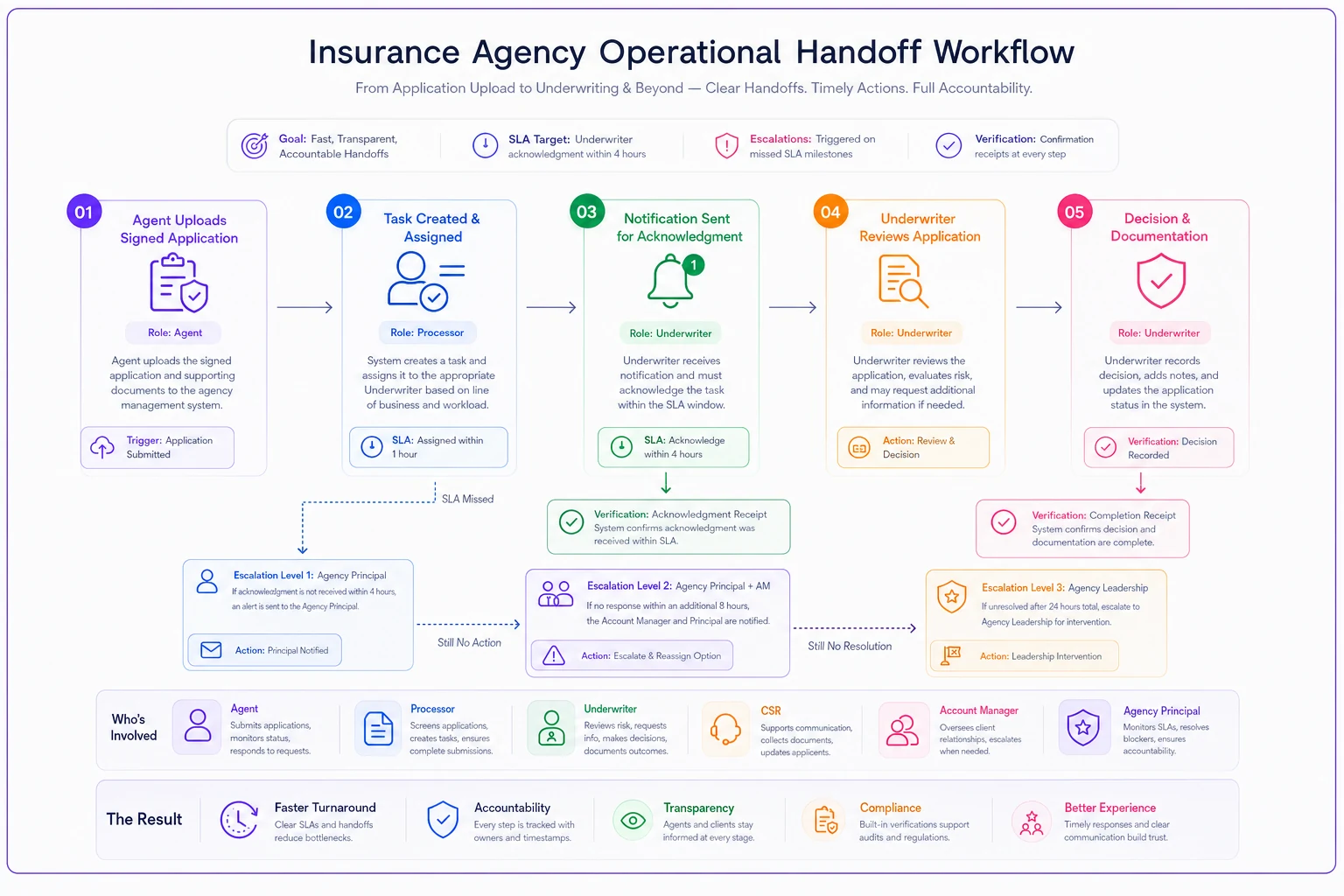
Handoff rules fail when written as hopes. A real handoff rule has three components: a trigger, an action, and verification.
New Business Handoffs: When an application is signed (trigger), the agent uploads it to the shared drive and assigns underwriting in the management system within 2 hours (action). The system sends a notification requiring acknowledgment within 24 hours (verification).
Renewal Processing Handoffs: Renewals at 60 days generate tasks for the assigned account manager. Follow the renewal transfer protocol to prevent policy issuance errors. If no action in 72 hours, escalate to the agency principal.
Claims Coordination Handoffs: First notice of loss goes to the CSR to create a claim record and assign by complexity. Personal auto routes to carriers; commercial claims or losses over $25k get an account manager assigned within one hour with confirmation copied to the original agent.
Service Request Routing: Intake categorizes endorsements as simple (CSRs, 24‑hour SLA) or complex (agents, 48‑hour SLA). Anything requiring underwriter review is flagged and tracked separately.
Verification is the critical piece many agencies miss. It creates accountability loops that make dropped handoffs visible immediately.
Stage-specific KPIs that reveal operational health
Operational health shows up in flow metrics—how smoothly work moves through the agency. Track KPIs by stage and by role, not just agency totals.
Quoting Stage KPIs:
-
Quote-to-bind ratio by producer
-
Average quote turnaround time (target under 24 hours for standard risks)
-
Percentage of quotes requiring underwriter review (target < 30%)
-
Abandoned quote percentage (over 20% indicates friction)
Binding Stage KPIs:
-
Bind-to-issue timeframe (target under 48 hours)
-
Binding errors requiring correction (target < 5%)
-
Percentage of binds missing required documents
Servicing Stage KPIs:
-
Service request completion time by type
-
Endorsements processed same-day (target 70% for simple changes)
-
Service requests requiring callbacks (target < 15%)
Renewal Stage KPIs:
-
Renewals reviewed 45+ days before expiration (target 85%)
-
Renewal retention rate by account manager
-
Remarketing success rate
-
Lost renewals due to processing delays (target zero)
Claims Stage KPIs:
-
First notice to carrier submission time (target under 4 hours)
-
Claims requiring follow-up (target < 20%)
-
Client satisfaction score post-claim
Track these KPIs by role. High-level agency numbers can mask role-level problems that will eventually affect retention and risk.
Integration requirements that eliminate information silos
Agencies run on a patchwork of systems: management systems for policies, CRMs for interactions, email for communication, phone logs, and carrier portals. Successful agencies build bridges at critical handoff points rather than forcing everything into one system.
Critical Integration Points:
-
Quoting tools push data to the management system automatically to avoid manual re-entry
-
Email attaches to client records automatically so communications are discoverable
-
Document management stores every file in a central, tagged repository
-
Task management is role-based and integrated into each user's workflow
-
Automate carrier downloads where possible to prevent manual entry errors
The Non-Negotiable: Single Source of Truth — contact data lives in the management system, coverage details in the policy system, and communications attached to the client record. Multiple copies of truth create wasted time and wrong decisions.
Common failure points across the policy lifecycle
Agencies rarely fail at a single point; they repeat the same failure patterns across many policies until the damage is obvious.
-
Quote Black Hole
quotes that never get followed up (roughly 30% die from lack of follow-up)
-
Renewal Scramble
renewals noticed too late, causing rushed work and errors
-
Documentation Gap
verbal binding promises without documents leading to disputes
-
Handoff Assumption
'I sent an email' without verification equals dropped work
-
Service Request Shuffle
requests forwarded repeatedly and never confirmed to client
Each pattern has a simple operational fix: define ownership, set SLAs with verification, and ensure the system surfaces missed actions immediately.
Building accountability without micromanaging
Accountability is visibility, not surveillance. When people can see pipeline status and what they're waiting on, accountability becomes automatic.
-
Daily huddles focused on blockers, not status dumps
-
Weekly pipeline reviews by role to surface patterns early
-
SLA tracking with automatic escalation (not punishment)
-
Clear ownership assignment
one named owner per task
Make metrics visible at the individual level. Agents who see their quote-to-bind ratio will improve it. CSRs who see their endorsement SLAs will triage better.
Scaling the blueprint: From 5 to 50 employees
The operational blueprint that works at one size will break at the next. Build flexibility into your structure and implement the next stage's systems early.
-
5–10 employees
Multiple hats but clear primary responsibilities; shared visibility via a basic system or spreadsheet.
-
10–20 employees
Role specialization and enforced handoff rules; KPIs tracked by role.
-
20–35 employees
Departments form; integrations become mandatory; team leads required.
-
35–50 employees
Deep specialization and governance to maintain consistency across teams.
Scaling secret: build for the next stage early. Being slightly over-systemized is cheaper than recovering from operational chaos during a growth spike.
Making it sustainable with AI-powered operational software
AI automation replaces repetitive coordination, not judgment. It automates routing, tracking, and proactive alerting so people focus on higher-value decisions.
-
Intelligent Routing
matches work to the right person by expertise, workload, and priority
-
Automated Tracking
records every handoff, task, and deadline without manual updates
-
Proactive Alerting
warns when quotes age, renewals run late, or SLAs approach breach
Example: one 22-person agency implemented AI routing and tracking and cut policy processing time by 40% in three months because work stopped getting lost between handoffs.
AI also identifies recurring failure points and recommends process improvements based on observed patterns—making the operational blueprint self-improving over time.
Sustainable growth isn't just more sales—it's operations that handle volume without more chaos. Agencies that scale define clear roles, enforce handoff rules with verification, track stage KPIs, integrate critical systems, and make accountability visible.
Next step: pick one recurring broken handoff—likely between sales and service—define a trigger/action/verification rule, measure the impact, and repeat. Over six months you'll transform scattered effort into a coordinated system that scales.
Ready to transform your insurance agency operations?
Join 500+ agencies using Covixly to reduce manual work, improve client service, and grow their book of business.