


Most agency acquisitions don't fail at the term sheet. They fail somewhere around day 40, when the seller's book is sitting in two different management systems, half the carrier appointments haven't transferred, and your CSRs are toggling between logins because nobody mapped how "policy effective date" in the old AMS lines up with the field in yours.
The deal math usually works. The integration is what quietly eats the margin. You paid 2.5x to 3.5x revenue for a book, and then spent the next six months bleeding renewals because the data moved badly and nobody knew who owned which client during the transition.
This is a systems problem, not a spreadsheet problem. The agencies that integrate cleanly treat it like a sequenced operation with dependencies — pre-close data work feeds carrier sequencing, which feeds field mapping, which feeds a parallel run, which feeds stabilization. Skip a dependency and everything downstream wobbles. Below is how the whole thing connects, where it breaks, and the templates worth building before you ever sign.
Why integrations break even when the deal is good
Nobody tells you this when you're buying a book: you're not buying policies, you're buying a pile of inconsistent data habits. The seller named files their way. They coded carriers their way. They tracked renewals in their head, or in a spreadsheet, or in the AMS notes field, or all three depending on which producer touched the account.
When you fold that into your operation, you're not merging two clean datasets. You're merging your conventions with someone else's accumulated shortcuts. And acquisitions compress the timeline — you've got carrier notification windows, E&O exposure during the handoff, and clients who will absolutely call during renewal season to ask why they got a letter from an agency they've never heard of.
-
Data that looked fine in the demo but wasn't. Export the seller's AMS and the "complete" book has 18% of commercial accounts missing a current COI, or personal auto records with no VIN on file.
-
Carrier appointments that lag the close. You own the book legally but can't service or remarket half of it for weeks because appointments and binding authority haven't moved.
-
Field mismatches nobody catches until renewal. Your system expects a date format or a coverage code the old system never used, so renewals misfire silently.
-
Ownership confusion during the overlap. Two teams, two systems, and no clear rule about who services a given client this week.
Each of these feeds the next. Bad pre-close data makes field mapping harder. Slow carrier sequencing extends the window where ownership is murky. The whole thing is a chain.
The pre-close data checklist: do the ugly work before money changes hands
The single highest-leverage move in any agency M&A integration is auditing the seller's data before close, while you still have negotiating leverage and they still have a reason to cooperate. After close, their motivation to help you clean up their records drops to roughly zero.
Eliminate paperwork bottlenecks and missed deadlines.
Covixly helps you track, manage, and close every policy and claim with confidence and speed.
- Unified policy & claims management
- Automated client notifications
- Agent task coordination
No credit card required
You're not trying to clean the data pre-close. You're trying to measure it — figure out what you're inheriting so you can price the cleanup into your stabilization plan.
Here's the pre-close audit worth running as a repeatable template:
-
Full AMS export, not a sample. Get the whole book in a flat export. Samples hide the messy tail, and the messy tail is where your E&O risk lives.
-
Critical field completeness scan. For each line of business, count how many records are missing fields you can't service without — effective/expiration dates, carrier, policy number, premium, named insured, mailing address, and line-specific fields like VIN or property address.
-
Duplicate and overlap check. Run the seller's book against your own. Shared clients are common, and merging them wrong creates ghost records and double renewals. Our safe duplicate-client merge playbook walks through how to do this without losing history.
-
Carrier concentration map. List every carrier in the book, policy count, and premium volume per carrier. This directly drives your appointment sequencing.
-
Renewal calendar density. Bucket the inherited book by renewal month. If 40% of the book renews in the 90 days right after close, your integration timeline just got a lot more aggressive.
-
Document and file-state review. Where do the actual policy documents live? Paper? A shared drive? Inside the AMS? If it's paper or scattered digital, you've got a migration project stacked on top of your integration — our paper-to-digital migration playbook covers the phasing and QA for that.
A typical example: an agency buying a roughly 1,400-policy commercial book runs the completeness scan and finds around 230 accounts with no current COI on file and about 90 with mismatched named-insured entities. That's not a reason to kill the deal — it's a reason to build a 60-account-per-week remediation track into the first phase and maybe revisit the holdback.
The output of this phase is a data condition report. That document becomes the input for everything that follows.
Carrier-appointment sequencing: the dependency everyone underestimates
You can have perfect data and still stall out here. If you can't service or remarket a policy because the appointment hasn't moved, the client is effectively stranded during the most fragile window of the whole process.
The mistake is treating appointments as a batch task — "we'll notify all the carriers after close." Carriers move at wildly different speeds. Some process a transfer in days; some take six to eight weeks and want a full documentation packet. If you sequence them randomly, your slowest carrier becomes the bottleneck for your highest-premium accounts.
| Priority | What goes here | Why it's first |
|---|---|---|
| 1 — Immediate | Carriers with policies renewing in the next 60 days | A renewal you can't touch is a renewal you lose |
| 2 — High | Top carriers by premium volume | Protects the majority of the revenue you just paid for |
| 3 — Medium | Carriers with known slow transfer timelines | Start early precisely because they're slow |
| 4 — Standard | Everything else | Lower volume, lower near-term renewal exposure |
The non-obvious insight: your slow carriers and your urgent carriers overlap more than you'd expect, and when they do, that's your true critical path. A slow carrier with a dense block of 45-day renewals should be the first phone call you make, even if they're small by premium volume.
Build a carrier-sequencing matrix that lists each carrier, transfer timeline estimate, policy count, premium, nearest renewal cluster, and a status column. Update it weekly. This is the document that tells you whether your integration is actually on track or just feels like it is.
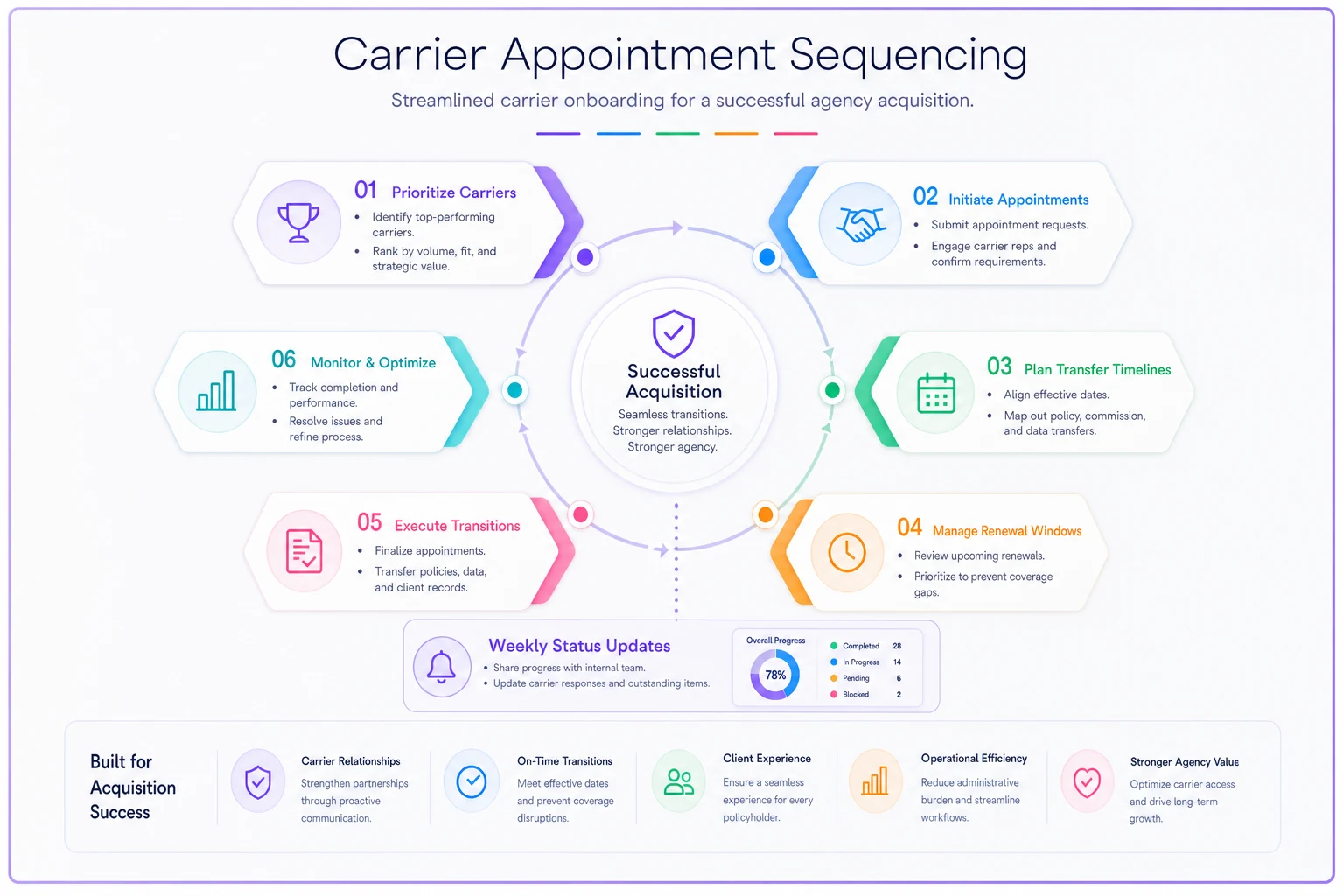
Use a simple visual board that highlights urgent overlaps and slow-transfer carriers so the team knows what to call first.
The AMS field-mapping matrix: where silent errors are born
This is the part that looks boring and causes the most expensive mistakes. When you move a book from the seller's management system into yours, every field has to land somewhere correct. Most of it maps cleanly. The 10% that doesn't is where renewals misfire and policies issue wrong.
The classic failure: the old system stored coverage limits as free text, your system expects structured values, and the import quietly truncates or drops them. Nobody notices until a renewal goes out with the wrong limit and now you've got an E&O conversation.
-
Source field (what it's called in the seller's AMS)
-
Target field (where it lands in yours)
-
Transformation rule (date reformatting, code translation, unit conversion)
-
Exception handling (what happens when the source is blank or invalid)
The fields that consistently cause the most trouble:
-
Dates — format mismatches that shift effective or expiration dates by a day, month, or entirely
-
Carrier codes — the seller's internal carrier naming vs. your standardized codes
-
Coverage and limit fields — especially anything stored as free text
-
Producer/servicer assignments — which need to map to real people in your org, not theirs
-
Status flags — active, cancelled, non-renewed, pending; different systems use different conventions and a mis-mapped status can make a live policy look dead
One thing worth flagging: don't let the migration vendor or carrier define your mapping without review. If you're leaning on outside tools or data partners for the move, the vendor selection framework is worth running first so you're not handing your book's integrity to a black box.
Validate vendor mapping outputs against your field-mapping matrix before executing any bulk imports.
The field-mapping matrix is reusable. Build it once per source-system type and your next acquisition from an agency on the same AMS starts at 80% done.
Parallel-run validation: don't flip the switch, overlap first
This is where discipline separates clean integrations from the ones that spiral. The temptation after a migration is to cut over immediately — kill the old system, go live, done. The problem is you have no way of knowing the migration was correct until something breaks in production, usually in front of a client.
A parallel run means you keep the source system readable (even if frozen) and validate the migrated data against it before you fully cut over. You're not running both systems for daily work — you're running the old one as the answer key.
-
Record-count reconciliation. Policies in equals policies out, by line and by carrier. If 1,400 went in and 1,388 came out, you have 12 records to find before you do anything else.
-
Premium and commission totals. Sum premium by carrier on both sides. Mismatches here surface dropped records and field errors fast.
-
Spot-check the hard cases. Pull the accounts your pre-close audit flagged as messy — multi-location commercial, oddly-named entities, policies with endorsements — and verify them manually.
-
Renewal-date integrity. Sort the migrated book by expiration date and confirm the nearest-renewal cluster matches what you expect. A date-format bug shows up here loudly.
-
Workflow dry run. Process a handful of test transactions end to end — a renewal, an endorsement, a COI issuance — before real clients hit the system.
The piece most people miss: validate samples weighted toward complexity, not random samples. Random sampling tells you the easy 90% migrated fine, which you already knew. The value is in confirming the hard 10% survived intact.
Only when counts reconcile and the complex cases check out do you cut over. The cutover checklist itself should be boring by this point — freeze the source, confirm backups, switch servicing, notify the team, monitor. Boring is the goal. Excitement during cutover means you skipped validation.
The 90-day stabilization calendar
Cutover isn't the finish line. It's the start of the window where you find out what you missed. A stabilization calendar gives the first 90 days structure so problems surface on a schedule instead of ambushing you.
-
Days 1–14 — Triage. Daily standups. Watch for the first service requests on inherited accounts. Every "the system won't let me…" ticket is a mapping bug surfacing. Log and fix.
-
Days 15–45 — Renewal protection. The first big batch of inherited renewals flows through. Monitor every one against the field-mapping matrix. This is also where your data-remediation track from the pre-close audit should be grinding through flagged accounts.
-
Days 46–75 — Client communication and retention. The welcome/transition outreach lands, clients start recognizing the new agency, and you watch retention numbers on the inherited book closely.
-
Days 76–90 — Normalize and review. Decommission the source system for real, close out remediation, and run a retrospective so the next acquisition goes faster.
A realistic scenario: a mid-size agency acquires a roughly $1.1M-revenue personal lines book. On their first deal they skipped most of the pre-close audit and lost close to 11% of the book in the first six months, mostly renewals that misfired during the handoff.
On the second acquisition they ran the full sequence — audit, carrier sequencing, mapping matrix, parallel run, 90-day calendar — and retention on the inherited book held in the low-to-mid 90s. Same team, same deal structure. The difference was the process, not the effort.
When this full playbook makes sense — and when it's overkill
Not every acquisition needs the whole apparatus.
Run the full sequence when: the book is more than a few hundred policies, it's commercial or mixed lines, the seller uses a different AMS than you, or renewals are densely clustered right after close. Any one of those raises the stakes enough to justify the discipline.
You can run a lighter version when: it's a small personal-lines book, the seller is already on your AMS, and the data is genuinely clean (verify, don't assume). A full parallel run on 120 clean policies is wasted effort.
Who should not attempt this without help: anyone doing their first acquisition while already understaffed. The integration work is a real project, not something your CSRs absorb between service calls. If you don't have someone who can own the sequencing and validation for 90 days, either hire the capacity or slow the deal down.
Where tooling quietly earns its keep
None of this requires fancy software to start — a disciplined spreadsheet beats a slick tool used carelessly. But as the book grows and you do more than one deal, the manual tracking gets fragile. The field-mapping matrix, the carrier-sequencing status board, the reconciliation counts, the stabilization calendar — these are exactly the kinds of recurring, structured workflows where AI-assisted operational platforms reduce the manual grind and catch mismatches that a tired human misses at record 1,200.
The practical wins show up in validation and monitoring: flagging migrated records whose fields fall outside expected patterns, watching the inherited renewal pipeline for policies that look wrong before they issue, and keeping one central view of appointment status instead of a half-dozen email threads. The point isn't to automate judgment — it's to automate the tedious reconciliation so your people spend their attention on the accounts that actually need a human.
If you make acquisitions a repeatable part of growth, build the templates once and let your systems carry the reconciliation load. That's the difference between an agency that integrates in 90 days and one that's still untangling its last deal when the next one closes.
The thing to remember
An acquisition is two operations becoming one, and operations don't merge by signing paperwork. They merge through sequenced, validated data work — pre-close audit, carrier sequencing, field mapping, parallel validation, stabilization. Each phase depends on the one before it. The agencies that treat integration as a repeatable system keep the renewals they paid for. The ones that improvise learn, expensively, that a good deal and a bad integration net out to a mediocre one.
Build the templates. Run them in order. The next deal gets easier, and the margin you negotiated actually shows up.
Ready to transform your insurance agency operations?
Join 500+ agencies using Covixly to reduce manual work, improve client service, and grow their book of business.