

Duplicate client records are one of those problems that stay invisible until the day they become expensive. An agency runs fine for years, then someone notices that "Robert Castellano" exists three times in the AMS — once with the auto policy, once with the umbrella, once with a half-finished homeowners quote from 2021. Each record has a different phone number. One has the wrong mailing address. And nobody's totally sure which one the carrier download is syncing to.
The instinct is to just merge them and move on. That instinct is exactly how agencies end up with orphaned policies, commission statements that no longer reconcile, and renewal notices mailed to an address the client left two years ago.
A duplicate client merge playbook isn't about clicking "merge" faster. It's about having a repeatable, auditable process that a human can trust — because in this business, a bad merge doesn't just lose data. It can detach an active policy from its billing record or wipe out the activity history you'd need if a claim goes sideways.
This is the playbook we'd hand to anyone cleaning up a client database that's accumulated years of duplicates.
Why insurance duplicates are riskier than other industries
Most CRMs treat a duplicate as a cosmetic annoyance. Two contacts, same person, merge them, done.
Agency management systems don't work that way. A client record in an AMS is a hub — policies, billing accounts, carrier download links, activity logs, attached documents, commission mappings all hanging off it. When you merge two records, every one of those connected objects has to be reassigned correctly, or it gets stranded.
Duplicates usually form in a handful of predictable ways:
-
A producer quotes a prospect, then a CSR creates a "new" client when the policy binds because they didn't find the existing quote record.
-
A carrier download comes in with a slightly different name spelling ("Bob" vs "Robert"), and the AMS creates a new client instead of matching.
-
A commercial client gets entered once under the DBA and once under the legal entity name.
-
A personal-lines client marries, changes their last name, and gets re-entered instead of updated.
The pattern underneath all of these is the same: the system had no reliable rule for deciding whether two records belonged to the same person or business. So it defaulted to creating a new one.
That's the real issue. You can't prevent — or safely clean up — duplicates without first defining, in writing, what "the same client" actually means.
Step one: field-level matching rules
Before any merging happens, you need matching rules that specify exactly which fields determine a match and how much weight each one carries. Vague rules ("looks like the same person") are how agencies merge two different people named John Smith.
Eliminate paperwork bottlenecks and missed deadlines.
Covixly helps you track, manage, and close every policy and claim with confidence and speed.
- Unified policy & claims management
- Automated client notifications
- Agent task coordination
No credit card required
Here's a matching framework that holds up in practice. Each candidate pair gets scored, and the score determines what happens next.
| Field | Match type | Weight | Notes |
|---|---|---|---|
| Date of birth (personal) / FEIN (commercial) | Exact | High | Strongest single identifier; near-conclusive |
| Full name | Fuzzy | Medium | Handle nicknames, maiden names, DBA vs legal |
| Primary address | Normalized | Medium | Standardize before comparing (St/Street, apt formats) |
| Phone number | Exact (last 7 digits) | Medium | Strip formatting; ignore country/area noise |
| Exact (lowercased) | Medium | Catches most personal-lines dupes | |
| Active policy number | Exact | High | Two records sharing a policy = almost always a dupe |
The scoring logic matters more than the exact numbers. A typical setup:
-
Auto-merge candidate DOB/FEIN exact match plus one more medium field agreeing. High confidence.
-
Human-review candidate name fuzzy match plus address or phone, but no DOB/FEIN confirmation.
-
No match / leave alone only the name matches and nothing else lines up.
One mistake agencies make is trusting name similarity too much. "Maria Rodriguez" might appear 14 times in a book of business across four actual people. Name alone should never trigger a merge — it should only flag a pair for a human to look at.
The other common error is skipping address normalization. "123 N Main St Apt 4" and "123 North Main Street #4" are the same place, but a raw string comparison treats them as different. Normalize addresses before scoring or your match rate falls apart.
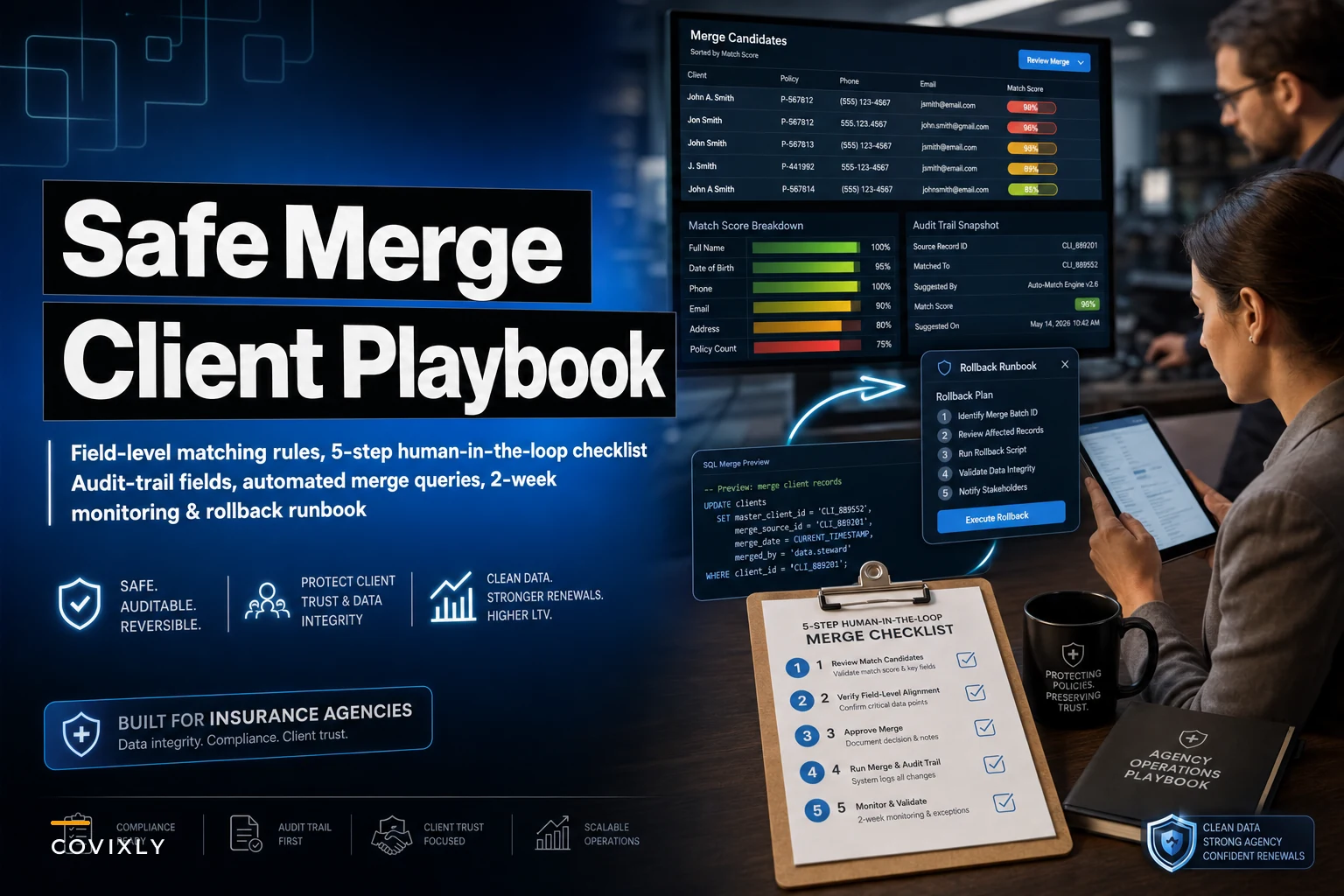
Step two: the 5-step human-in-the-loop merge checklist
Even with solid matching rules, ambiguous merges need a human looking at them before anything commits. The goal is to make that review fast but disciplined — not a judgment call someone improvises every time.
Here's the checklist a reviewer runs on each pair flagged for human approval:
-
Confirm it's genuinely the same client. Open both records side by side. Verify DOB/FEIN or at least two independent identifiers. If you can't confirm, do not merge — flag for a producer who knows the account.
-
Identify the surviving record. Pick the record with active policies, the most complete data, and the correct carrier download link as the "keep" record. The other becomes the "merge-from."
-
Check what's attached to the losing record. List every policy, billing account, activity note, and document on the record being merged away. Confirm each one will move, not vanish.
-
Resolve field conflicts manually. When both records have different phone numbers or addresses, decide which is current — don't let the system auto-pick. The most recently updated field is usually right, but verify against the newest policy.
-
Record the decision before committing. Note who reviewed it, which record survived, and why. Then execute the merge.
The step people skip is number three. They confirm it's the same person, pick a survivor, and merge — without ever checking what's hanging off the record they're about to collapse. That's how a paid-up auto policy ends up detached from its billing history.
For commercial accounts especially, this checklist should never be fully automated. The relationships between legal entities, DBAs, and additional insureds are too easy to collapse incorrectly. Someone who actually understands the account structure has to sign off.
Step three: required audit-trail fields
If a merge later turns out to be wrong — and some will — you need to be able to reconstruct exactly what happened. That's impossible without an audit trail captured at the moment of the merge.
Every merge should write a record containing, at minimum:
-
Timestamp of the merge
-
User who approved and executed it
-
Surviving record ID and merged (deleted) record ID
-
Match score and which rule triggered the merge (auto vs human-reviewed)
-
Policies reassigned — a list of policy numbers moved
-
Field conflicts and resolutions — what the old value was, what was kept
-
Pre-merge snapshot of both records (so you can restore)
That last one is the difference between "we think we can undo this" and "we can undo this." A snapshot of both records before the merge is your rollback insurance. Without it, a bad merge is permanent.
This is also where the audit trail connects to broader data governance. If you've done work on cleaning critical fields before — the kind described in a policy lifecycle structure approach — the audit trail should feed back into that same governance system so you're not solving the same mess twice.
Don't treat the audit trail as optional cleanup documentation. It's an operational control. When a client calls asking why their renewal went to an old address, the audit trail tells you in thirty seconds that a merge six weeks ago picked the wrong one — instead of you spending an afternoon guessing.
Step four: automated merge queries for the clear cases
Not every duplicate needs a human. Running every pair through manual review would take months on a book with thousands of clients. The point of good matching rules is to let the obvious, high-confidence merges process automatically while humans handle the gray area.
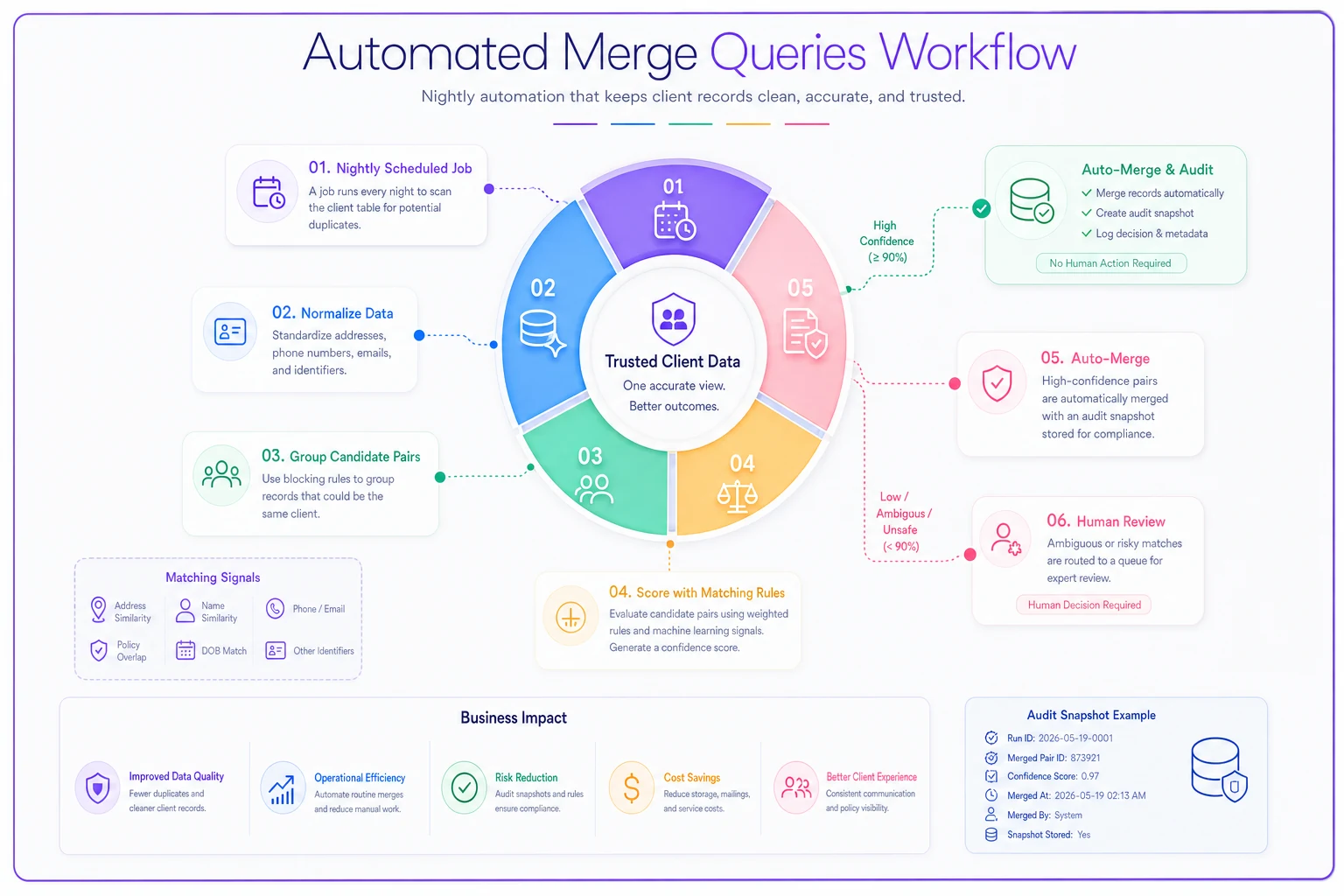
The workflow: A scheduled job scans the client table nightly. It groups records by normalized identifiers and scores each candidate pair against the matching rules. Pairs that hit the auto-merge threshold — DOB/FEIN exact plus a second confirming field, with no conflicting active policies on different carriers — get queued for automatic processing. Everything else drops into the human-review queue. Before any auto-merge commits, the query writes the full audit record and snapshot. If any safety check fails (say, both records have active policies with different carriers that don't reconcile), it refuses to auto-merge and escalates to a human instead.
Where AI-assisted operational tools earn their keep is in fuzzy matching and conflict detection that rigid rules miss. Pattern-based matching catches nickname variations, transposed fields, and near-duplicate business names far better than exact-string logic — while still routing anything genuinely ambiguous to a person. The automation isn't making the risky decisions. It's clearing the easy volume so your team only spends time where judgment actually matters.
The failure mode to avoid: letting the automation run without safety escalations. An auto-merge that proceeds despite two different active carrier policies is how you detach a live policy. When in doubt, the query should escalate — never guess.
The workflow looks like this.
Where AI-assisted operational tools earn their keep is in fuzzy matching and conflict detection that rigid rules miss. Pattern-based matching catches nickname variations, transposed fields, and near-duplicate business names far better than exact-string logic — while still routing anything genuinely ambiguous to a person. The automation isn't making the risky decisions. It's clearing the easy volume so your team only spends time where judgment actually matters.
Step five: a 2-week monitoring cadence after the merge
Merges don't fail loudly. They fail quietly, three weeks later, when a carrier download can't find the record it used to sync to, or a commission statement stops reconciling against a policy that's now under a different client ID.
That's why the merge isn't "done" when it commits. It's done after two weeks of monitoring confirm nothing broke downstream.
A workable cadence:
-
Days 1–3 Verify every reassigned policy still shows correct billing status and carrier download linkage. This is where detached policies surface fastest.
-
End of week 1 Run a commission reconciliation check on any merged commercial accounts. If a commission that used to post now has no home, the merge broke a mapping. This ties directly into the kind of discipline covered in a monthly commission audit reconciliation checklist — merges are a common source of the discrepancies that audit is designed to catch.
-
End of week 2 Confirm the next carrier download cycle matched to the surviving record, not a ghost. Review the audit log for any merges flagged with warnings.
Check the audit trail first when investigating a downstream issue; it usually points right to the problematic merge.
Across agencies doing this well, the vast majority of merge problems show up inside the first download cycle after the merge. If two weeks pass clean, you're almost certainly solid.
When to automate, and when not to
Automation makes sense for high-volume personal-lines duplicates with strong identifier matches — same DOB, same policy number, cases where the answer is obvious and the only cost is reviewer time.
It's a bad idea for:
-
Commercial accounts with layered entity structures. DBAs, parent companies, and additional insureds are too easy to collapse incorrectly.
-
Records with active policies on different carriers. Reconciling those relationships needs a human.
-
Any book you haven't yet cleaned at the field level. If your addresses aren't normalized and your names aren't standardized, automated matching will produce garbage. Clean the fields first, then automate the merging.
Who should not run a mass merge at all yet: any agency that can't produce a pre-merge snapshot and can't roll back. If you don't have a reliable undo, don't do bulk merges. Fix the audit trail first.
The rollback runbook
Some merges will be wrong. The agencies that handle this well aren't the ones who never make mistakes — they're the ones who can reverse a bad merge in minutes instead of reconstructing a client record by hand.
-
Locate the merge record in the audit log by client name or merge timestamp.
-
Pull the pre-merge snapshots of both original records.
-
Recreate the merged-away record from its snapshot.
-
Reassign the policies and billing accounts that were moved back to their original record, using the "policies reassigned" list in the audit trail.
-
Run validation queries to confirm the restore worked.
Those validation queries are the part people forget. After a rollback, at minimum you check:
-
Policy count match does each restored record have exactly the policies it had before the merge?
-
Orphan check are there any policies or billing accounts not linked to a client? (Zero is the only acceptable answer.)
-
Download linkage does each carrier download map to the correct record again?
-
Commission mapping does every active commission have a valid policy and client it posts to?
If all four pass, the rollback is clean. If any fail, you've got an orphaned object to track down manually — which is far easier with the audit trail than without it.
A real scenario
A mid-size agency — roughly 2,800 personal-lines clients, two producers and three CSRs — discovered during an AMS cleanup that close to 400 of their records were likely duplicates, built up over about eight years of inconsistent entry habits.
Their first attempt was a manual merge marathon. Two people spent the better part of a week and got through maybe 90 records before they hit one that detached an active auto policy from its billing account. That single bad merge took most of a day to untangle, and it stopped the project cold — nobody trusted the process anymore.
The reset: they defined field-level matching rules, normalized addresses first, and split the work. Automated high-confidence merges cleared around 220 records with no human touch and no downstream breakage. The remaining roughly 180 ambiguous pairs went through the five-step human checklist, which surfaced about a dozen pairs that turned out to be different clients who'd have been wrongly merged under a name-only approach.
Two weeks of monitoring caught three merges with billing-link issues, all fixed in under an hour each because the audit trail pointed straight at them. The whole cleanup took around three weeks of part-time effort instead of the open-ended slog it started as — and nothing broke that they couldn't trace and reverse.
The takeaway
The difference between a safe duplicate merge and a dangerous one isn't speed or software. It's whether you defined what "the same client" means before you started, kept a human in the loop on the ambiguous cases, and captured enough of an audit trail to undo your mistakes.
Get those three things right and merging becomes routine maintenance. Skip them, and every merge is a small bet that nothing downstream depended on the record you just collapsed — and in an agency, something almost always did.
Get those three things right and merging becomes routine maintenance. Skip them, and every merge is a small bet that nothing downstream depended on the record you just collapsed — and in an agency, something almost always did.
Ready to transform your insurance agency operations?
Join 500+ agencies using Covixly to reduce manual work, improve client service, and grow their book of business.