


Most agency owners don't get burned during the sales demo. They get burned 14 months later, when they realize the shiny AMS add-on they bought owns their client data, charges a fee to export it, and integrates with exactly nothing else in their stack. By then the vendor has your book, your workflows are built around their quirks, and switching feels like a second implementation nightmare.
That's the part nobody really prepares for. Vendor selection isn't purely a purchasing decision — it's an operational commitment that shapes how your CSRs work, how your renewals flow, and how badly it hurts when you eventually want to leave. The frameworks agencies actually need aren't about picking the "best" tool. They're about picking something you can live with, integrate cleanly, and walk away from without your data being held hostage.
This article covers the full lifecycle: the procurement checklist before you talk to anyone, a lean RFP you can actually send, an evaluation scorecard weighted for the things that quietly kill agencies (integration risk, data ownership, SLAs), and — the part everyone skips — a sunset checklist for when a vendor relationship ends.
How to buy, onboard, and eventually retire agency technology without wrecking your data or your renewals
Why agency tech decisions break differently than other businesses
A restaurant that picks the wrong POS loses some time and money. An agency that picks the wrong core system risks its compliance posture, its E&O exposure, and its ability to service policies during a renewal crunch. The stakes are structurally higher because your tech sits directly on top of regulated, time-sensitive workflows.
There's a pattern that shows up constantly. An agency buys a tool to solve one visible problem — certificate management, a client portal, whatever. The tool works fine for that one thing. But it doesn't sync cleanly with the AMS, so someone starts double-entering data. Six months in, the "solution" has quietly created a new manual reconciliation task that eats a couple hours a day. The tool didn't fail. The selection process did, because nobody scored integration risk before buying.
The other thing that breaks: agencies evaluate vendors on features during the demo, then live with the vendor on reliability, support, and data access. Those are completely different axes. A tool can demo beautifully and still leave you stranded when a batch renewal fails on a Friday afternoon and support tickets take three days to get a response.
The procurement checklist (before you write a single RFP)
Do not send an RFP until you can answer these internally. A lot of bad vendor decisions come from agencies that skipped straight to demos before they understood their own requirements.
Eliminate paperwork bottlenecks and missed deadlines.
Covixly helps you track, manage, and close every policy and claim with confidence and speed.
- Unified policy & claims management
- Automated client notifications
- Agent task coordination
No credit card required
-
Define the workflow you're actually fixing. Not "we need a better portal" — instead, "we want to cut inbound ID-card and COI calls by routing them to self-service." Vague goals produce vague vendors.
-
Map where this tool touches your existing stack. AMS, rater, email, e-signature, accounting. Write down every point of contact. Each one is a potential integration failure.
-
Identify the data it will hold and who legally owns it. Client PII, policy data, claims notes. If you can't get a straight answer on ownership and export rights, that's already your answer.
-
Decide your non-negotiables vs. nice-to-haves. Most agencies invert these under sales pressure.
-
Set a realistic budget range including implementation and switching costs, not just the monthly per-seat price.
-
Name an internal owner. One person accountable for the evaluation. Committees pick tools nobody ends up using.
Agencies that write down their integration touchpoints before the RFP end up rejecting roughly a third of vendors immediately, just on architecture. The ones that skip this discover the integration gaps during onboarding — which is the most expensive possible time to find out.
If you haven't mapped how your policy workflows actually move between roles, do that first. Vendor selection sits on top of process, and our operational blueprint for policy lifecycle management walks through the handoffs and stage KPIs you'll need to reference when scoring vendors.
A lean RFP template agencies actually send
Long RFPs get skimmed and produce marketing answers. Keep it tight and force specific responses. Here's the structure that tends to get useful replies:
-
Agency context (short). Size, lines of business, current core systems, and the one problem you're solving. Vendors answer better when they understand your environment.
-
Functional requirements. List them as "must / should / nice." Ask vendors to respond to each explicitly rather than pointing you to a features page.
-
Integration requirements. Name your AMS and key systems. Ask
"Do you have a native integration, an open API, or neither?" Ask for a reference client using the same integration.
-
Data ownership and portability. Ask flat out
Who owns the data? Can we export it in a standard format at any time? Is there a fee? What happens to our data if we cancel?
-
Security and compliance. SOC 2, encryption at rest and in transit, breach notification timelines. For anything touching high-risk commercial policies, tie this to your own compliance rules.
-
SLAs and support. Uptime guarantee, support hours, response times by severity, and what happens when they miss.
-
Pricing, full picture. Per-seat, implementation, data migration, integration fees, and cancellation or export costs.
-
References. Two agencies of similar size, ideally on the same AMS.
The single most revealing question on that list is number four. Ask three vendors "what happens to our data if we cancel" and watch how they respond. The good ones have a clear, documented offboarding process. The risky ones get vague or defensive. That reaction tells you more than any feature comparison.
The evaluation scorecard — weighted for what actually hurts
Most agencies weight features at 60% and treat everything else as an afterthought. Features are the easiest thing to fix or work around. Integration risk, data ownership, and reliability are the things that quietly destroy operations and are nearly impossible to change after you've committed.
| Evaluation category | Suggested weight | What you're actually scoring |
|---|---|---|
| Integration fit | 25% | Native integration vs. API vs. manual; proven with your AMS |
| Data ownership & portability | 20% | Who owns it, export format, export fees, deletion on exit |
| Reliability & SLAs | 15% | Uptime history, support responsiveness, severity handling |
| Core functionality | 20% | Does it solve the defined problem well |
| Security & compliance | 10% | SOC 2, encryption, breach process |
| Total cost of ownership | 10% | All-in cost including switching and exit |
Score each category 1–5, multiply by the weight, and total it. If a vendor scores a 5 on functionality but a 2 on data portability, the weighting keeps you from getting seduced by the demo. Be strict on integration too: a "we have an API" answer without a reference client actually using it with your AMS should score no higher than a 2. Open APIs are promises; working integrations are proof.
Vendors that score high on functionality and low on everything structural are usually newer companies that built a solid feature set but haven't been forced to handle enterprise-grade data and reliability demands yet. Sometimes that's a fine bet — just go in knowing you're the one absorbing that risk.
When a highly-rated vendor is still the wrong choice
A good scorecard score doesn't automatically mean "buy." A few situations where the winning vendor is still wrong for you:
When it deepens your dependence on a single ecosystem. If a vendor scores well but locks you further into a stack you're already trying to reduce reliance on, you're trading a short-term win for a long-term corner. More vendors isn't the goal, but neither is total lock-in to one.
When the integration is "coming soon." Roadmap integrations have a way of staying on the roadmap. If your workflow depends on a sync that doesn't exist yet, you're buying a promise. Score it as if that feature doesn't exist, because operationally it doesn't.
When your team can't absorb another tool. Every new system carries a training and adoption cost. An agency running four systems that people half-use doesn't need a fifth great one — it needs consolidation. Sometimes the right answer to the whole RFP process is "none of these, fix what we have."
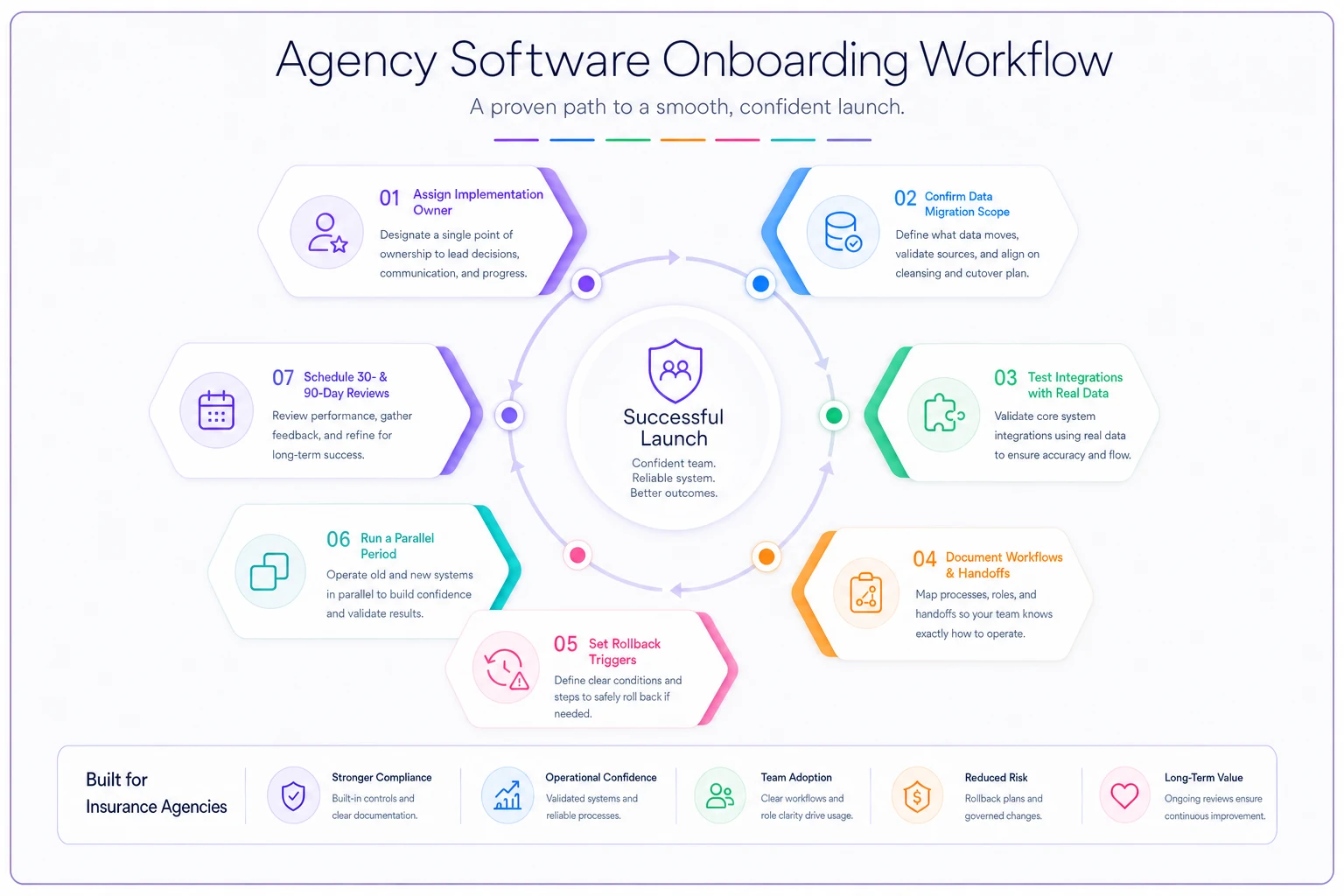
The vendor onboarding checklist
Selection is only half the job. A strong tool implemented badly still creates the double-entry and reconciliation problems that erase its value. Onboarding is where the integration risk you scored becomes real.
-
Assign an internal implementation owner — the same person, ideally, who ran the evaluation.
-
Confirm data migration scope before go-live. What's moving, in what format, and who validates it. Spot-check a sample of migrated records against the source.
-
Test the integration with real data, not a sandbox with three fake clients. Run a batch that mirrors a normal week.
-
Document the new workflow explicitly — who does what, where handoffs happen, what changed. Don't assume people will infer it.
-
Set a rollback trigger. Define, in advance, the conditions under which you pause or abandon the rollout. Agencies that skip this keep limping forward on broken implementations because nobody wants to admit it isn't working.
-
Run a parallel period where possible, so you're not fully dependent on the new system until you've verified it under load.
-
Schedule a 30- and 90-day review against the original problem you defined. Did calls actually drop? Did the manual task actually go away?
The 90-day review is the step almost everyone skips, and it's the one that catches the "tool works but created a new manual task" trap early — while you still have some leverage with the vendor.
Run the integration test with the busiest week of real data to catch edge-case failures early.
A quick visual of the onboarding flow.
The 90-day review is the step almost everyone skips, and it's the one that catches the "tool works but created a new manual task" trap early — while you still have some leverage with the vendor.
The vendor sunset checklist — the part nobody plans for
Every vendor relationship ends eventually. Companies get acquired, pricing changes, better tools appear, or the fit just erodes as you grow. The agencies that get hurt are the ones that never planned an exit. Data extraction turns into a hostage negotiation, and the migration drags on for months while workflows sit half-broken.
-
Pull your data early and in full, before you give notice. Export everything in the most standard format available, and store a verified copy independently.
-
Map every workflow that touches the vendor. Anything you built around their quirks needs a new home. This is where your original integration map pays off.
-
Identify replacement or interim manual processes for each affected workflow so nothing goes dark during transition.
-
Handle compliance and retention obligations. Some client and policy records must be retained for years regardless of which vendor holds them. Confirm your retention requirements before deleting anything on their end.
-
Confirm deletion of your data on their side in writing, especially PII, once you've verified your own copy.
-
Sequence the cutover away from renewal peaks. Sunsetting a system in the middle of a heavy renewal month is how issuance errors happen.
-
Debrief the team on what to watch for during the gap. Communication during a system transition prevents the small errors that compound.
The compliance thread here connects back to vendor transitions specifically. When you're moving data between systems — especially for regulated commercial lines — the same care you apply to your automated rules applies to migrations. Our breakdown of compliance automation pitfalls for high-risk commercial policies covers the escalation and validation logic worth carrying into any vendor transition.
A real scenario: the portal that owned the book
A mid-size personal lines agency — around 11 staff, mostly auto and home — bought a client portal add-on to cut inbound service calls. The demo was great. Nobody scored data ownership. The tool synced from the AMS but not back to it, so when clients updated info in the portal, a CSR had to manually re-key it into the AMS. What was sold as a time-saver quietly added somewhere around 8–10 hours of re-keying per week across the team.
The bigger problem surfaced when they tried to leave 15 months in. The portal held client-entered data and communication history that never made it back to the AMS. Export was technically possible but came in a messy format with a data extraction fee over a thousand dollars, plus days of cleanup work.
They eventually replaced it, but the second time they ran a proper scorecard. Integration fit and data portability carried the weight. The replacement synced bidirectionally, and the CSR re-keying task disappeared entirely — recovering close to a full workday per week across the team.
The lesson wasn't "portals are bad." It was that the first decision skipped every structural check and cost them over a year of manual work plus a painful exit.
Where operational software fits into this
The reason integration risk and data ownership matter so much is that most agencies are trying to reduce the number of disconnected systems their team juggles, not add to it. Every tool that doesn't talk to the others creates a manual bridge — someone copying data, reconciling records, chasing what didn't sync. Those bridges are where mistakes and wasted hours pile up.
This is the practical case for consolidating onto operational platforms that centralize your workflows and let AI automation handle the repetitive coordination — routing, data validation, follow-ups — instead of scattering those tasks across five tools and three people. It's not about technology for its own sake. A platform that owns your workflow end-to-end has far fewer integration seams to break, and clearer data ownership because it isn't stitched together from vendors who each want a piece of your book.
You don't need to buy into that vision to use this framework. But it does explain why the scorecard weights the structural stuff so heavily. Every seam you avoid is a failure point you never have to manage.
Putting it together
The framework isn't complicated, but it demands discipline the sales process actively works against. Define your problem and your integration map before you talk to anyone. Send a tight RFP that forces specific answers on data and integration. Score vendors on the things that actually hurt — not the demo. Onboard with a rollback trigger and a 90-day review. And plan the exit before you sign, because you will need it eventually.
The agencies that treat vendor selection as a one-time purchase keep repeating the same expensive cycle: great demo, quiet manual workaround, painful exit, repeat. The ones that treat it as a lifecycle — selection through sunset — end up with a tech stack that actually supports the operation instead of slowly working against it. That distinction, more than any individual tool choice, is what separates agencies that scale cleanly from the ones that are constantly patching the gaps their own stack created.
The framework isn't complicated, but it demands discipline the sales process actively works against. Define your problem and your integration map before you talk to anyone. Send a tight RFP that forces specific answers on data and integration. Score vendors on the things that actually hurt — not the demo. Onboard with a rollback trigger and a 90-day review. And plan the exit before you sign, because you will need it eventually.
The agencies that treat vendor selection as a one-time purchase keep repeating the same expensive cycle: great demo, quiet manual workaround, painful exit, repeat. The ones that treat it as a lifecycle — selection through sunset — end up with a tech stack that actually supports the operation instead of slowly working against it. That distinction, more than any individual tool choice, is what separates agencies that scale cleanly from the ones that are constantly patching the gaps their own stack created.
Ready to transform your insurance agency operations?
Join 500+ agencies using Covixly to reduce manual work, improve client service, and grow their book of business.