


Most failed carrier integrations don't blow up on launch day. They rot slowly. A field gets renamed on the carrier's side three weeks in, your sync stops populating effective dates, and nobody notices until a client calls asking why their binder shows coverage starting a month late. By then you've got dirty data sitting in your management system and no clean way to trace where it came from.
The agencies that avoid this aren't smarter engineers — they just refuse to start an integration without a written field-contract. A document both sides sign off on that spells out exactly what data moves, what format it's in, how failures get handled, and who owns what when something breaks. This post is that contract, broken into pieces you can hand to a carrier or downstream vendor before anyone touches an API endpoint.
If you're already managing multiple carrier feeds, this pairs closely with the work in automated carrier requirements tracking for multi-carrier agencies — the mapping discipline there is the same muscle you'll use here.
Why these integrations fail (and it's almost never the API itself)
The carrier's API usually works fine. The vendor's docs are usually "good enough." What breaks is the space between two systems that each assumed the other would handle something.
A typical example: a commercial lines agency connects to a carrier's policy feed to auto-populate renewals. The carrier sends premium as a string with a dollar sign ("$4,200.00"). The agency's system expects a number. For six weeks everything looks fine because the test records happened to be clean. Then a policy comes through with a premium over $1M, the carrier formats it as "1,042,000.00," the agency parser chokes on the comma, and that renewal silently drops out of the batch. Nobody built a rule for what happens when a record fails mid-batch, so it just vanishes.
That's the pattern across almost every bad integration: nobody wrote down the edge cases, so each side quietly made an assumption, and the assumptions didn't match. A field-contract forces those assumptions into the open before they cost you a policy.
The field-mapping template: your single source of truth
The foundation of every clean integration is a field map — not a vague "we'll sync policy data," but an actual line-by-line table that both sides initial. This is the document that ends arguments six months later.
Eliminate paperwork bottlenecks and missed deadlines.
Covixly helps you track, manage, and close every policy and claim with confidence and speed.
- Unified policy & claims management
- Automated client notifications
- Agent task coordination
No credit card required
Here's the structure we hand over for any carrier or vendor feed:
| Your field | Source field | Type / format | Required? | Transform rule | Example value | Owner |
|---|---|---|---|---|---|---|
policy_number | polNum | string, uppercase | Yes | trim whitespace | CA-889201 | Carrier |
effective_date | effDt | ISO 8601 (YYYY-MM-DD) | Yes | convert from MM/DD/YYYY | 2025-03-01 | Carrier |
premium | premium | decimal, 2 places, no symbols | Yes | strip $ and commas | 1042000.00 | Agency |
producer_code | agentId | string | Yes | map via lookup table | P-4471 | Agency |
cancel_reason | cxlCd | enum (see code list) | No | null if empty | NONPAY | Carrier |
Three things make this template actually work, and most teams skip at least one:
-
The "owner" column. Every field needs one party responsible for its correctness. When premium comes in malformed, you already know whose problem it is. No meeting required.
-
Explicit format for dates and money. These are where most silent failures live. Decide on ISO dates and symbol-free decimals, write it down, and reject anything that doesn't match rather than cleaning it up on the fly.
-
A real example value per row. Abstract type definitions like "string" cause arguments. A concrete example like
CA-889201ends them.
One thing worth flagging: the field map is only useful if it's versioned. When a carrier adds a field or changes an enum, that's a new version of the contract — dated and re-signed. Teams that treat the map as a living wiki page with no version history end up unable to explain why last quarter's data looks different from this quarter's.
Error-code handling: decide what every failure means in advance
Nobody wants to talk about failure during a kickoff call. But the integrations that survive are the ones where both sides agreed up front on exactly what each error code means and what the receiving system should do about it.
You want a shared table that maps every error the source can throw to a specific action on your side:
-
4xx validation errors → log, route to a human exception queue, do not retry. A malformed record won't fix itself by sending it again.
-
401 / 403 auth errors → halt the whole job, alert immediately. Something changed on the credential side and retrying just burns time.
-
429 rate limit → back off and retry (more on this below).
-
500 / 503 server errors → retry with backoff, then escalate after N attempts.
-
Business-rule rejections (e.g. "producer code not found") → route to the owner of that field, not to IT.
The mistake that comes up constantly: teams treat every non-200 response the same way. They retry everything. So a record that failed because the premium had a comma in it gets retried five times, fails five times, and then gets dropped — when a human should have seen it on attempt one. Separating the "retry might help" failures from the "a human needs to look at this" failures is a single distinction that prevents most of the silent data loss.
Retry, backoff, and the compensating-transaction problem
Retries sound simple until you realize that a naive retry can create duplicates, double-post a payment, or issue the same endorsement twice.
The retry pattern that won't hurt you
-
On a retryable error (429, 500, 503), wait and try again — but use exponential backoff so you don't hammer a struggling server. Roughly: wait 1 second, then 2, then 4, then 8, capping at some ceiling.
-
Add a little jitter (randomness) to each wait so that if the carrier's system is recovering, you're not retrying in lockstep with every other agency hitting the same endpoint.
-
Set a hard retry limit — usually 4 or 5 attempts. After that, the record goes to the exception queue, not the void.
-
Make every write request idempotent. Attach a unique key (like a combination of policy number + transaction timestamp) so that if a retry succeeds after the first attempt secretly also succeeded, the carrier recognizes it as the same request and doesn't process it twice.
That last point is the one that burns agencies. Picture a batch that posts endorsements. The request actually succeeds on the carrier's side, but the response times out before you hear back. Your system assumes failure and retries. Now the endorsement exists twice. An idempotency key makes the second attempt a no-op.
Compensating transactions: the undo button you have to build yourself
APIs don't have a "roll it all back" button across two systems. If you push a three-step update — create policy, attach form, post premium — and step three fails, you're left with a half-created record. A compensating transaction is the pre-agreed cleanup action: if step three fails, you run a defined reversal of steps one and two.
You have to design these before launch, written into the contract. For every multi-step write, the question is: what's the undo? If you can't cleanly undo a step, that step has to go last, or the whole sequence needs rethinking. Agencies that skip this end up manually reconciling orphaned records every month — exactly the kind of mess the operational blueprint for policy lifecycle management is meant to prevent from creeping in through the back door.
Visualizing the flow below helps both teams agree how retries, idempotency, exception queues, and compensating transactions interact in a real incident.
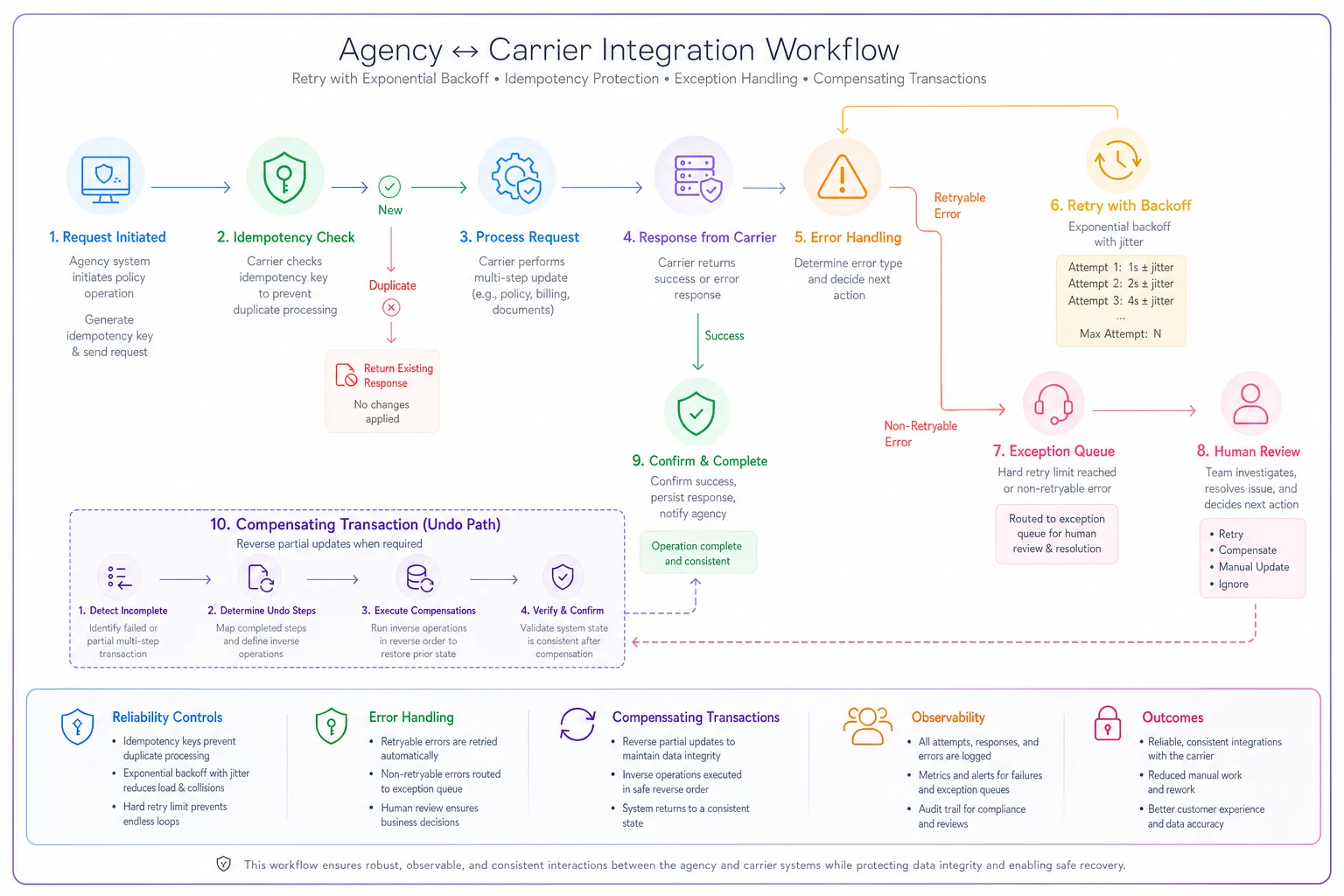
APIs don't have a 'roll it all back' button across two systems. If you push a three-step update — create policy, attach form, post premium — and step three fails, you're left with a half-created record. A compensating transaction is the pre-agreed cleanup action: if step three fails, you run a defined reversal of steps one and two.
Security and PII scopes: narrow it on purpose
The default posture of most integrations is "grab everything, figure out what we need later." That's a liability, not a convenience. When you're exchanging data that includes SSNs, dates of birth, driver's license numbers, and sometimes health info, every field you pull that you don't actually use is just risk sitting on your servers.
Your contract should specify:
-
Exact scope. List the fields the integration is authorized to read or write. If you don't use
dateofbirthin the renewal feed, don't request it. Minimum necessary, written down. -
PII classification per field. Mark which fields are sensitive so your logging rules know what to mask. A log that prints a full SSN because nobody flagged it is a breach waiting to happen.
-
Credential rotation schedule. API keys and secrets get rotated on a defined cadence, and the contract names who holds them and where — a secrets manager, not a shared spreadsheet, and definitely not hardcoded.
-
Data retention and deletion. How long does the vendor keep what you send them? When a client leaves, what's the deletion path?
The biggest PII exposure in agency integrations usually isn't the main data flow — it's the error logs and debug output that capture full request bodies, including sensitive fields, sitting unprotected in a logging tool half the team can access. Decide what gets masked in logs before you turn the pipe on.
Test-data plans: the step everyone skips and everyone regrets
"It worked in testing" usually means "it worked on the five clean records we tried." A real test-data plan deliberately includes the ugly stuff.
Your test set should cover:
-
A normal, clean record (the happy path).
-
A record with a very large premium (comma-formatting test).
-
A record with a null in every optional field.
-
A record with special characters in names (O'Brien, hyphens, accents).
-
A record with a date at a boundary (leap day, year-end).
-
A record that should be rejected — to confirm your error handling actually fires.
-
A duplicate submission — to confirm idempotency works.
The last two matter most. Most teams only test records that should succeed. You learn far more from feeding the integration something that's supposed to fail and confirming it fails gracefully — lands in the exception queue, logs cleanly, doesn't corrupt anything downstream.
A pre-flight checklist before you go live
Hand this to both sides. Nobody flips the switch until every box is checked.
-
[ ] Field map signed, versioned, dated, with an owner per field
-
[ ] Date and money formats explicitly defined and enforced (reject, don't guess)
-
[ ] Error-code table agreed, with retry vs. human-queue decisions per code
-
[ ] Retry logic uses backoff + jitter + a hard attempt cap
-
[ ] All write operations carry an idempotency key
-
[ ] Compensating transactions defined for every multi-step write
-
[ ] PII scope limited to fields actually used; sensitive fields flagged for log masking
-
[ ] Credential storage and rotation schedule documented
-
[ ] Test-data set includes malformed, boundary, duplicate, and should-fail records
-
[ ] Exception queue exists and has a named human owner who checks it daily
-
[ ] A rollback plan for the whole integration, not just individual records
Make the exception-queue owner a named role (e.g., "Daily Queue Owner") rather than a vague team to ensure consistent daily triage.
Running through this before launch takes maybe an hour. Skipping it can cost you weeks of cleanup and, in the worst cases, real E&O exposure.
An example spec page you can actually hand over
Endpoint: Renewal policy feed (read)
Direction: Carrier → Agency
Frequency: Nightly batch, 2:00 AM ET
Auth: OAuth2 client credentials, keys rotated every 90 days
Fields: See field map v2.3 (12 fields; 4 flagged PII)
Error handling: 429 → backoff retry (max 5); 4xx → agency exception queue; 5xx → retry then alert ops after 5 fails
Idempotency: policynumber + effectivedate as dedupe key
Acceptance criteria: 100% of the 7-record test set processed as expected (5 succeed, 1 rejected cleanly, 1 duplicate ignored); zero unmasked PII in logs; batch completes under 20 minutes.
That acceptance-criteria line is the part people cut for time. Don't. "It runs" is not acceptance. "It processed the test set exactly as predicted and logged nothing it shouldn't have" is.
When a lightweight integration actually makes sense — and when it doesn't
Not every data exchange needs this full apparatus. If you're pulling a once-a-quarter report with no PII and no writes, a heavy contract is overkill — a simple field map and a sanity check on the output is enough.
The full field-contract becomes non-negotiable the moment any of these are true: the integration writes data back to the carrier, it moves PII, it runs unattended on a schedule, or a failure could affect coverage or billing. Those four conditions are where silent failures turn into E&O exposure.
Who should not attempt a deep carrier integration yet: agencies without a clean internal data model. If your own management system has three different formats for producer codes and nobody's sure which is canonical, fix that first. An integration will faithfully multiply your internal mess across two systems. Getting your vendor evaluation discipline in order first — the kind laid out in the agency tech vendor selection framework — saves you from wiring up a feed to a tool you'll regret in a year.
A real scenario
A mid-sized commercial agency, roughly 14 staff, ran a nightly feed from one carrier to auto-update policy status in their management system. No field-contract — just a developer and the carrier's docs. For about four months it seemed fine.
The problem surfaced during an audit. The carrier had been sending cancellation reason codes, but the agency's map never defined the enum, so unrecognized codes were silently dropped to null. Somewhere in the range of 40–50 cancellations over those months showed up internally as active policies. Two of them generated certificates of insurance for clients whose coverage had actually lapsed.
The fix wasn't exotic. They rebuilt the integration behind a signed field map with a defined cancel-reason enum, added a rule that rejected any unknown code to a human queue instead of nulling it, and ran a test set that deliberately included bad codes. After the rebuild, unknown codes stopped vanishing — they landed in an exception queue a CSR cleared each morning, usually a handful of items. The orphaned-cancellation problem didn't recur. The cost of the rebuild was a fraction of what a single disputed COI could have run them in an E&O claim.
The takeaway
A carrier integration isn't really a technical project — it's an agreement about edge cases. The code is the easy part. What protects you is the written contract that forces both sides to say, out loud and in advance, what happens when the data is malformed, when a step half-fails, when a code shows up that nobody planned for.
Write the field map. Define every error's fate. Make writes idempotent and reversible. Narrow the PII scope. Test the failures, not just the successes. Do that before launch and you spend your mornings clearing a short exception queue instead of reconstructing where your data went wrong three weeks after it already did.
Ready to transform your insurance agency operations?
Join 500+ agencies using Covixly to reduce manual work, improve client service, and grow their book of business.