



Every agency that grows past a handful of carriers eventually hits the same wall. Carrier A wants the signed application, a loss run, and a signed UM/UIM rejection form before they'll bind. Carrier B wants the same three things plus a completed supplemental for anything with a swimming pool. Carrier C accepts the app but bounces it back two days later because the prior carrier cancellation date was entered in the wrong field.
None of these are hard requirements individually. The problem is that no two carriers ask for the same package, and the differences live in people's heads, scattered underwriting emails, and a spreadsheet somebody made in 2021 that's now half-wrong.
That's the actual mechanics behind most carrier rejections. Not agent incompetence. A missing map between "what this carrier needs" and "what we actually submitted."
The rejection that nobody catches until it's expensive
Here's the pattern that repeats across multi-carrier shops. A commercial lines CSR quotes a small contractor with three carriers. One comes back best. She fills out the app, attaches what she thinks is the full package, and submits. Two days later underwriting kicks it back: they needed a signed W-9 and a subcontractor cost breakdown for anything over a certain payroll threshold.
Now the client's effective date is at risk. The CSR emails the insured for the missing docs, waits, re-submits, and the whole thing slips four business days. Multiply that by however many new business and renewal submissions flow through the agency in a month.
What makes this worse than it looks: the requirement wasn't secret. It was documented somewhere in a carrier underwriting guide. But carrier requirements tracking in an insurance agency almost never lives in a usable, per-carrier, per-line format. It lives as tribal knowledge. The senior CSR who's been placing business with that carrier for six years just knows. The new hire doesn't, and there's no artifact to teach them except the rejection itself.
A typical example: an agency writing across roughly 12–18 carriers, each with 3–6 product lines, each line carrying its own document and field quirks. That's easily 200+ distinct requirement combinations. Nobody memorizes that. So they guess, submit, and let the carrier tell them what's missing. The carrier becomes your QA department, and every rejection is a round trip that costs a day or two.
Why the "we have a checklist" answer doesn't hold up
Most agencies think they've solved this. They have a shared doc. Maybe an onboarding-era checklist that lists carrier requirements. The reason it fails isn't that checklists are bad — it's that carrier requirements are a moving target and a flat checklist can't keep up.
Eliminate paperwork bottlenecks and missed deadlines.
Covixly helps you track, manage, and close every policy and claim with confidence and speed.
- Unified policy & claims management
- Automated client notifications
- Agent task coordination
No credit card required
-
Carriers change requirements quietly. An underwriter memo goes out, the supplemental form gets a new version, and your document still says the old thing. Nobody updates it because updating it is nobody's job.
-
Requirements are conditional, not universal. "Need a UM rejection" only applies in certain states. "Need a supplemental" only applies above a payroll or property-value threshold. A flat list can't express if this, then that, so people either over-ask (annoying the client) or under-ask (getting rejected).
-
The checklist isn't attached to the workflow. It sits in a folder. The CSR working a submission at 4:45pm is not opening a 40-tab spreadsheet to cross-reference. They're going from memory.
The mistake underneath all of this is treating carrier requirements as reference material instead of structured data. Reference material gets ignored. Structured data can be mapped, checked, and enforced automatically.
Build a standardized requirement profile per carrier
The fix starts with one boring, high-leverage exercise: turn each carrier's requirements into a standardized profile with the same schema across every carrier. Same fields, same structure, every time. That consistency is what makes the whole thing mappable later.
A workable profile schema for each carrier + line looks like this:
| Field | Example (Commercial Auto, Carrier X) |
|---|---|
| Carrier / Line | Carrier X — Commercial Auto |
| Required documents | Signed app, MVRs (all drivers), loss runs (3-yr) |
| Conditional documents | IFTA docs if interstate; garage supplemental if garaging risk |
| Field-level rules | Prior carrier cancel date → mm/dd/yyyy; VIN required for all units |
| State-specific triggers | UM/UIM rejection form (select states) |
| Threshold triggers | Additional financials if fleet > 10 units |
| Common rejection reasons | Missing driver DOB, blank prior-coverage field |
| Underwriter contact / escalation | UW desk email, response SLA |
| Last verified date | 03/2024 |
The two fields people skip are the ones that matter most: common rejection reasons and last verified date. The rejection-reasons field turns every past mistake into future prevention — you're literally documenting the ways this carrier has burned you. The last-verified date tells you when a profile is stale enough to re-check before you trust it.
The insight most agencies miss here: you already own this data. It's sitting in your rejection history. Pull the last few months of kicked-back submissions per carrier, and the recurring reasons write your profile's "watch out for" section for you.
Map submissions against the profile — before they go out
A profile alone is just better reference material. The value shows up when you map an actual submission against the relevant carrier profile and catch gaps before hitting submit, not after.
The mapping logic, in plain terms:
-
Identify the target. Carrier + line + state for this specific submission.
-
Pull the profile. Load that carrier's standardized requirement set.
-
Evaluate conditionals. Run the risk details against the threshold and state triggers — fleet size, payroll, property value, garaging state — to resolve which conditional documents actually apply here.
-
Compare against what's attached. Line up required + resolved-conditional documents against what's actually in the submission packet.
-
Flag field-level mismatches. Check the known problem fields (date formats, blank prior-coverage, missing VINs/DOBs) against what's entered.
-
Produce a gap list. Output a short, specific list
"Missing: subcontractor cost breakdown. Field issue: prior cancel date format."
That gap list is the whole game. Instead of a CSR guessing and a carrier rejecting, the gap is visible pre-submission, when it costs five minutes to fix instead of two days.
Here's a quick visual of that pre-submission mapping workflow.
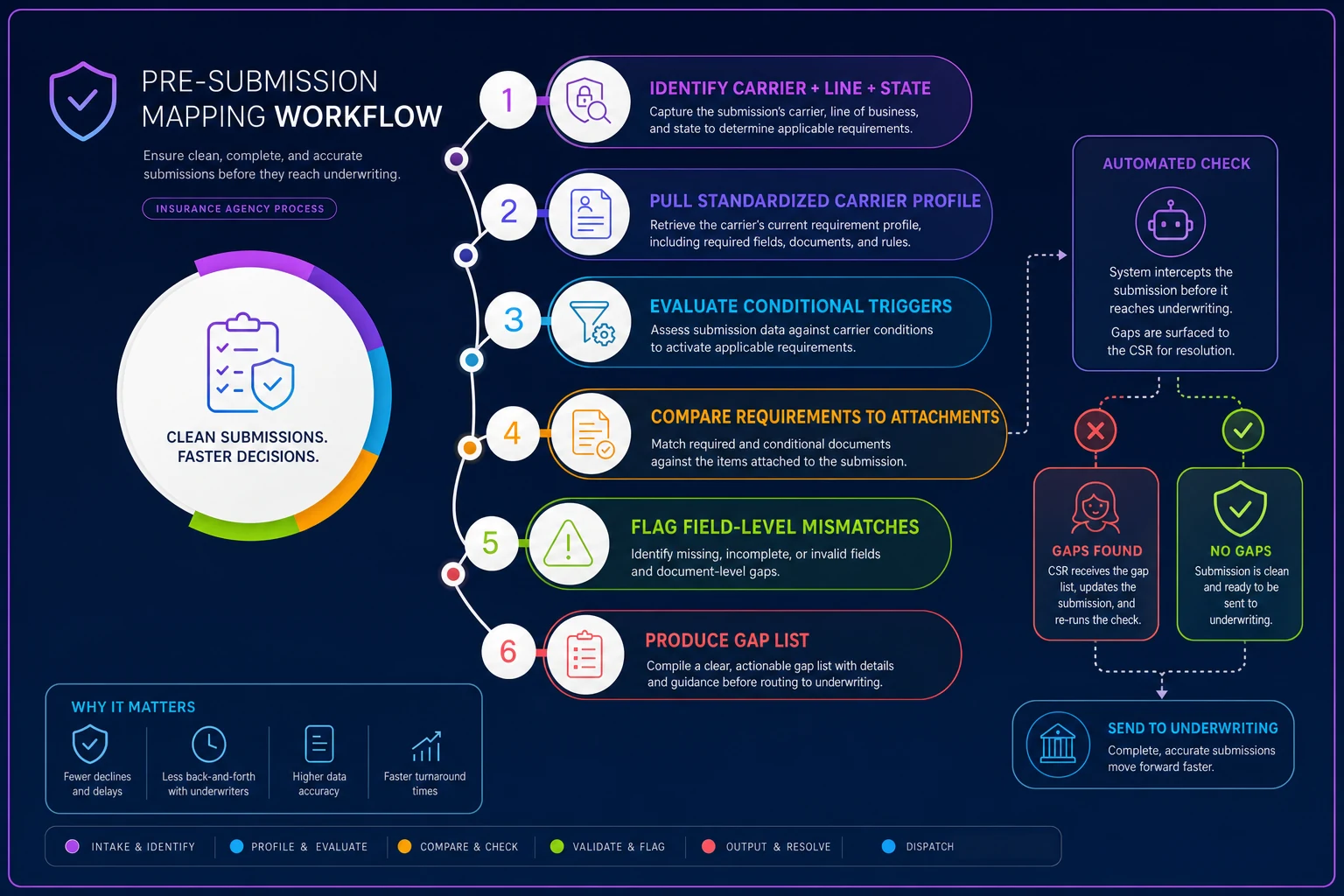
This is where automation earns its place — not as a gimmick, but as the thing that actually keeps the map current and runs the comparison every single time without someone remembering to.
The pre-submission checklist that actually gets used
A checklist only works if it's short and lives inside the workflow. Here's the lean version worth enforcing on every submission:
-
[ ] Correct carrier profile loaded for this line and state
-
[ ] All base required documents attached and signed where needed
-
[ ] Conditional triggers evaluated (thresholds, state, risk type)
-
[ ] Conditional documents attached where triggered
-
[ ] Known problem fields checked (dates, prior coverage, VINs, DOBs)
-
[ ] Profile "last verified" date within an acceptable window
-
[ ] Recurring rejection reasons for this carrier reviewed
The one item people push back on is "profile last verified within an acceptable window." It feels like busywork until a carrier quietly changes a form and you submit twenty applications against the old version. Set the window — quarterly for high-volume carriers, semi-annually for the rest — and assign the re-verification to a specific person, not "the team."
A real scenario
A mid-size independent agency, personal and commercial mixed, writing across about 14 carriers. Their commercial lines rejection rate on new business submissions was running somewhere around 1 in 4 — a kickback on roughly a quarter of everything that went out. Each one cost a couple of days and two or three CSR touches on average.
They spent about three weeks building standardized profiles for their top eight carriers — the ones covering the bulk of their volume — pulling rejection reasons straight from their kickback emails. Then they enforced a pre-submission gap check against those profiles.
Within a couple of months, first-pass acceptance on those eight carriers climbed noticeably. Rejections on that book dropped to somewhere in the 8–12% range. The bigger win wasn't even the percentage. It was the CSRs getting out of the constant re-request loop with insureds, which had been quietly eroding client trust. "Why do you keep asking me for more stuff?" is not a great thing for a client to be thinking. Cleaner submissions, fewer effective-date scares, less follow-up churn.
Not a miracle. Just the difference between guessing and mapping.
When this is worth it — and when it isn't
When it makes sense:
-
You write across roughly 8+ carriers with meaningful volume on each
-
You've got newer staff placing business (they don't have the tribal knowledge)
-
Your rejection or "need more info" rate is anywhere north of 15%
-
You're growing and can't scale on senior-CSR memory forever
When it's overkill:
-
You place almost everything with two or three carriers and the whole team knows them cold
-
Your book is tiny and rejections are rare enough that the profile-building effort won't pay back
One thing worth calling out: if your submissions are getting rejected mostly for underwriting appetite reasons — the risk just doesn't fit the carrier — requirement mapping won't fix that. That's an appetite-guide and quoting-discipline problem, not a documentation problem. Fix your appetite matching first, then come back to requirement profiles.
Start with your worst offender
You don't need to profile all 15 carriers this quarter. Pull your rejection log, find the carrier that kicks back the most submissions, and build one clean profile for its highest-volume line. Use the actual rejection reasons as your source material. Enforce the gap check on that one carrier for a few weeks and watch the kickbacks drop.
Then do the next-worst offender. Within a couple of months you'll have covered the carriers responsible for most of your rejection pain, and the remaining long-tail carriers can wait.
The core shift is small but changes everything downstream: stop treating carrier requirements as something people memorize, and start treating them as structured, versioned data you can check every submission against. Do that, and the carrier stops being your QA department — which is exactly where it never should have been.
Ready to transform your insurance agency operations?
Join 500+ agencies using Covixly to reduce manual work, improve client service, and grow their book of business.