


Most agencies staff their service team like everyone handles everything. A commercial account manager who can quote a manufacturing package policy is also the person emailing a certificate of insurance to a landscaping client. On paper it looks flexible. In practice, you're paying senior-level wages for junior-level work, and the complicated accounts — the ones that actually need experience — get squeezed into whatever time is left.
Service tiering is about matching the difficulty of the work to the cost and skill of the person doing it. Sounds obvious. Almost nobody does it cleanly. And the reason it breaks down isn't that owners don't understand the concept — it's that the routing is invisible. Work shows up in an inbox or a task queue, and whoever grabs it owns it. There's no filter deciding "this is a Tier 1 request, this is a Tier 3 account." The sorting happens by accident, usually based on who answered the phone.
This post is about building that filter intentionally: how to classify complexity, how to route by it, what your staffing mix should actually look like, and how to transition without blowing up service quality halfway through.
Why the "everyone does everything" model quietly costs you money
When an agency is small — two or three service people — pooling everything makes sense. There isn't enough volume to specialize, and cross-training keeps you covered when someone's out. The problem is that this model doesn't scale, and most agencies never notice the exact moment it stops working.
As the book grows, the volume of simple requests grows faster than the complex ones. ID cards, COIs, address changes, mortgagee updates, billing questions — these multiply with every new policy. Meanwhile, your genuinely complex work (large commercial renewals, coverage restructuring, claims advocacy on messy losses) grows more slowly. So your senior people spend an increasing share of their day on low-value tasks, and it feels like you're constantly "busy" without the revenue reflecting it.
On a typical mixed personal-and-commercial book, somewhere around 60–70% of inbound service requests are low-complexity. If a $75k-a-year account manager is spending even a third of their week on those, you're burning roughly $8k–$10k a year of senior salary on work a $40k CSR could do faster. Multiply that across a team of five and the leak adds up.
The deeper cost isn't the wage mismatch, though. It's that complex work gets rushed. When your best person is drowning in small tasks, the hard endorsement gets a five-minute review instead of the twenty it needed. That's where E&O exposure lives — not in the COI sent to the wrong email, but in the coverage gap nobody caught because the person who'd have caught it was busy resetting a portal password.
Building a complexity taxonomy that people actually use
The first mistake agencies make when they try to tier is overcomplicating the taxonomy. Someone builds a nine-tier matrix with weighted scoring, nobody remembers it, and within a month everyone's back to grabbing whatever's in the queue.
Eliminate paperwork bottlenecks and missed deadlines.
Covixly helps you track, manage, and close every policy and claim with confidence and speed.
- Unified policy & claims management
- Automated client notifications
- Agent task coordination
No credit card required
Keep it to three or four tiers, and define them by what the work requires, not by product line. A commercial account isn't automatically complex, and a personal auto policy isn't automatically simple. Complexity comes from a few real factors:
-
Judgment required — does resolving this need coverage interpretation, or is it a defined procedure?
-
Carrier interaction — self-service system update vs. underwriter negotiation
-
Error consequence — how bad is it if this is done wrong?
-
Account value / relationship sensitivity — is this a $1,200 personal auto or a $180k commercial account that referred you three others?
Here's a workable taxonomy:
| Tier | What it looks like | Skill needed | Typical error cost |
|---|---|---|---|
| Tier 1 – Transactional | ID cards, COIs, mortgagee changes, billing questions, simple address updates | Trained CSR, checklist-driven | Low — usually fixable same day |
| Tier 2 – Standard servicing | Personal lines endorsements, straightforward renewals, adding a vehicle/driver, routine coverage questions | Experienced CSR / junior account manager | Moderate — coverage or premium impact |
| Tier 3 – Complex servicing | Commercial renewals, coverage restructuring, mid-term endorsements on complex risks, multi-policy accounts | Account manager with product depth | High — E&O and retention exposure |
| Tier 4 – Advisory / escalation | Claims advocacy on disputed losses, large-account remarketing, coverage gap analysis | Senior producer / specialist | Very high — legal and relationship risk |
The point of writing this down isn't the table itself. It's giving your team a shared language so that when a request comes in, someone can say "that's a Tier 3, route it to the AM pool" without a debate.
One thing worth flagging: don't let account size alone define the tier. Agencies that dump every commercial account into the "complex" bucket wonder why their commercial team is constantly buried. A commercial COI request is still Tier 1 work. The account is complex; the task isn't.
Routing rules: where the system lives or dies
A taxonomy without routing is just a poster on the wall. The routing rules are what actually change behavior — and this is the part that connects to everything else in your operation: your SLAs, your handoffs, your capacity planning.
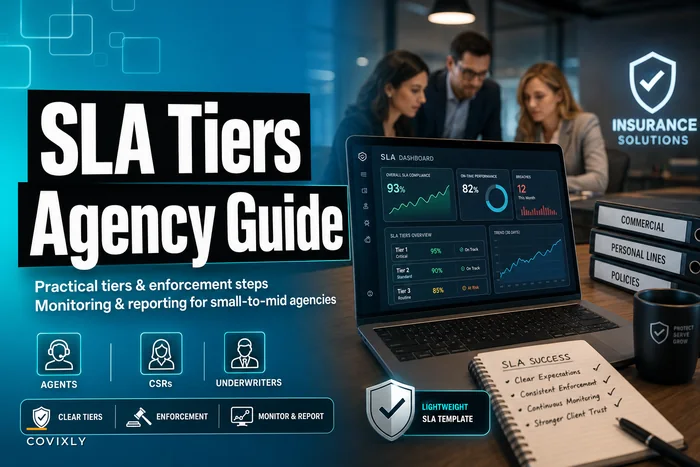
Routing should answer three questions the moment a request lands: what tier is this, who owns it, and how fast does it need a response? If you've already built out a lightweight SLA framework for agents, CSRs and underwriters, tiering slots right into it — each tier gets its own response and resolution target instead of one blanket SLA that's either too slow for simple stuff or too aggressive for complex work.
A basic routing process looks like this:
-
Capture the request in a single intake point — one shared inbox, one form, one queue. If requests come in through five different channels, no routing rule survives contact with reality.
-
Classify at intake. Either a triage person or a rule-based system tags the tier based on request type and account flags.
-
Route to the pool, not the person. Tier 1 goes to the CSR pool. Tier 3 goes to the account manager pool. Routing to a pool instead of a named individual is the difference between load-balancing and creating five personal bottlenecks.
-
Apply the tier's SLA clock. Tier 1 might be same-day; Tier 3 might be 48 hours because it requires actual work.
-
Escalation path is pre-defined. A Tier 2 that turns into a coverage dispute gets bumped to Tier 4 with a documented handoff — not silently absorbed by whoever got stuck with it.
The escalation piece is where most systems leak. A CSR picks up what looks like a simple endorsement, discovers it's actually a coverage restructuring question, and rather than kicking it up, they muddle through because escalating feels like admitting they couldn't handle it. Six weeks later there's a gap and a call from an adjuster. Make escalation a normal, expected move, not a failure. The best-run service teams escalate cleanly and often.
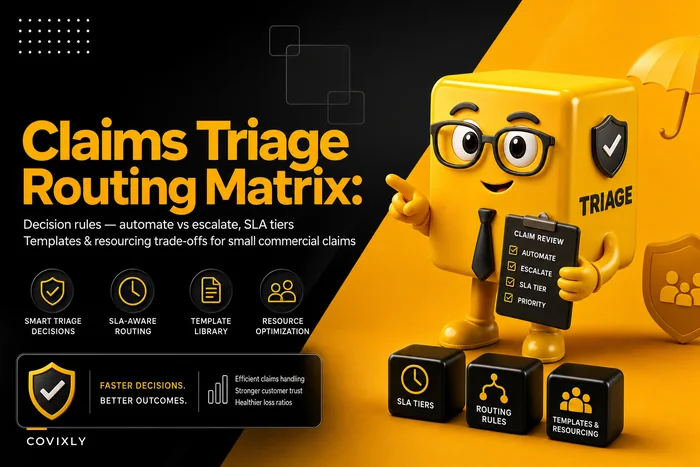
This mirrors the logic behind a claims triage matrix for high-volume small commercial claims — same principle, different queue.
Here's a simple visual of that routing workflow.
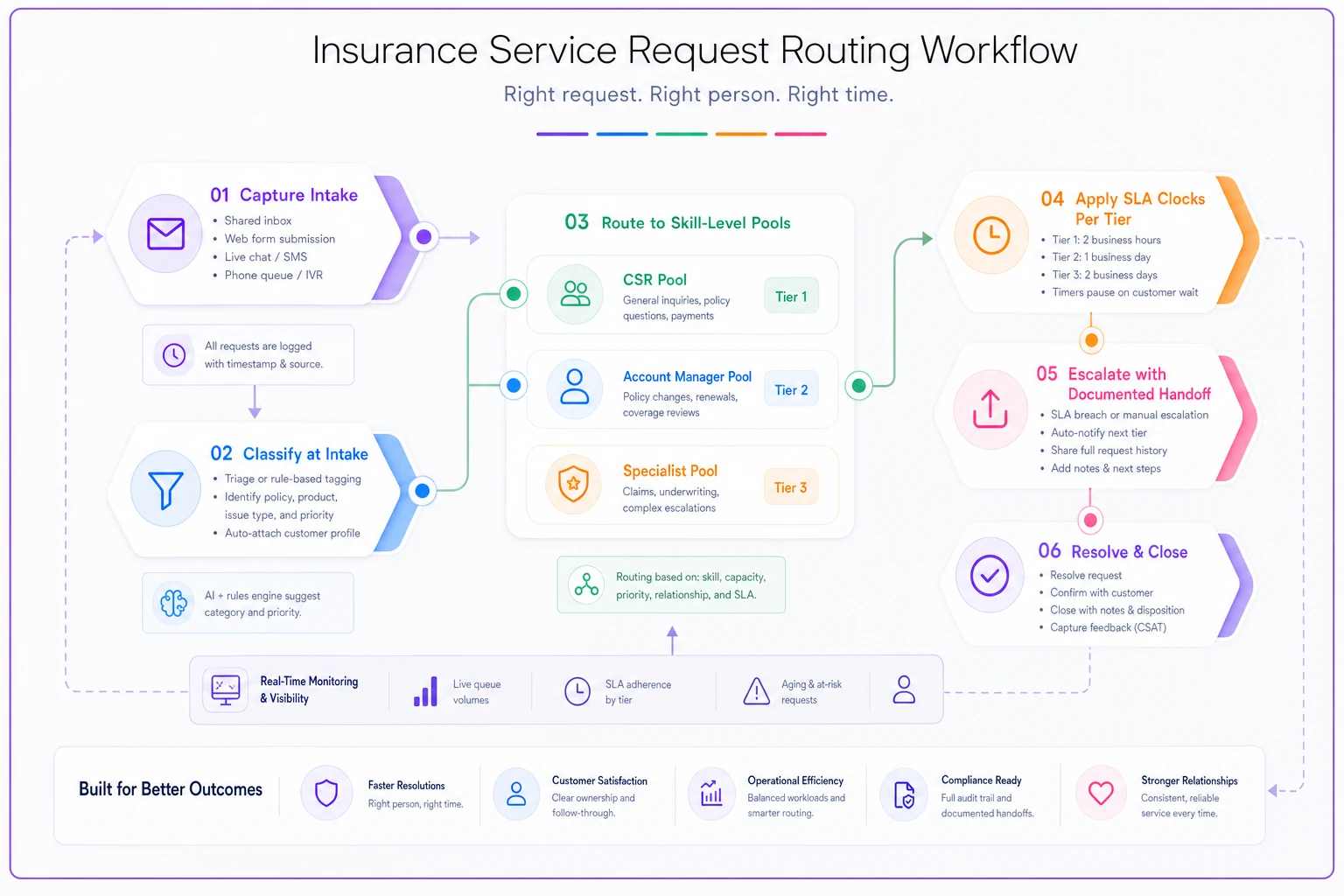
Sort by complexity first, route second, and don't let the hard stuff hide inside the easy stuff.
Staffing mix: what the pyramid should actually look like
Once work is tiered, your staffing mix becomes a real decision instead of an accident. Most agencies are top-heavy without realizing it — too many account managers, not enough CSRs, because they hired experienced people to "handle anything" and never built the base.
If roughly two-thirds of your volume is Tier 1 and Tier 2, your team should reflect that. A rough shape for a mid-sized agency service team of around eight people:
-
3 CSRs handling Tier 1 and overflow Tier 2
-
3 account managers handling Tier 2 and Tier 3
-
1–2 senior specialists / producers handling Tier 3 and Tier 4
That's a base-heavy pyramid, and it's both cheaper and more resilient than the diamond shape most agencies drift into. The transactional work flows to lower-cost, faster people. The complex work gets real attention from people who aren't buried in ID card requests.
On the cost side: if your service payroll runs around $420k and a top-heavy team is spending 30% of senior time on Tier 1 work, that's somewhere in the range of $40k–$50k of misallocated labor annually. Rebalancing toward CSRs for the transactional load can either trim that cost or — more usefully — free your account managers to actually work accounts instead of just reacting to them. The money's often better spent improving retention than saved outright.
When this makes sense — and when it doesn't
-
It makes sense when you're past roughly 4–5 service people and volume is high enough that specialization pays off.
-
It's a bad idea if you're a three-person shop. You don't have the volume, and rigid routing just adds friction. Stay pooled.
-
Who should NOT do this agencies with inconsistent data on their book. If you can't reliably tell which accounts are complex, you can't route them. Clean the data first.
Clean the data first.
A transition plan that doesn't break service quality
The risk in switching to tiered service is the middle period — those few weeks where old habits and new rules are both half-active and things fall through the cracks. Here's a phased approach that avoids the worst of it.
Weeks 1–2: Observe and classify. Don't change routing yet. Just tag every incoming request with a tier for two weeks. You'll get real data on your actual mix — which is almost always different from what people assume. Most agencies find they have more Tier 1 volume than they thought.
Weeks 3–4: Set up single intake. Consolidate your request channels into one queue before routing anything. This is the unglamorous part that determines whether the whole system works.
Weeks 5–6: Route Tier 1 only. Start by pulling just the transactional work out and sending it to the CSR pool. Lowest-risk change, fastest relief to your senior people. Don't touch Tier 3/4 routing yet.
Weeks 7–10: Layer in Tier 2 and escalation rules. Now that the base is flowing, formalize the middle tier. Define and rehearse the escalation path. Watch for accounts that get misclassified and adjust the flags.
Weeks 11–12: Full tiering and review. Everything's routed by tier, SLAs are attached, and you review misroutes weekly. Expect to keep tuning the taxonomy for another month or two — the flags almost always need adjusting.
Throughout all of this, keep a manual override. There will always be the client who calls their favorite AM directly, and forcing that through a rigid queue just annoys everyone. Route by default, override by exception.
A real scenario
A regional agency — around 4,200 policies, mostly personal lines with a growing commercial book, seven service staff — was losing account managers to burnout. Two resigned in one year, both citing "doing the same paperwork all day." Their team was five account managers and two CSRs. Upside down for their actual work mix.
They ran the two-week tagging exercise and found close to 65% of requests were Tier 1. Their account managers were spending roughly half their time on transactional work. Over about a quarter, they rebalanced — moved one AM into a Tier 3/4 specialist role, hired two CSRs, and routed all transactional requests to the CSR pool.
Four months later, the results weren't dramatic on paper but mattered operationally: response time on complex commercial requests dropped from "a few days" to under 24 hours, one of the earlier resignations came back, and their account managers started working renewals proactively instead of just reacting. Retention on mid-size commercial accounts ticked up a few points over the following renewal cycle. Nothing miraculous — just work flowing to the right people.
Where the tooling fits
You can run tiering manually with a shared inbox and a tagging convention, and plenty of agencies do exactly that at the start. Where it gets hard is classification at scale — consistently tagging hundreds of weekly requests, applying the right SLA clock, and catching misroutes before they cause problems.
That's where operational software that can auto-classify incoming requests by type, route to the right pool, and flag escalations starts saving real time. AI-assisted routing is genuinely useful here — not because it's clever, but because it removes the human bottleneck of someone eyeballing every request to figure out where it goes. The system handles the sorting; your people handle the work that actually needs judgment.
Tooling is the last step, not the first. The taxonomy and routing rules have to exist before software can enforce them. Automate a broken process and you just get a faster broken process.
The takeaway
Tiering service by complexity isn't about building a rigid bureaucracy. It's about acknowledging that not all service work is equal, and that treating it like it is quietly wastes your most expensive and most capable people. Sort the work by what it actually requires, route it to the right skill level, staff a base-heavy pyramid, and transition in phases so nothing breaks along the way. Do that, and your senior people go back to doing senior work — which is the whole point of hiring them in the first place.
Ready to transform your insurance agency operations?
Join 500+ agencies using Covixly to reduce manual work, improve client service, and grow their book of business.