



Most agencies don't have a hiring problem. They have a keeping problem dressed up as a hiring problem. You bring someone on, spend three months getting them productive, and just as they start pulling weight, they leave for a carrier gig or a competitor offering fifty cents more an hour. Then you're back posting on Indeed, except now you're short-staffed and everyone left behind is covering the gap.
The frustrating part is that turnover rarely happens because someone hates the work. It happens because the path forward is invisible. New hires can't see what "getting better" actually looks like, owners can't tie raises to anything measurable, and nobody knows whether a given experiment — new comp plan, new bonus, new schedule — actually moved the needle. So the whole talent operation runs on gut feel, and gut feel doesn't scale past your first five or six people.
This is about treating retention like an operational system, the same way you'd treat renewals or claims triage. Not a vibe. A set of connected mechanisms: how you profile who you hire, how competency ties to pay, and how you actually test whether your retention moves are working.
Why talent falls apart the same way in almost every agency
There's a pattern that shows up constantly. An agency grows to maybe 8–12 people. The owner is still the one who "knows" who's good and who isn't. Raises happen when someone complains, threatens to leave, or catches the owner in a good mood. There's no rubric, so two CSRs doing nearly identical work end up making different money for reasons nobody can explain — and everybody eventually finds out, because they always do.
At the same time, the thing that actually makes people stay — feeling like they're growing and being recognized for it — is completely undefined. Ask most agency owners "what does a Level 2 CSR do that a Level 1 doesn't?" and you'll get something hand-wavy about "experience" or "handling harder accounts." That's not a milestone. That's a feeling. And feelings can't be earned toward on purpose.
What breaks at scale: when you had four people, you could hold the whole talent picture in your head. Who's ready for a raise, who needs coaching, who's flight-risk. At fifteen people across a couple of lines of business, that mental model collapses. You forget someone's been crushing it for eight months. You promote the loud one over the quiet one who's actually more competent. And every one of those small misjudgments compounds into resentment, which compounds into turnover.
The other failure point is experiments that aren't really experiments. An owner reads about a retention bonus, rolls it out to everyone at once, sees turnover drop the next quarter, and concludes the bonus worked. Except three other things changed that quarter too. No control group, no baseline, no way to know what actually did the work. So they keep paying for something that might do nothing.
The three connected systems
A real insurance agency talent strategy isn't one policy. It's three systems that feed each other:
Eliminate paperwork bottlenecks and missed deadlines.
Covixly helps you track, manage, and close every policy and claim with confidence and speed.
- Unified policy & claims management
- Automated client notifications
- Agent task coordination
No credit card required
-
A profile-based hiring rubric so you're selecting for the traits that actually predict success in your agency, not just a nice interview.
-
Competency milestones tied to pay progression so people can see the ladder and earn their way up it on defined terms.
-
Measurable retention experiments so you know which of your talent moves are worth the money.
When these connect, something useful happens. The rubric you hire against becomes the same framework you measure competency against, which becomes the same thing pay progression is built on. One vocabulary, top to bottom. When they don't connect — when hiring criteria have nothing to do with your raise criteria — you get people who interviewed great but never advance, and people who advance without anyone knowing why.
A quick visual makes the flow obvious.
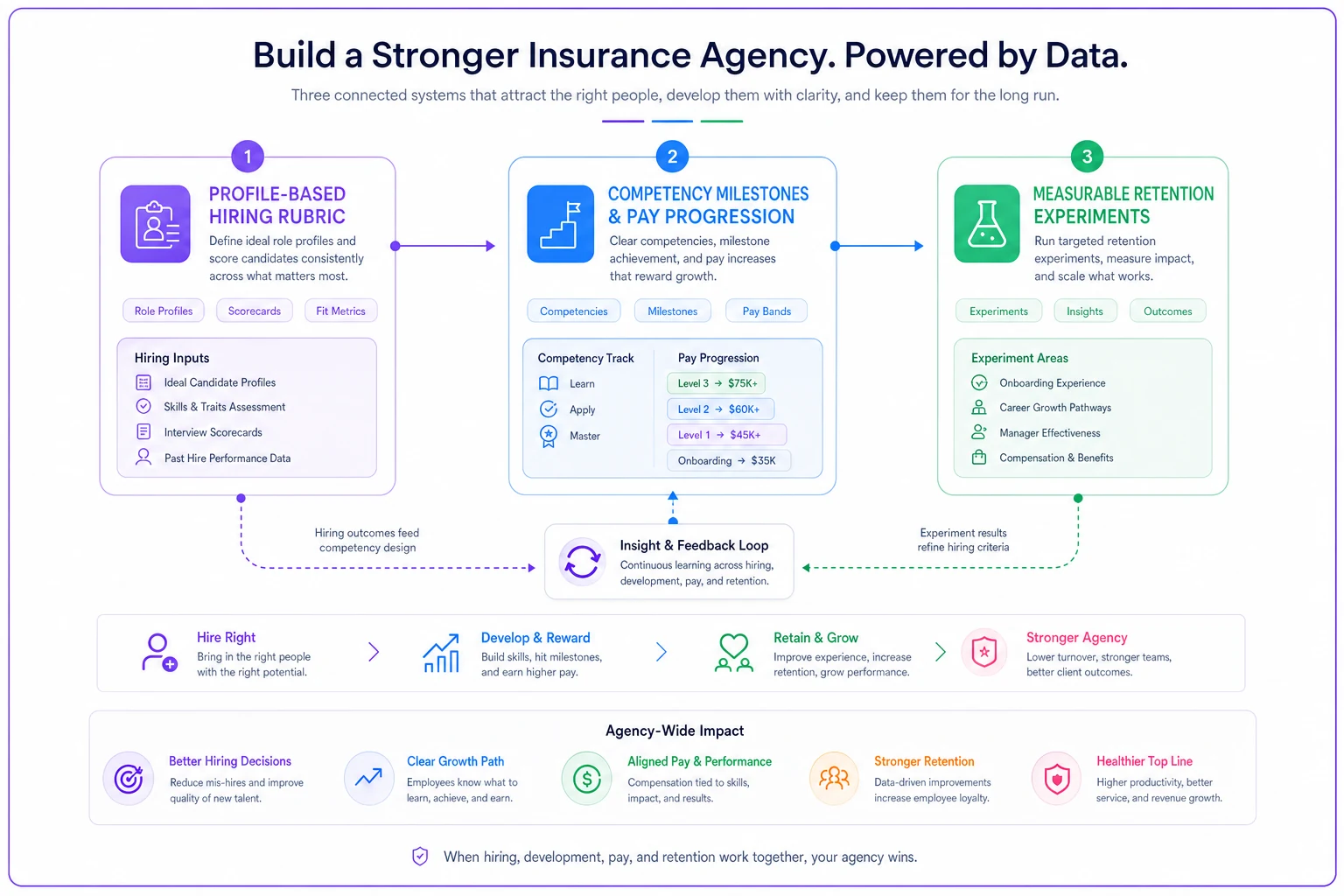
When they don't connect — when hiring criteria have nothing to do with your raise criteria — you get people who interviewed great but never advance, and people who advance without anyone knowing why.
Profile-based hiring: stop scoring "good interview"
The mistake most agencies make in hiring is scoring for likeability and confidence, which correlate with almost nothing about whether someone will still be productive and present in eighteen months. A profile-based rubric means you decide in advance what the actual predictors are, weight them, and score every candidate against the same criteria.
For a personal-lines CSR role, the predictors that tend to matter aren't "insurance experience." They're things like attention to detail under repetitive load, comfort with structured software, ability to follow a process without needing to reinvent it, and tolerance for interruption. A candidate who worked in a busy pharmacy handling refills and insurance rejections often outperforms someone with two years at an agency where they picked up bad habits.
A workable rubric looks something like this — each dimension scored 1–5, with weights that reflect what the role actually demands:
| Dimension | Weight | What a 5 looks like |
|---|---|---|
| Process-following under volume | High | Describes a system they used to stay accurate when swamped |
| Software/data comfort | High | Learns new tools fast, not intimidated by structured entry |
| Written communication clarity | Medium | Clean, specific, no rambling in the writing sample |
| Handling correction | Medium | Talks about a mistake without defensiveness or blame |
| Retention signals | Medium | Job history shows they stay, or good reasons they didn't |
Weighting is where agencies go wrong even when they bother to build a rubric. If you weight "friendly and personable" as heavily as "process-following," you'll hire people who charm clients but leave a trail of coverage errors. For a service role behind the scenes, accuracy under load beats charisma almost every time. Save charisma-weighting for producer roles.
One practical rule: have two people score independently before comparing.
When your scores diverge by more than a point on any dimension, that's the conversation worth having — usually one of you saw something the other missed, and that's more valuable than the average.
Competency milestones tied to pay progression
This is the piece that actually retains people, and it's the piece almost nobody builds properly. The idea is straightforward: define what competence looks like at each level, in observable terms, and attach pay to hitting those levels. Not tenure. Not asking. Demonstrated competency.
Tenure-based raises fail because they reward the wrong thing. Someone can stick around three years and still be sloppy, while a fast learner hits mastery in fourteen months and earns the same as the slow veteran. Both people notice. Both get demotivated. Milestone-based progression fixes this by making the standard the thing, not the calendar.
-
Level 1 — Onboarding through competent. Handles standard personal-lines endorsements, ID cards, and simple service requests within SLA. Needs review on anything non-routine. A solid 30-day onboarding plan and structured ramp does the heavy lifting here — but the ramp shouldn't end at day 30, which we'll get to.
-
Level 2 — Independent operator. Handles the full personal-lines book solo, manages renewals, resolves most carrier issues without escalation, meets error-rate targets consistently for a defined stretch — say, three months under threshold.
-
Level 3 — Complex and commercial-capable. Takes on small commercial, handles COIs and endorsements on more complex accounts, trains Level 1 hires, catches issues before they escalate.
-
Level 4 — Specialist / team lead. Owns a book of complex accounts, sets service standards, mentors, and makes judgment calls without needing sign-off.
Each level has a pay band, and movement between them is earned against defined criteria, not negotiated. The power here is that a new hire on day one can see the whole ladder and the money attached to it. Growth stops being a mystery. When someone asks "how do I make more?" you point at the wall instead of shrugging.
A critical detail people miss: the criteria have to be measurable, or the whole thing collapses back into favoritism. "Handles complex accounts well" is not a criterion. "Maintains endorsement error rate under X% across a full quarter while carrying at least N complex accounts" is. If you can't measure it, you can't promote fairly against it, and people will smell the arbitrariness fast.
This connects directly to how you enforce service standards. If you've already got tiered SLAs for agents, CSRs and underwriters, your competency milestones can borrow those exact thresholds — meeting SLA consistently is a competency signal, and now it's doing double duty.
When milestone-based pay is a bad idea
This system assumes you can actually measure output cleanly. If your data is a mess — no reliable error tracking, no visibility into who touched what — you'll build milestones on top of numbers you can't trust, and that's worse than tenure raises because now you're making confident decisions on bad data. Fix the measurement first.
It's also not worth the overhead if you're running a two or three-person shop. Under five or six people, just be transparent and pay well.
The ramp plan that extends beyond 30 days
Most agencies stop paying structured attention to a new hire at day 30. The person is "onboarded," they've got a login, they know where the coffee is — so they're on their own now. That's exactly where a lot of turnover gets seeded. Not in the first month, but in months two through five, when someone's technically doing the job but quietly drowning and too proud to say so.
Days 1–30: Core workflow competency. Shadowing, supervised transactions, learning the systems. Standard onboarding territory.
Days 31–60: Supervised independence. They're handling real work solo but with a defined review cadence — a manager or senior CSR spot-checks a sample of their transactions weekly and gives specific feedback. The goal is catching drift before it becomes habit.
Days 61–90: Volume and accuracy targets. They should now be carrying a realistic load and meeting error-rate thresholds. This is your first real read on whether the hire is working out, early enough to intervene meaningfully.
Days 91–150: Progression toward Level 2. Reduced review cadence, expanded account complexity, and a clear checkpoint where you decide together whether they're on track for the next pay band and roughly when.
The check-ins get less frequent, not absent. The mistake is going from daily attention to zero attention overnight. Fading support out on a schedule is what turns a shaky month-two hire into a solid month-five operator.
-
Weekly transaction sample reviewed for the first 60 days, then biweekly
-
Error rate tracked and shared with the person, not just filed away
-
One documented "how are you actually doing" conversation per month
-
Explicit statement, by day 90, of where they stand against the Level 2 criteria
-
A named next-milestone target and rough timeline by day 120
The check-ins get less frequent, not absent. The mistake is going from daily attention to zero attention overnight. Fading support out on a schedule is what turns a shaky month-two hire into a solid month-five operator.
Measurable retention experiments (the part nobody does right)
Almost no agency has this discipline: treating a retention move like a test with a baseline, not a hope you throw money at.
Say you want to know whether a quarterly retention bonus reduces turnover. The wrong way is to give it to everyone and check turnover next year. The right way is to define your baseline first — what's your current annualized turnover, by role, over the last 18–24 months? Then change one thing, isolate it as much as you can, and measure against that baseline over a defined window.
-
Define the metric. Voluntary turnover, annualized, by role. Or time-to-Level-2. Or first-year retention rate.
-
Establish baseline. Pull real numbers from before the change. No baseline, no experiment.
-
Change one thing. New comp structure, new milestone visibility, a schedule change, whatever.
-
Set the window. Long enough to be real — usually two to four quarters for retention.
-
Compare and decide. Keep it, kill it, or adjust. Then run the next one.
The insight most owners miss: the smallest retention interventions often outperform the expensive ones, but you'll never know unless you measure. Making the pay ladder visible costs nothing and frequently does more than a bonus, because it removes the "I have no future here" feeling that drives quiet quitting. But if you never test, you'll keep spending on the flashy lever and ignoring the free one.
A real scenario
A mid-sized agency — around 14 staff across personal and commercial lines — was losing roughly a third of its service team every year. Every departure cost them somewhere in the range of two to three months of reduced productivity plus the owner's time re-hiring, and the churn was quietly capping their growth because they were always training instead of scaling.
They built a competency ladder with four levels and posted the pay bands openly. They extended their ramp plan to 150 days with fading check-ins. And they ran one experiment at a time — first, just making the ladder visible; a couple quarters later, adjusting the Level 2 pay band after they saw where people were stalling.
Nothing dramatic happened overnight. But over the following year, voluntary turnover on the service team dropped noticeably — closer to the mid-teens as a percentage — and, more tellingly, people started asking about the next milestone instead of asking about the door. Time-to-independent-operator tightened up too, because now there was a target to move toward. The owner's takeaway wasn't "we found the magic bonus." It was that the biggest retention gain came from the free change — visibility — which they'd never have discovered if they'd thrown money at everything at once.
Where the systems have to connect
These three pieces aren't separate initiatives. Your hiring rubric defines the traits. Those same traits become the competency milestones. The milestones drive pay progression. And your retention experiments tell you whether the whole apparatus is actually keeping people. Break any link and the others weaken — a great ladder with a broken hiring rubric just promotes the wrong people faster.
The agencies that get this right stop thinking about talent as a series of emergencies — someone quit, post a job, panic — and start thinking about it as a machine that produces competent, retained people on a predictable curve. That shift is what lets you grow past the point where the owner's memory is the only HR system in the building. And once the framework is defined, keeping it consistent across a growing team is mostly a matter of tracking the right competency and error data in one place, so promotion and retention decisions run on real numbers instead of whoever spoke up last.
You don't need all of this on day one. Start with the ladder, make it visible, get your baseline numbers honest, and run one experiment at a time. The compounding effect of people staying and improving instead of leaving and being replaced is, over a couple of years, the difference between an agency that scales and one that's permanently stuck training its next replacement.
Ready to transform your insurance agency operations?
Join 500+ agencies using Covixly to reduce manual work, improve client service, and grow their book of business.