

Most agency owners think their producer comp problem is a number problem. It's not. It's a governance problem wearing a number costume.
You can have the "right" commission percentage and still watch it quietly wreck your P&L — because the percentage isn't where things break. What breaks is everything around it. Who gets credited on a messy split. How quotas get set, and whether anyone revisits them when the book shifts. What happens when two producers both swear they own the same account. Whether the person signing checks can actually see how a producer's pay connects to the margin that account throws off.
When those pieces aren't governed, comp becomes a slow leak. Nobody notices in month one. By year three, you're overpaying on low-margin business, underpaying your best cross-seller, and burning an afternoon every pay cycle refereeing arguments that should have had a rule years ago.
This is a runbook for the governance layer — not the plan design itself. Think of it as the operating system your comp plan runs on.
Why comp governance quietly falls apart as you grow
At two or three producers, you don't need governance. You are the governance. You remember who brought in the Hendricks account, you know Dave helped on the big commercial renewal, and you can sort out a split in your head over coffee.
That memory-based system has a hard ceiling, and most owners blow right past it without noticing.
The pattern tends to look like this: you hire producer four and five. A couple of CSRs start functioning as inside producers without a formal title. A retiring producer's book gets carved up. Someone goes part-time. Suddenly the "I'll remember it" system is holding maybe forty credit decisions a month in one person's head — and that person is also trying to run the agency.
Comp disputes don't spike gradually. They hit a wall. The agency crosses some threshold — usually around six to eight producers or the first book transfer — and the volume of "wait, who gets credit for this?" conversations roughly triples in a quarter. Not because people got greedier. Because the informal rules that lived in the owner's head no longer scale, and everyone starts filling the vacuum with their own interpretation.
The deeper issue is that comp touches three systems that usually don't talk to each other:
-
Production data (what got written, by whom)
-
Finance data (what it actually earned after loss ratios, carrier contingencies, and servicing cost)
-
People management (quotas, reviews, retention, who's being developed)
When those live in three separate spreadsheets owned by three different people, comp governance can't work. You're reconciling fiction against fiction.
The four decisions that have to be governed
Before any cadence or template, get clear on what you're actually governing. There are four core decisions, and most agencies have an unwritten, inconsistent answer for all of them.
Eliminate paperwork bottlenecks and missed deadlines.
Covixly helps you track, manage, and close every policy and claim with confidence and speed.
- Unified policy & claims management
- Automated client notifications
- Agent task coordination
No credit card required
| Decision | What breaks without a rule | Who usually owns it |
|---|---|---|
| Quota-setting | Quotas get set once and never revisited; a producer rides a soft number for years | Owner / sales leader |
| Split assignment | Credit arguments, double-paid accounts, resentment | Nobody — which is the problem |
| Dispute resolution | Every conflict escalates to the owner; decisions feel arbitrary | Owner, by default |
| Pay review cadence | Comp drifts out of line with market and margin; surprises at raise time | Finance + owner, often disconnected |
Notice that two of the four default to "the owner, reactively." That's the tell. Governance means these decisions have an owner, a cadence, and a documented rule — before the situation arises, not during the argument.
Quota-setting: make it a cadence, not an event
The single most common quota mistake isn't setting them too high or too low. It's setting them once.
A producer gets a $300k new-business quota when they start. Three years later they've got a renewal book throwing off steady commission, the market's hardened, their mix has shifted toward commercial — and they're still being measured against the same number they got as a rookie. The quota has become meaningless, and worse, it's quietly rewarding coasting.
-
Annual reset (Q4 for the coming year). Rebuild each producer's quota off their current book, realistic market conditions, and your capacity forecast — not last year's number plus an arbitrary bump.
-
Mid-year sanity check (end of Q2). Not a full reset. A check
did anything structural change? A big account loss, a carrier appointment, a book transfer, a market shift? Adjust only if the ground moved.
-
Trigger-based review (any time). Certain events force a quota conversation regardless of calendar — a book inheritance, a territory change, a move from personal to commercial lines, a role change.
The thing most owners miss: quotas should be set against margin-weighted production, not raw premium or raw commission. A producer writing $500k of high-loss-ratio personal auto is not contributing what a producer writing $350k of clean commercial is. If your quota is a flat premium number, you're incentivizing the wrong growth.
This is exactly the kind of linkage that falls out naturally once you've done the work of breaking down profitability by product, producer, and channel. Our P&L playbook on decomposing profit by product walks through how to get that margin view in the first place — which is the raw material quota-setting actually needs.
Split-assignment rules: write them before you need them
Splits are where governance earns its keep, because splits are emotional. Money people believe they earned is on the table, and memory conveniently rewrites who did what.
The failure mode is predictable. No written rule exists, so splits get negotiated case by case. The producer who argues hardest tends to win. Everyone watches. Within a year you've trained your team that credit goes to the loudest advocate, not the actual contributor. That's corrosive, and it's entirely self-inflicted.
A workable split framework answers these questions in advance:
-
New business origination. Who sourced it? Default credit sits here unless another rule overrides.
-
Account-of-record vs. producer-of-record. When a house account or inherited book renews, who gets renewal credit, and for how long?
-
Collaboration splits. When two producers genuinely co-sell, what's the default? A fixed menu (70/30, 60/40, 50/50 based on role) beats open negotiation every time.
-
Servicing credit. Does the CSR or service producer who saves a troubled account at renewal get anything? A lot of plans ignore this, then wonder why service producers don't fight for retention.
-
House accounts. What's the credit rule when leadership or marketing sources the lead, not a producer?
Write the rule as defaults with documented exceptions. The default handles the vast majority of cases automatically. The exception process handles the rest without turning into a brawl.
A checklist for your split policy
-
- [ ] Every credit type (new, renewal, cross-sell, service save) has a default rule
-
- [ ] Collaboration splits use a fixed menu, not open negotiation
-
- [ ] Book-transfer and inheritance credit has a defined decay schedule (e.g., full credit year one, reduced thereafter)
-
- [ ] House-account rules are written and visible to all producers
-
- [ ] Every split decision is logged somewhere searchable — not in email threads
-
- [ ] Producers can see their credited splits in near-real-time, not at pay time
That last point matters more than it looks. Most split disputes aren't really about the rule — they're about surprise. A producer finds out at commission time that they only got 40% of something they thought was fully theirs. If they'd seen the split the day the account was written, the conversation happens early, calmly, and once.
Dispute intake and resolution: a protocol, not a mood
The pattern in ungoverned agencies: every comp dispute goes straight to the owner, gets resolved based on how the owner feels that day, and the resolution is remembered differently by everyone involved. Next quarter, a nearly identical dispute gets resolved the opposite way, and now you've got a fairness problem on top of a money problem.
Intake. Disputes get submitted through one channel, with a required format — what account, what credit is contested, what the producer believes the correct split is, and why. No hallway complaints. No "hey, got a sec?" The act of writing it down resolves a meaningful portion of disputes on its own, because people realize they don't actually have a case once they try to explain it.
Resolution tiers:
-
Rule check (same day). Does an existing split rule already answer this? Most disputes die here — the answer was written, someone just didn't read it.
-
Manager review (within a few days). Genuine gray areas go to whoever owns comp governance. They apply judgment, document the reasoning, and that reasoning becomes a precedent.
-
Owner escalation (rare). Only novel situations with no precedent reach the owner. When they do, the decision gets written into the rulebook so it's never novel again.
The entire point is to drain disputes away from the owner. If you're resolving the same categories of fight over and over, your rulebook has a gap. Fill it, and that category of dispute disappears for good.
A quiet benefit that doesn't get mentioned enough: a documented resolution history protects you. When a producer claims they've been shorted for two years, you can pull the actual decisions and the reasoning behind each one. Without that record, you're negotiating against someone's edited memory.
Pay-review cadence and connecting it to the P&L
This is where comp governance either becomes a strategic tool or stays a bookkeeping chore.
Most agencies review pay reactively — when a producer threatens to leave, when someone complains, or when the owner feels generous. That's not a cadence. It's a series of fire drills, and it systematically overpays the people who ask loudest and underpays the people who quietly produce.
Track one — plan health (annual). Once a year, step back from individuals and ask whether the comp plan itself is still aligned with the margin you're trying to produce. Are you paying rich commissions on a product line that barely breaks even after servicing cost? Is the plan rewarding retention, or just new logos? This is a plan-design question, and it should be answered with P&L data in front of you.
Track two — individual review (semi-annual or tied to milestones). Each producer's actual pay-to-production-to-margin ratio gets examined. Not just "did they hit quota" but "what did their book actually contribute to the bottom line, and is their comp proportional?"
The connection most owners never build: pay review and margin review are the same conversation. A producer whose book looks great on premium but carries a rough loss ratio and heavy servicing load is not the producer your plan should be richly rewarding. You only see that if the pay review pulls from the same margin data as your financial review.
Reporting templates that make the link visible
-
Written premium (new + renewal)
-
Commission earned
-
Loss ratio on their book
-
Estimated servicing cost of their book
-
Contribution margin after the above
-
Total comp paid
-
Comp as a percentage of contribution margin
That last line is the one that changes behavior. When you can see that Producer A costs you 22% of the margin they generate and Producer B costs you 41%, you stop guessing about who your comp plan is actually rewarding. Usually it's a surprise. Usually it's uncomfortable. That discomfort is exactly the signal governance exists to surface.
Pay progression also has to connect to development, not just production. A producer moving up a competency ladder should see comp move with them in a predictable way — otherwise your best people hit a ceiling and leave. We get into how to build those ladders in the retention-by-design talent playbook, and comp governance is what makes those milestones mean something financially instead of just being a title change.
Where the systems have to connect
The reason this is a governance problem and not a spreadsheet problem is coordination. Comp pulls from production data, finance data, and people data — and the moment those live in disconnected places, every reconciliation becomes manual, every split becomes contestable, and every pay review runs on stale numbers.
In practice, the breakdown usually looks like this: production lives in the AMS, loss ratios live in carrier portals, commission tracking lives in one accountant's workbook, and splits live in the owner's memory and a few email threads. To answer one simple question — what is this producer actually worth to us after everything? — someone has to spend half a day stitching four sources together. So nobody does it, and comp decisions get made blind.
Here's a simple workflow to visualize how the pieces should flow into a single source of truth.
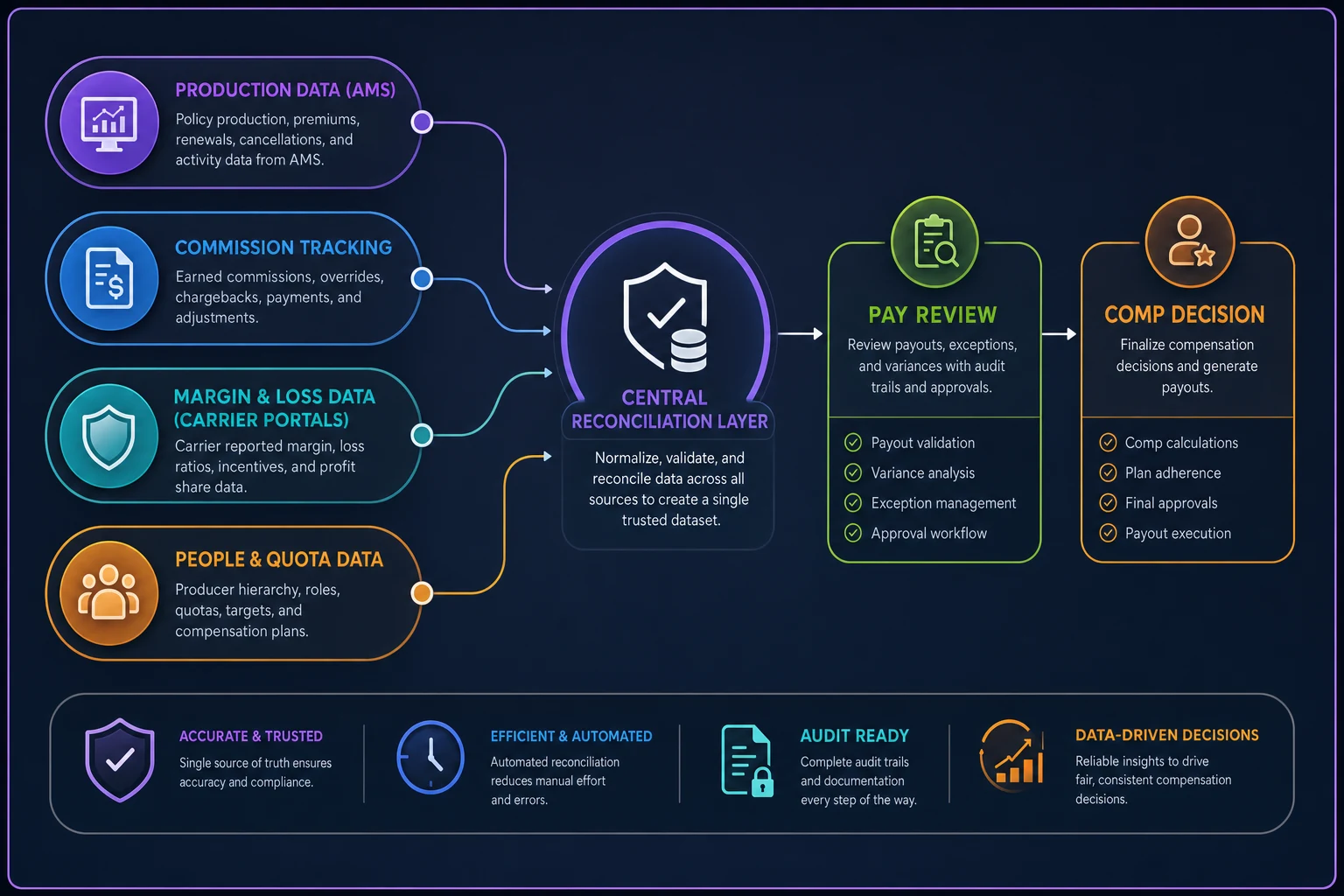
Whether that's a purpose-built operational platform or a tightly disciplined set of connected reports matters less than the principle — the three systems have to share a single source of truth, or governance stays theoretical. Modern operational software helps here mostly by killing the manual reconciliation and keeping the data current, so you're actually governing instead of stitching.
A real scenario: the six-producer agency that was leaking margin
A mixed personal and commercial agency, six producers, somewhere around $1.1M in revenue. Comp plan looked fine on paper — standard new-business and renewal percentages, nothing exotic.
The problems were all governance. Splits were handled case by case, so roughly one afternoon per pay cycle went to arguments. Quotas hadn't been reset in about three years. And nobody had ever lined up producer pay against book-level margin.
When they finally built the per-producer margin-to-comp report, two things jumped out. Their top premium producer was writing a lot of low-margin personal lines with a rough loss ratio — comp was running close to 40% of the actual contribution that book threw off. Meanwhile a quieter commercial producer was sitting around 20%, under-quota'd, and getting zero recognition because the quota was still built for a rookie three years earlier.
The fixes were structural, not dramatic. Written split defaults with a logged exception process. A quota reset tied to margin-weighted production. A semi-annual pay review that pulled from the same margin data as the financials. Nothing about the base commission percentages changed.
Within a couple of cycles, the pay-cycle argument time dropped to near zero because the rules answered most questions before they became disputes. The margin picture shifted as quotas started steering production toward the commercial book instead of low-margin auto. The owner's estimate on recovered margin over the year landed somewhere in the mid five figures — not from paying people less, but from paying people in proportion to what they actually contributed and steering new production toward profitable business.
When this level of governance makes sense — and when it doesn't
When it's worth it: You've got five or more producers, any form of book transfers or shared accounts, or you've noticed comp disputes landing on your desk more than occasionally. If you can't quickly answer "which producer's book is actually most profitable after loss and servicing," you need this now.
When it's overkill: Two or three producers, no splits, no inherited books, and you can genuinely hold it all in your head without distorting anything. Don't build a dispute protocol for disputes that never happen. Governance should match your complexity.
Who should wait: If your underlying P&L data is a mess — you don't have reliable loss ratios or servicing-cost estimates by book — fix that first. Comp governance built on bad margin data just automates bad decisions. Get the profitability view clean, then layer governance on top.
The real point
Producer compensation governance for an insurance agency isn't about finding the magic commission percentage. It's about building the decision-making system around comp so that the right things happen automatically — quotas adjust, credit gets assigned fairly, disputes resolve by rule instead of by whoever's most persistent, and pay tracks the margin each producer actually generates.
Get that system right and comp stops being a quarterly fire drill and starts being a lever you can actually pull. Get it wrong, and you'll keep paying your most profitable producers like they're average while your average producers quietly negotiate their way into your margin. The difference between those two outcomes isn't the plan. It's the governance underneath it.
Get that system right and comp stops being a quarterly fire drill and starts being a lever you can actually pull. Get it wrong, and you'll keep paying your most profitable producers like they're average while your average producers quietly negotiate their way into your margin. The difference between those two outcomes isn't the plan. It's the governance underneath it.
Ready to transform your insurance agency operations?
Join 500+ agencies using Covixly to reduce manual work, improve client service, and grow their book of business.