



The moment you open a second location, you stop running an agency and start running a system of agencies. Most owners don't realize this fast enough. They treat the second branch like a bigger version of the first — same expectations, same people, same "we'll figure it out." And for a while, it works, because the founder is still close enough to catch the problems before they compound.
Then the third branch opens. Suddenly one office is quoting commercial auto differently than another. One CSR team closes service tickets in two days, another takes nine. Your producers in the north branch are on a slightly different comp structure because someone made a side deal three years ago. Renewals are handled inconsistently. And when you pull everything together at month-end, you can't actually compare branches because nobody's measuring the same thing the same way.
That's the real problem behind multi-branch agency governance: not that branches perform differently — they always will — but that you lose the ability to see why, and lose the authority to fix it once each office has built its own habits. This article covers the operating structure that keeps that from happening — the governance model, the KPI rollups that let you compare apples to apples, and a realistic six-month path to get there without blowing up your existing offices.
The two governance models you're actually choosing between
Almost every multi-branch agency ends up somewhere on a spectrum between two models. You don't need to pick a textbook version, but you do need to be honest about which direction you're leaning — because half-committing to both is where the chaos lives.
Centralized means the core operational functions live in one place. Underwriting support, service processing, accounting, commission reconciliation, marketing, compliance — these run out of a central team, and branches are essentially sales-and-relationship front ends. Producers sell and manage client relationships; the back office is shared.
Hub-and-spoke keeps each branch mostly self-contained for day-to-day operations but ties them to a central hub for standards, reporting, and shared services that don't make sense to duplicate. Each spoke has its own service staff and runs its own book, but they follow the hub's playbooks and roll their numbers up to the same dashboard.
The distinction that actually matters in practice: centralized optimizes for consistency and cost, hub-and-spoke optimizes for local ownership and speed. Neither is inherently better. What breaks agencies is defaulting to hub-and-spoke — because it's easier, you just let each office keep doing its thing — while expecting centralized-level consistency and reporting.
| Factor | Centralized | Hub-and-spoke |
|---|---|---|
| Service processing | One shared team | Per-branch teams, shared standards |
| Consistency of client experience | High | Medium (depends on enforcement) |
| Speed of local decisions | Slower | Faster |
| Cost efficiency at scale | Better | Higher (duplicated roles) |
| Best branch count | 4+ tightly clustered | 2–6 geographically spread |
| Biggest failure risk | Bottleneck at the center | Drift between branches |
| Onboarding a new branch | Fast (plug into center) | Slower (rebuild local team) |
One pattern worth noting: agencies that grew through acquisition almost always start hub-and-spoke whether they meant to or not, because each acquired office comes with its own staff, systems, and habits. Agencies that grew by opening new offices tend to start centralized because the founder never bothered to duplicate the back office. Knowing how you got here tells you which model you're fighting against.
When centralization actually makes sense
Centralize when your branches are close enough — geographically or by line of business — that a shared service team can handle everyone without losing context. It works well when you have high volume in similar policy types, because the central team gets fast and consistent. It's also the right call when compliance risk is high and you can't afford ten different interpretations of the same rule.
When hub-and-spoke is the smarter choice
Go hub-and-spoke when local relationships and market knowledge genuinely drive the business. A rural commercial branch and an urban personal lines branch don't operate the same way, and forcing them into one central process usually slows everyone down. It's also better when you're acquiring agencies and need to keep the existing team's momentum instead of ripping out their workflow on day one.
Who should NOT centralize
If your branches serve very different markets, or if your central team would immediately become a bottleneck — routing 400 service requests a week through three people — don't centralize processing yet. Centralize the standards and reporting first. Centralize the work later, once volume justifies dedicated central roles. Rushing this is how you end up with clients waiting a week for a certificate because everything now funnels through one overwhelmed hub.
Why branches drift apart (it's not a discipline problem)
The instinct is to blame people — "the east branch just doesn't follow the process." But branch drift is structural, and it happens for predictable reasons.
Eliminate paperwork bottlenecks and missed deadlines.
Covixly helps you track, manage, and close every policy and claim with confidence and speed.
- Unified policy & claims management
- Automated client notifications
- Agent task coordination
No credit card required
The first is that the original process lived in the founder's head, not in a document. When branch one was the whole company, nobody needed a written renewal protocol because the owner just handled the weird cases. Open a branch, hire a manager, and that manager invents their own version of the missing process. Multiply by three branches and you have three "correct" ways to do the same thing.
The second is compensation sprawl. Side deals, legacy splits, and "we'll match what they had at their old agency" hires create branches that literally can't be compared because the incentives underneath them differ. When your monthly commission numbers don't reconcile cleanly across branches, this is usually why.
The third — and this is the sneaky one — is inconsistent data entry. Two branches can follow the "same" process and still produce numbers you can't compare, because one team logs a renewal as complete when the quote goes out and the other logs it complete when the policy binds. Same word, different meaning, useless rollup. If you've read our breakdown of the operational blueprint for policy lifecycle management, you already know how much depends on everyone agreeing on what each stage actually means. Across branches, that agreement is the entire ballgame.
KPI alignment: measuring the same thing the same way
You can't govern what you can't compare. The most common mistake in multi-branch reporting isn't tracking the wrong metrics — it's tracking the right metrics with definitions that quietly differ by office.
Before you argue about which KPIs, nail down the boring part: shared definitions, shared measurement points, shared time windows. "Retention rate" means nothing at the group level unless every branch calculates it identically — same numerator, same denominator, same cut-off date.
A workable core set for branch rollups. Keep it small. Ten metrics you actually trust beats thirty you argue about every month.
-
Retention rate — policies retained vs. up for renewal, measured 30 days post-renewal date
-
New business written — bound premium, not quoted premium (this alone catches a lot of inflated numbers)
-
Service turnaround — time from ticket open to close, with a shared definition of "closed"
-
Quote-to-bind ratio — per producer and per branch
-
Loss ratio — where you have the data, for carrier relationship health
-
Errors & omissions near-misses — self-reported, and yes, branches will under-report; track the trend not the absolute
-
Commission reconciliation variance — how far off each branch's expected vs. received commissions run each month
The insight most owners miss: don't let each branch report its own numbers into a spreadsheet you assemble by hand. That's where definitions drift back apart, month after month, regardless of how many times you standardize the template. The numbers need to come out of the same system, calculated the same way, without a human interpreting them at the branch level. Our deeper walkthrough of metric selection and cadence lives in the agency owner's KPI dashboard guide — the group-level version is just that, applied consistently across every location.
Automate KPI calculations in your central system so branches can't apply their own definitions at month-end.
The rollup reporting template
Layer 1 — Branch scorecard (weekly). One page per branch. Current-week actuals against target for the core metrics. This is what the branch manager lives in.
Layer 2 — Comparative rollup (monthly). All branches side by side on the same metrics, same definitions, ranked. This is what surfaces drift. When branch C's service turnaround is 6 days and everyone else is at 2–3, you see it immediately instead of finding out during a client complaint.
Layer 3 — Trend + exception view (monthly/quarterly). Not the numbers themselves but the movement — which branches are improving, which are sliding, and which exceptions crossed a threshold that needs an owner conversation.
The trap is stopping at Layer 2. A comparative snapshot tells you who's behind this month; it doesn't tell you whether a branch is quietly declining over a quarter while still looking "fine" against target. Layer 3 is where governance actually happens.
A decision matrix for standardization: what to centralize vs. leave local
You will never standardize everything, and you shouldn't try. Some things genuinely need to differ by branch. The skill is knowing which. Score each process on two questions: Does inconsistency here create risk or cost? and Does local flexibility here create real value?
| Process area | Standardize | Leave local | Why |
|---|---|---|---|
| Compliance & E&O procedures | ✅ | Inconsistency is pure risk | |
| Renewal handling | ✅ | Directly hits retention numbers | |
| Data entry / stage definitions | ✅ | Without this, rollups are fiction | |
| Commission structure | ✅ (mostly) | Legacy deals should be grandfathered out, not perpetuated | |
| Client communication cadence | ✅ | Consistent experience across branches | |
| Local marketing & community outreach | ✅ | Local knowledge wins here | |
| Carrier relationships | ✅ (with visibility) | Often built on personal trust | |
| Staffing structure | Partial | Partial | Depends on branch volume |
The mistake to avoid: standardizing the visible stuff — logos, email signatures, office layout — while leaving the invisible stuff to local habit. How a renewal gets worked, how a claim gets logged — clients don't feel your logo consistency. They feel whether every office returns a certificate request in a day.
A realistic 6-month standardization roadmap
Standardizing across live branches is open-heart surgery on a running business. You can't pause client service while you fix the plumbing. So this rolls out in phases, and the early months are almost entirely about measurement and agreement, not enforcement. Trying to enforce before you've standardized definitions just generates resentment and gamed numbers.
-
Month 1 — Baseline and honesty. Document how each branch actually works right now, not how it's supposed to. Pull raw numbers even though they won't compare cleanly yet. The goal is a truthful map of the differences. Expect surprises — you'll almost certainly find at least one branch doing something completely undocumented that actually works better than your "standard."
-
Month 2 — Definitions and metric alignment. Lock down shared definitions for every core KPI and every lifecycle stage. This is unglamorous work, and it's the most important month. Get branch managers in a room and force agreement on what "closed," "bound," and "retained" actually mean. Nothing else works until this does.
-
Month 3 — Pick one process to standardize first. Renewals or service turnaround are good starting points because they're high-frequency and directly tied to retention. Roll one standardized process to all branches. One. Prove the model on something concrete before touching everything else.
-
Month 4 — Reporting rollup live. With definitions aligned and one process standardized, stand up the three-layer rollup. Now branch comparisons mean something. Run the first real comparative monthly review.
-
Month 5 — Governance rhythm. Establish the cadence
weekly branch scorecard reviews, monthly comparative review with all managers, quarterly trend review with ownership. Governance is a meeting rhythm as much as a document. Without a recurring forum, standardization decays back to local habit within a quarter.
-
Month 6 — Expand and grandfather. Roll standardization to the next two or three processes now that the model is proven. Begin sunsetting legacy comp deals and one-off exceptions — grandfather existing arrangements where you have to, but stop creating new ones. End the six months with a documented playbook that a new branch could plug into on day one.
A note on pacing: if this feels slow, good. Agencies that try to standardize five processes across four branches in a single quarter almost always trigger a service quality dip, because staff are relearning workflows while still carrying full caseloads. Slow and sticky beats fast and abandoned.
Visualizing the rollout can help keep stakeholders aligned.
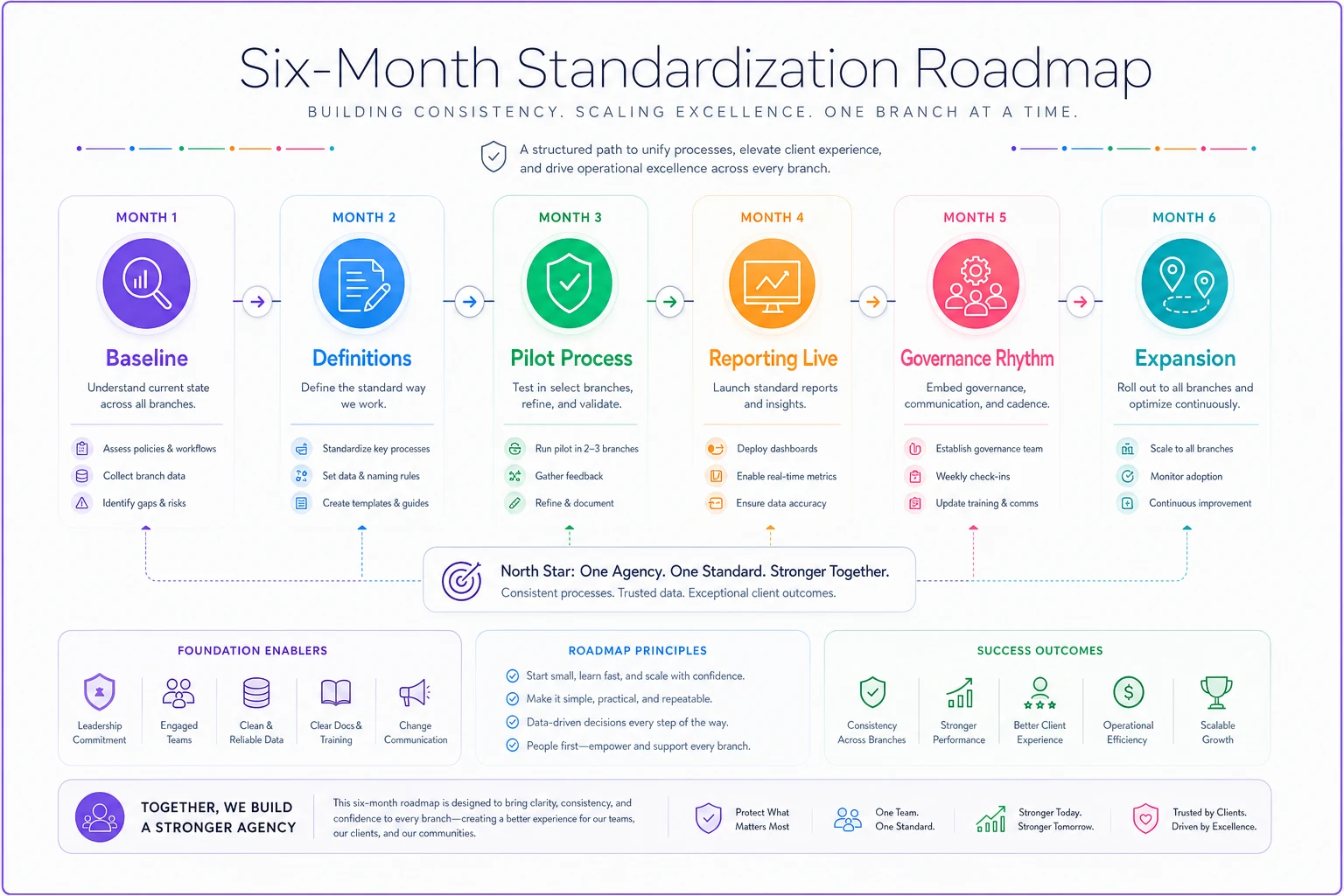
Keep the visualization simple: milestones, owners, and expected outcome for each month.
Where the tooling actually fits
Most of the failure in multi-branch governance isn't strategy — it's that the numbers are assembled by hand, branch by branch, in spreadsheets that drift out of alignment the moment the person who built them goes on vacation. When every branch types its own figures into a shared sheet, you're not really standardized; you're re-negotiating definitions every month without realizing it.
This is where an operational platform with AI-assisted reporting earns its place. Not as a magic fix, but as the thing that pulls the same metrics, calculated the same way, out of every branch's activity automatically — so a "closed ticket" in branch A is counted identically to a "closed ticket" in branch D without anyone interpreting it at the local level. When rollups generate from actual work logged in the system, the comparative view stops being an argument about whose spreadsheet is right.
AI automation also quietly catches the drift you'd otherwise miss — flagging when a branch's stage definitions or turnaround patterns start diverging from the group before it surfaces as a client complaint. The point isn't the technology itself; it's that consistent data entry and honest rollups are nearly impossible to sustain by hand across more than two or three locations.
A real scenario
A four-branch personal and commercial lines agency — grew by acquiring two smaller books, then opened two offices from scratch. On paper, group retention looked fine, hovering around the high 80s. But the owner couldn't explain why one branch always felt "behind," and month-end reconciliation took the better part of a week every single month.
The baseline audit found the actual problem: the two acquired branches counted retention at renewal offer, the two newer branches counted it at renewal bind. Same word, two definitions, and the group number was a blend of both — meaningless. Service turnaround ranged from roughly 2 days at the best branch to 8 or 9 at the worst, but nobody had ever seen the numbers side by side because each office reported into its own format.
After aligning definitions in month two and standardizing renewals in month three, the comparative rollup exposed that the "behind" branch wasn't actually worse at retention — it was slower on service, which was dragging renewals late and creating avoidable churn. Six months in, group service turnaround tightened to roughly 2–4 days across all four offices, month-end reconciliation dropped from about a week to a couple of days, and the numbers finally meant the same thing everywhere. Retention didn't magically jump; it just became something they could actually see, compare, and manage.
Pulling it together
Multi-branch governance isn't about control for its own sake, and it definitely isn't about forcing every office into an identical mold. It's about keeping the ability to see clearly and act consistently as you add locations — because that ability erodes silently, one undocumented workaround and one custom comp deal at a time.
Pick your model deliberately instead of defaulting into one. Align your definitions before you argue about targets. Build rollups that compare like with like. Standardize the invisible processes that clients actually feel, and leave the local knowledge that genuinely drives business alone. Do that over a realistic six months, hold the governance rhythm, and the third and fourth and fifth branches stop feeling like separate companies you're trying to hold together — and start feeling like one agency that happens to have several front doors.
Ready to transform your insurance agency operations?
Join 500+ agencies using Covixly to reduce manual work, improve client service, and grow their book of business.