


A field inspection should close a question, not open three new ones. But most agencies live with the opposite: an agent drives out to a commercial roof, snaps 18 photos on their phone, uploads whatever syncs, and two days later an underwriter sends a note asking for a wide shot of the north elevation, a close-up of the HVAC curb flashing, and a readable serial plate. Now you're scheduling a second visit, or worse, guessing.
Why sloppy field photos quietly stretch your underwriting and claims cycles
The cost of that back-and-forth doesn't show up on any single invoice. It hides inside cycle time. And the root cause is almost never the agent being lazy — there's just no agreed-on standard for what "done" looks like when someone is standing in a parking lot with a phone, bad lighting, and five minutes before their next stop.
This playbook is about fixing that one thing: making mobile intake tight enough that the first set of photos is the only set you need.
Start from the failure, not the ideal
The usual way agencies write photo guidelines is to describe the perfect inspection. Twelve angles, good light, clean framing. Nice in theory. Useless in the field.
Eliminate paperwork bottlenecks and missed deadlines.
Covixly helps you track, manage, and close every policy and claim with confidence and speed.
- Unified policy & claims management
- Automated client notifications
- Agent task coordination
No credit card required
A better approach is working backward from the follow-up requests underwriters actually send. Pull the last 50 or so "need more info" emails tied to inspections and you'll see the same gaps repeat:
-
No wide establishing shot, so nobody can place the close-ups in context
-
Serial or data plates photographed but unreadable — glare, angle, motion blur
-
Roof or systems shown but no indication of condition over time
-
No timestamp or location proof, so the photo could be from any property
-
Damage shown without scale — is that crack two inches or two feet?
Every one of those is preventable at the point of capture. Once you see the pattern, the minimum shot set almost writes itself. You're not building a photography course. You're building a checklist that kills your five most common follow-ups.
Minimum shot sets by inspection type
The core of this playbook is defining the minimum — not the maximum — required shots per inspection type. Agents should know they can always add more, but they cannot submit fewer. That one rule does most of the work.
Here's a baseline most agencies can adapt:
| Inspection type | Minimum required shots | Must-capture specifics |
|---|---|---|
| Habitational / dwelling | 8–10 | Front elevation, all 4 corners, roof overview, electrical panel, water heater, any visible damage |
| Commercial building | 12–16 | All elevations, roof surface + penetrations, HVAC units with data plates, main electrical, egress points |
| Auto (physical damage) | 6–8 | All 4 sides, VIN plate, odometer, damage close-up with scale, undamaged comparison panel |
| Commercial vehicle / fleet | 8–10 | Full exterior, DOT number, mileage, cargo area, prior damage, equipment/liftgate if present |
| Equipment / inland marine | 5–7 | Full unit, serial/data plate, model number, operating condition, attachments |
The numbers aren't magic. What matters is that each type has a floor, and that floor is tied to the questions underwriting and claims keep asking. An agency doing mostly small commercial might only need three well-defined sets. Don't overbuild this.
Lead with the wide establishing photo taken first — it gives every subsequent close-up context.
One thing worth flagging: the single most valuable shot in almost every inspection is the wide establishing photo taken first. It gives every subsequent close-up context. Agents who lead with close-ups create files nobody downstream can interpret without calling them directly.
The metadata rules that actually matter
Photos without reliable metadata are evidence you can't fully defend. EXIF data — the timestamp, GPS coordinates, and device info embedded in the image — is what turns "here's a photo of a roof" into "here's a photo of this roof, taken then, from there."
-
Location services must be on during capture. This is the one agents disable most often and the one underwriters care about most. A photo with no GPS is a photo that could be from any property.
-
Shoot inside the app or camera, not pulled from a gallery. Screenshots, forwarded images, and re-saved photos strip or alter EXIF. If it didn't come straight from the camera at the scene, treat it as unverified.
-
Don't edit before upload. Cropping and filters in some apps rewrite metadata and can nuke the timestamp. The original goes up untouched; annotation happens later in the file.
A quiet failure mode here: agents who text photos to the office. The moment an image passes through a messaging app, compression kicks in and EXIF usually gets stripped. That "helpful" text becomes a photo you can't prove anything with. The rule has to be explicit — inspection images never travel by text.
Naming conventions that survive the handoff
Naming is boring, and it's also where files go to die. IMG_4471.jpg tells nobody anything. By the time a photo reaches an underwriter or claims adjuster, it's usually passed through at least two hands, and the filename is often the only thing keeping it tied to the right policy and the right property.
A workable convention bundles the essentials into the name itself:
[PolicyOrClaim#][InspectionType][ShotLabel]_[Date]
So a commercial roof overview becomes something like CPP10432CommBldgRoofOverview_20240614.jpg. Readable, sorts cleanly, and anyone opening the folder knows what they're looking at without opening a single image.
The same logic that makes document filing sane applies here. It connects directly to the broader naming and taxonomy standards that keep claim files findable after the person who created them has moved on. Field photos aren't an exception to the taxonomy — they're part of it.
The mistake agencies make is letting naming happen "later, at the desk." It never happens later. It has to happen at upload or it doesn't happen at all.
Upload and validation: catch the gap before the agent drives away
The highest-leverage moment in this whole process is the thirty seconds before the agent leaves the site. That's the only time a missing shot is cheap to fix. Once they're back on the road, every gap becomes a phone call, a return trip, or a stalled file.
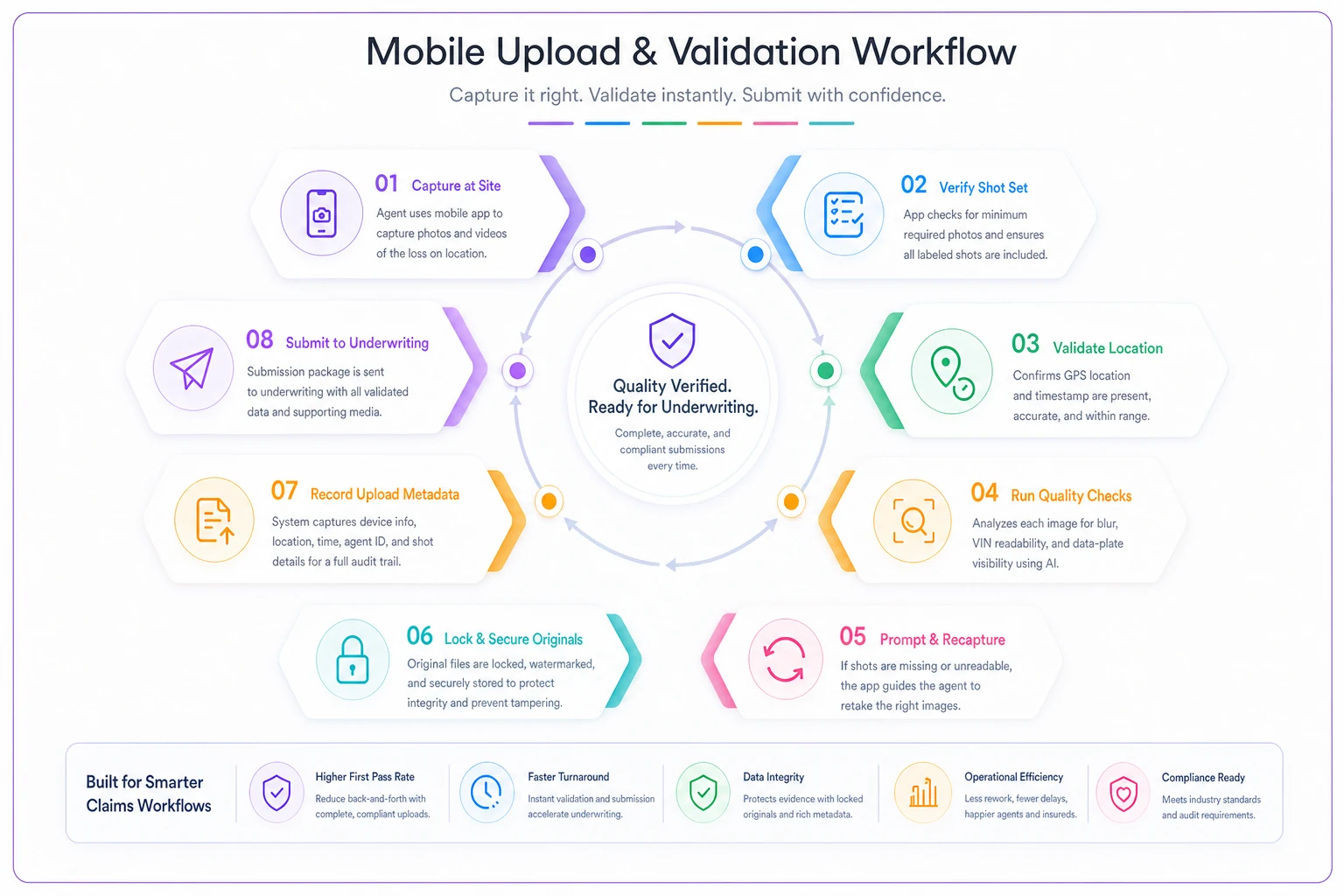
Validation has to run at the point of upload, while the agent is still standing there. A solid upload flow checks:
-
Did the minimum shot count get met for this inspection type?
-
Does each required labeled shot exist — not just "8 photos" but the 8 right photos?
-
Does each image carry GPS and a timestamp?
-
Is anything obviously unusable — black frame, extreme blur, duplicate?
This is where AI-assisted operational tools earn their place quietly. A mobile intake platform can flag a missing data-plate shot or a blurry VIN before submission, and some can read a serial number or confirm an image actually shows a roof versus a parking lot. The point isn't to replace the agent's judgment — it's to catch predictable gaps automatically so the agent isn't trying to remember all 14 requirements under time pressure. A simple prompt like "North elevation missing — capture before submitting" removes most follow-ups before they start.
What you want to avoid is validation that only runs back at the office. By then, the information advantage is gone.
Chain of custody, without the overhead
Chain of custody sounds like a legal burden, and for routine underwriting photos you don't need courtroom-grade rigor. But for claims — especially anything that might be disputed or subrogated — you need to answer three questions: who took it, when, and has it been altered since.
A lightweight flow looks like this:
-
Capture is logged with the agent's identity, device, timestamp, and location automatically.
-
Upload records the moment the image enters your system, creating a clear "nothing touched it in between" window.
-
Access and edits are tracked — if someone annotates or crops a working copy, the original stays locked and unchanged.
-
Export notes who pulled the file and when, so you know where evidence went.
The common weak point is step 3. Agencies let people overwrite originals with marked-up versions, and then there's no clean image to fall back on when a claim gets challenged. Keep the original immutable. Everything else is a copy.
This connects naturally to how the rest of your claim moves. If you've already built a claim lifecycle map to eliminate duplicate work, field photos are just another piece of evidence that needs a defined owner and a clear handoff at each stage. Clean intake feeds that map.
A real scenario
A mid-sized agency writing a lot of small commercial property was averaging close to three inspection-related follow-ups per file. Underwriters were kicking back roughly 40% of inspection submissions for missing elevations, unreadable HVAC plates, or photos with no location data. Each kickback added somewhere around two to four days to the quote cycle, and a handful required a second site visit at the agent's cost.
They didn't overhaul anything dramatic. They defined three minimum shot sets — dwelling, small commercial building, equipment — required location services on, locked in the naming convention at upload, and added a pre-submission check so agents couldn't leave a site missing a required angle.
Within about two months, kickback rates dropped to somewhere in the 12–15% range. Second site visits became rare. Underwriters stopped treating field photos as a coin flip, and quote turnaround on inspected risks tightened by a few days on average. Nothing exotic — just a floor on quality enforced at the one moment it was cheap to enforce.
When this level of rigor makes sense — and when it doesn't
Worth building when you run meaningful inspection volume, carry commercial or higher-value risks, or when inspection follow-ups are a known bottleneck in your quote and claims cycles. If photos regularly trigger return trips, the payback is fast.
Overkill when you're doing a handful of simple personal-lines inspections a month and your carriers aren't particular. Writing a 16-shot protocol for a business that does four inspections a quarter is ceremony. Define two or three shot sets and move on.
Who should not run this as-is: agencies whose carriers already dictate a strict inspection photo spec. In that case, your job isn't to invent a standard — it's to map your intake exactly to the carrier's requirements so nothing gets rejected on a technicality. Build around their checklist, not a generic one.
The one habit that holds it together
Most of this playbook lives or dies on a single behavior: validating completeness while the agent is still on site. Minimum shot sets, metadata rules, naming, chain of custody — all of it only pays off if gaps get caught at capture instead of at the underwriter's desk.
Follow-ups aren't a sign your agents are careless. They're a sign nobody told them precisely what "complete" means and nobody checked before they drove away. Fix those two things and the rest of the cycle speeds up on its own. Everything downstream gets easier when the raw inputs are right the first time — including a cleaner client self-service portal experience when clients want to view their own documentation.
Most of this playbook lives or dies on a single behavior: validating completeness while the agent is still on site. Minimum shot sets, metadata rules, naming, chain of custody — all of it only pays off if gaps get caught at capture instead of at the underwriter's desk.
Ready to transform your insurance agency operations?
Join 500+ agencies using Covixly to reduce manual work, improve client service, and grow their book of business.