


Most insurance agencies discover their claim lifecycle problems during audits—after months of duplicate work have already frustrated clients and burned out staff. The real operational waste happens in those gray zones between stages where nobody's quite sure who owns what.
I spent last month mapping claim workflows across twelve different agencies (personal lines, small commercial, mixed books) and the pattern was consistent: agencies without clear stage definitions averaged 2.3x more touches per claim than those with mapped lifecycles. Not because their people worked harder—because they worked on the same tasks repeatedly without realizing it.
The worst case I documented involved a simple auto glass claim that got touched by four different people across six days. The adjuster reviewed it, passed it to a CSR who re-reviewed it, went back to the adjuster for clarification, then to another CSR for processing. Each person basically did the same verification work because nobody knew where the previous person left off.
Why claim handoffs create duplicate effort (and how to spot it happening)
Watch your team handle claims for about two hours and you'll see the duplication patterns. Someone pulls up a claim file, spends ten minutes figuring out what's already been done, then redoes half of it "just to be safe." Meanwhile, another team member is waiting for that same file, planning to verify the exact same information.
The operational breakdown usually starts with vague stage names. When your system shows a claim as "In Review" for three days, nobody knows if that means initial triage, coverage verification, estimate review, or final approval. So everyone treats it like it might be at any stage.
Morning: Adjuster opens a property damage claim marked "pending." Calls the insured to verify details. Updates notes. Moves to next claim.
Afternoon: CSR sees same claim still marked "pending" (adjuster forgot to update status). Calls insured again to verify details. Insured is confused, slightly annoyed. CSR discovers adjuster's notes buried in the file.
Next day: Different adjuster covering for sick colleague sees claim marked "pending review." Can't tell from notes if verification is complete. Calls insured for the third time. Insured now actively frustrated, considering switching agencies.
This isn't a people problem or a training issue. It's a lifecycle definition problem. Without clear stages and ownership rules, even experienced teams duplicate effort.
Building stage definitions that actually prevent rework
Forget generic stages like "Open," "Pending," and "Closed." Those tell you nothing about what work has been completed or what comes next. Effective claim lifecycle mapping for insurance agencies requires stages that describe completed actions, not current states.
Eliminate paperwork bottlenecks and missed deadlines.
Covixly helps you track, manage, and close every policy and claim with confidence and speed.
- Unified policy & claims management
- Automated client notifications
- Agent task coordination
No credit card required
Instead of "In Review," use:
-
Initial Contact Complete
-
Coverage Verified
-
Estimate Requested
-
Settlement Approved
Each stage name should answer three questions:
-
What specific work just finished?
-
Who completed it?
-
What needs to happen next?
Working stage definitions that eliminate most duplicate effort look like this:
| Stage | Definition | Owner | Completed Actions | Next Actions | Max Time |
|---|---|---|---|---|---|
| FNOL Captured | First notice recorded, basic info collected | CSR | Policy verified, claim number assigned, initial details logged | Assign to adjuster for triage | 2 hours |
| Triage Complete | Severity assessed, coverage confirmed | Adjuster | Coverage review done, complexity rated, reserves set | Schedule inspection or fast-track | 4 hours |
| Documentation Gathered | All required docs received | Adjuster/CSR | Photos uploaded, estimates received, reports filed | Begin settlement review | 48 hours |
| Settlement Calculated | Payment amount determined | Adjuster | Calculations complete, deductibles applied, limits checked | Approval routing based on amount | 24 hours |
| Payment Authorized | Settlement approved per authority | Manager/Adjuster | Approval documented, payment initiated | Process payment, notify insured | 4 hours |
Each stage describes something that's finished, not something in progress. This removes ambiguity about whether work is complete.
Ownership rules that eliminate the "whose job is this?" delays
The most expensive delays in claim processing happen when multiple people could theoretically handle something, so nobody does. Clear ownership rules remove this friction.
Don't assign ownership by job title alone. Assign by capability and availability. The framework that works:
Primary Owner: The role that must complete this stage unless explicitly unavailable Backup Owner: Who takes over if primary is out (sick, vacation, overloaded) Escalation Owner: Who gets pulled in after time threshold exceeded
-
Glass claims under $500 - Primary: Any available CSR - Backup: Junior adjuster - Escalation: Senior CSR (after 4 hours)
-
Property claims $500-$5,000 - Primary: Assigned adjuster - Backup: Adjuster pool (round-robin) - Escalation: Claims manager (after 24 hours)
-
Complex commercial claims over $25,000 - Primary: Senior adjuster only - Backup: Claims manager - Escalation: Agency principal (after 48 hours)
Make ownership automatic based on claim characteristics, not requiring someone to manually assign every claim. Manual assignment creates bottlenecks—waiting for a manager to assign claims that could auto-route based on simple rules.
Template notes that standardize handoffs (so nothing gets missed or repeated)
Even with clear stages and ownership, handoffs fail without standardized notes. Adjusters write novels that nobody reads and CSRs write three words that explain nothing. Neither approach works.
Build template notes for each stage transition. Not forms to fill out—actual sentence templates that ensure critical information gets communicated consistently.
FNOL to Triage handoff template:
"Insured [name] reported [peril type] occurring [date/time] at [location]. Initial estimate: [amount or unknown]. Insured requests [contact preference]. Special circumstances: [time sensitivity/injuries/temporary repairs needed]. Photos: [received/pending]."
Actual example filled out:
"Insured Maria Chen reported wind damage occurring 11/3 2pm at primary residence 1847 Oak St. Initial estimate: unknown but visible roof damage. Insured requests text updates only. Special circumstances: tarp installed, rain expected Thursday. Photos: 6 received in email."
Documentation to Settlement handoff template:
"All docs received [date]. Estimate from [source] shows [amount]. Coverage applies: [yes/no/partial] because [reason]. Deductible: [amount]. Prior claims: [relevant history]. Recommend settlement: [amount] based on [reasoning]."
These templates do three things:
-
Force completion of critical information
-
Create scannable format for next person
-
Prevent "I thought someone else handled that" scenarios
Even with clear stages and ownership, handoffs fail without standardized notes. Adjusters write novels that nobody reads and CSRs write three words that explain nothing. Neither approach works.
The hidden bottlenecks in multi-adjuster claims
Complex claims involving multiple adjusters create special duplication risks. Property claim with auto damage. Liability claim with medical components. Commercial claim with business interruption. Each adjuster might handle their piece perfectly while the overall claim stalls.
Last month I tracked a commercial property claim where three adjusters each waited for "the other parts" to be finished before proceeding. The claim sat for eight days with nobody actively working it, even though each component could have progressed independently.
The fix: designate a "claim coordinator" role (not necessarily a person—could rotate based on primary damage type) who owns the overall timeline even when specialists handle components.
-
Property damage leads when building is primary loss
-
Auto damage leads when vehicles are primary loss
-
Liability adjuster leads when injury is involved
-
Highest dollar component leads when unclear
The coordinator doesn't do all the work—they ensure all the work happens and nobody's waiting unnecessarily.
Measuring handoff efficiency (without complex tracking systems)
You don't need expensive analytics to spot handoff problems. Track three simple metrics weekly:
Touch count: How many different people interact with a claim before settlement?
-
Good
2-3 for simple claims, 4-5 for complex
-
Problem
6+ for simple, 10+ for complex
Rework flags: How often do notes mention re-verifying, re-confirming, or double-checking previous work?
-
Good
Less than 10% of claims
-
Problem
Over 25% of claims
Handoff time: How long do claims sit between stage transitions?
-
Good
Under 2 hours for simple, under 8 hours for complex
-
Problem
Over 8 hours for simple, over 24 hours for complex
Pull ten random closed claims each week. Count touches, search notes for rework keywords, calculate wait times between stages. Takes about 20 minutes and reveals patterns immediately.
Pull ten random closed claims each week to count touches and reveal patterns quickly.
Pull ten random closed claims each week. Count touches, search notes for rework keywords, calculate wait times between stages. Takes about 20 minutes and reveals patterns immediately.
When to break your own rules (and how to document exceptions)
Rigid processes break during unusual situations. Hurricane claims. Total losses. Fraud investigations. Your lifecycle map needs exception protocols that maintain clarity even when normal rules don't apply.
Document exceptions as temporary stage modifications, not process abandonment:
Storm surge scenario: Normal stages still apply but with adjusted timelines and bulk processing rules. Add prefix to stage names: "STORM: Documentation Gathered" tells everyone this follows modified protocols.
Suspicious claim scenario: Insert investigation stage between existing stages without disrupting the lifecycle. "Triage Complete → INVESTIGATION PENDING → Documentation Gathered" preserves the flow while flagging special handling.
Executive escalation scenario: Parallel track that shadows normal stages: claim progresses normally while executive reviews separately. Prevents the entire claim from stalling during review.
Don't abandon your lifecycle mapping during busy or unusual periods. That's exactly when clear stages and ownership matter most.
Software automation impact on lifecycle efficiency
Most agencies try to solve handoff problems with more training or better communication. But when your team processes 50+ claims daily, manual coordination breaks down regardless of training quality.
AI-powered operational software changes this equation. Instead of relying on people to remember stage definitions and update statuses, automated workflows handle the mechanical parts while your team focuses on actual claim work.
A properly configured claim lifecycle automation:
-
Auto-advances stages based on completed actions
-
Routes claims to correct owners instantly
-
Generates template notes from system data
-
Flags stalled claims before they become problems
-
Prevents duplicate work by showing who did what when
The operational difference is dramatic. Agencies running manual lifecycle tracking average 6-8 touches per claim. Those using AI-assisted operational platforms average 3-4 touches for identical claim types. That's not because the software is smart—it's because the software enforces consistency that humans can't maintain at scale.
Example from an agency that automated their lifecycle mapping: their windshield claims went from 4.2 average touches to 1.8 touches. Same team, same claim types. The difference? Software that automatically moved claims through stages based on actions taken, not manual status updates everyone forgot to do.
Building your agency's claim lifecycle map this week
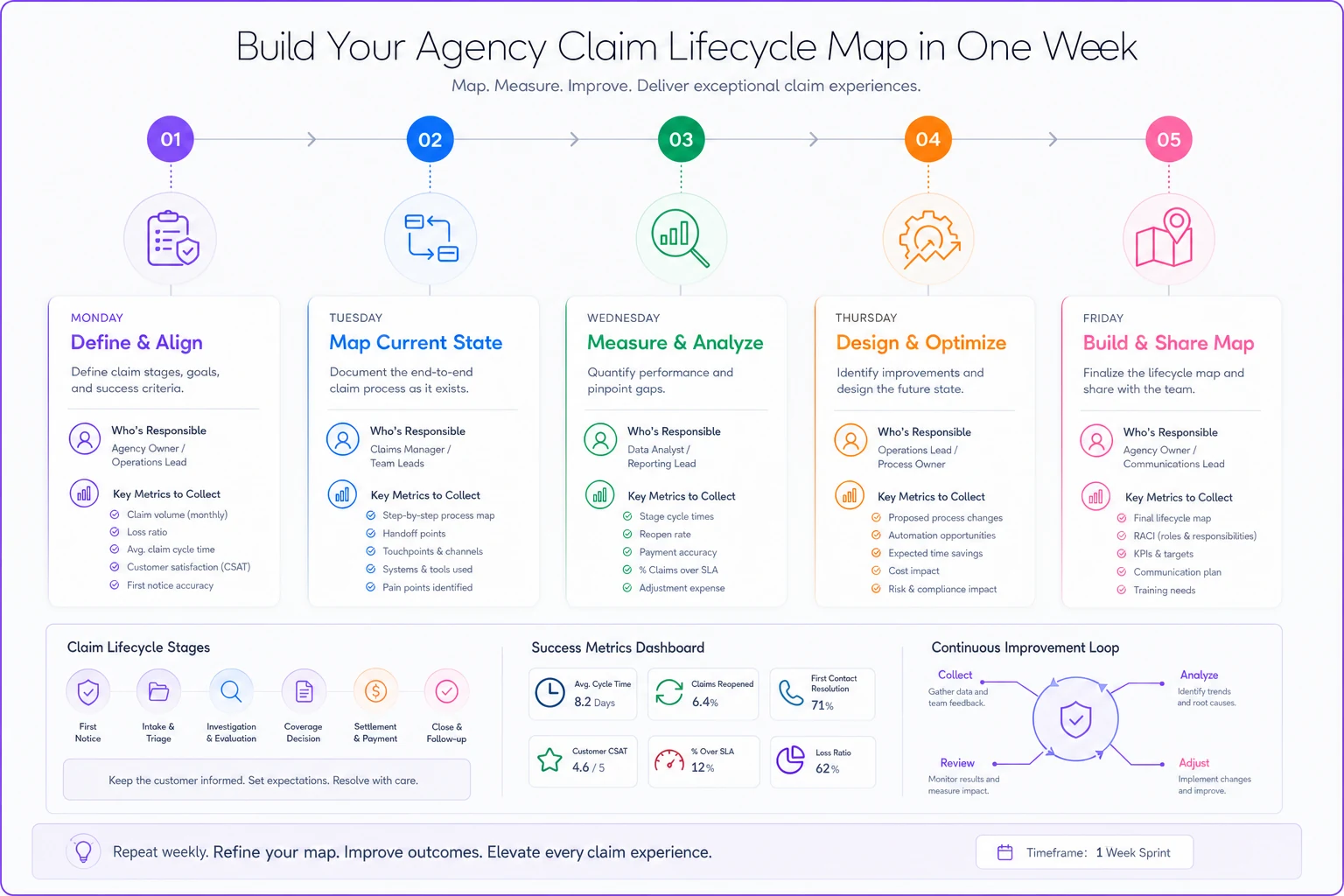
Start with your five most common claim types. Don't try to map everything at once—you'll create an unusable mess. Pick the claims that consume 80% of your team's time.
-
Monday Document current state
-
Tuesday-Wednesday Define stages and ownership
-
Thursday Test with real claims
-
Friday Adjust and implement
-
Monday
Track 10 claims through your existing process
-
Monday
Note every handoff, delay, and duplication
-
Monday
Mark where people get confused about ownership
-
Tuesday-Wednesday
Create 5-7 stages per claim type
-
Tuesday-Wednesday
Assign primary/backup/escalation owners
-
Tuesday-Wednesday
Write template notes for each handoff
-
Thursday
Run 5 claims through new lifecycle map
-
Thursday
Time each stage transition
-
Thursday
Note where reality doesn't match the map
-
Friday
Fix the obvious breaks from testing
-
Friday
Train team on new stages
-
Friday
Start measuring touch counts
Here's a simple visual workflow for the week-long mapping process.
Within two weeks, you'll see duplicate work decrease. Within a month, claim cycle times drop by 20-30% just from eliminating confusion about who owns what when.
The agencies that handle claims most efficiently don't have better adjusters or fancier systems. They have clear lifecycle maps that eliminate the gray zones where duplicate work hides. When everyone knows exactly what "Documentation Gathered" means and who owns it, claims move through your agency without the constant back-and-forth that frustrates clients and exhausts staff. Your claim lifecycle map becomes the operational backbone that lets good adjusters do great work without stepping on each other or missing handoffs.
The agencies that handle claims most efficiently don't have better adjusters or fancier systems. They have clear lifecycle maps that eliminate the gray zones where duplicate work hides. When everyone knows exactly what "Documentation Gathered" means and who owns it, claims move through your agency without the constant back-and-forth that frustrates clients and exhausts staff. Your claim lifecycle map becomes the operational backbone that lets good adjusters do great work without stepping on each other or missing handoffs.
Ready to transform your insurance agency operations?
Join 500+ agencies using Covixly to reduce manual work, improve client service, and grow their book of business.