
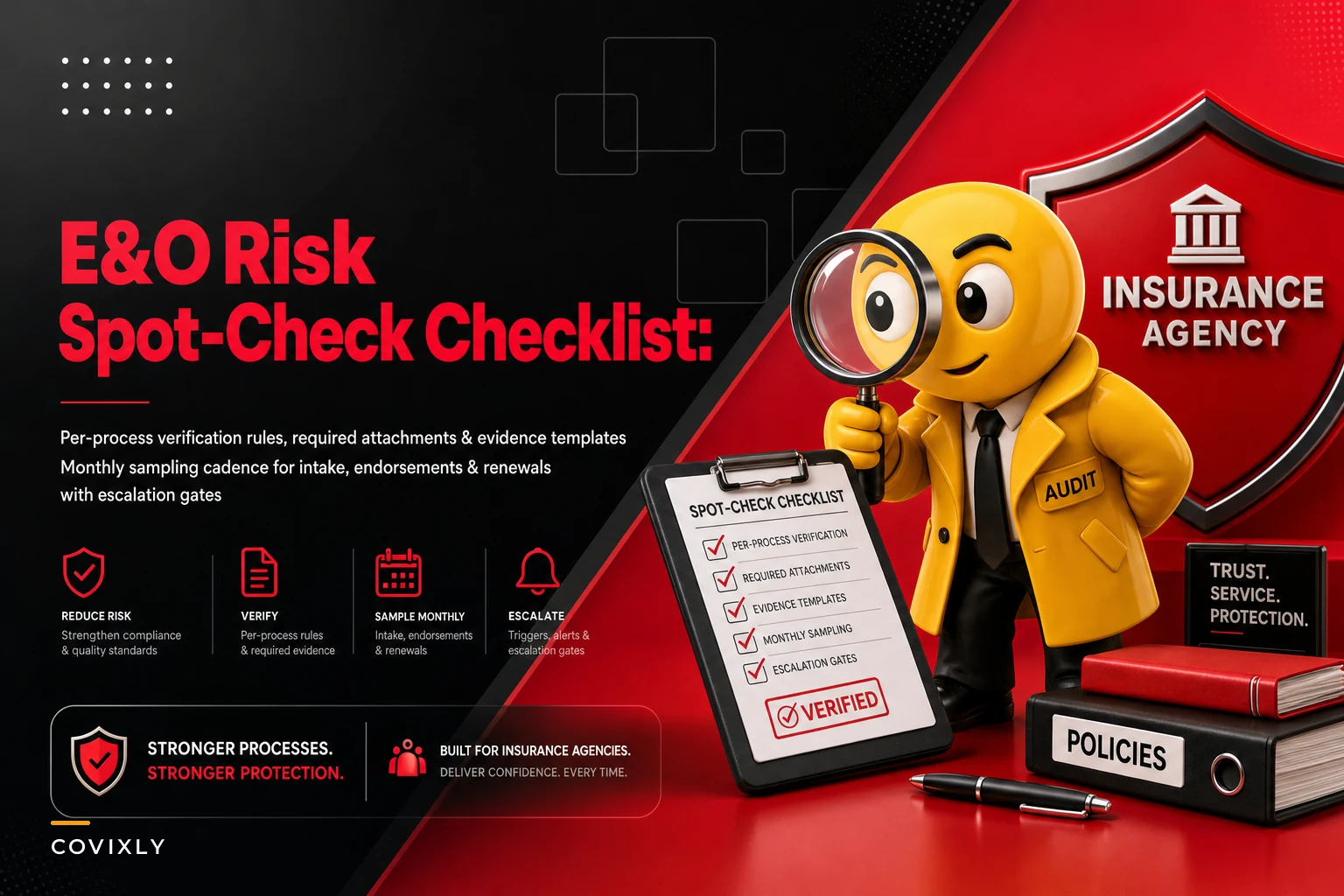

Most E&O claims don't come from exotic coverage disputes. They come from boring, repeatable process gaps — a missing attachment, an endorsement request that never got confirmed in writing, a renewal that quietly dropped a coverage the client assumed they still had. The frustrating part is that almost every one of these is detectable before it becomes a claim, if you know exactly where to look and how often to look there.
This isn't a lecture on why E&O matters. If you own or run an agency, you already know. What follows is a working checklist you can hand to your CSRs and producers — organized by process, not by theory — with the verification evidence, sampling logic, and spot-check cadence that actually catches problems at intake, endorsements, and renewals.
Why these three processes carry most of your exposure
Intake, endorsements, and renewals share a dangerous trait: they all involve a change in what the client believes they have versus what the policy actually says. That gap is where E&O lives.
-
Intake creates the first written record of client intent. If a producer under-documents a declined coverage or an uninsured exposure, there's nothing to point to later.
-
Endorsements are high-volume, low-ceremony changes. A CSR fields a quick call, makes the change, and moves on. The problem is that "I requested it" and "the carrier processed it correctly" are two different events, and the gap between them is rarely verified.
-
Renewals are where silent erosion happens. Limits drift, a carrier changes a form, an exclusion gets added, and nobody flags it because the renewal "looked normal."
The checklist below treats each process separately because the failure modes are different. A single generic QA review won't catch all three.
The core principle: evidence, not memory
The single biggest shift that reduces E&O exposure is moving from "we did it" to "here's the proof we did it." When a claim gets filed eighteen months later, the only thing that protects you is a timestamped record showing what was requested, what was confirmed, and what the client was told.
Eliminate paperwork bottlenecks and missed deadlines.
Covixly helps you track, manage, and close every policy and claim with confidence and speed.
- Unified policy & claims management
- Automated client notifications
- Agent task coordination
No credit card required
-
The request (what the client or producer asked for)
-
The confirmation (what the carrier actually did)
-
The client notice (what the client was told, in writing)
If any of the three is missing, the task isn't done — it's just unfinished in a way that looks finished.
Process 1: Intake
Intake is where you set the documentation floor for the entire relationship. The most common E&O trigger here isn't a wrong quote — it's a coverage the client wanted or needed that never got documented as offered, declined, or unavailable.
Required attachments at intake
-
Signed application (matching what was submitted to the carrier, not a draft)
-
Coverage selection / rejection form (UM/UIM, flood, cyber, EPLI where relevant)
-
Any "declined coverage" acknowledgment, signed or email-confirmed
-
Proof of prior coverage or loss runs where applicable
-
Written summary of what was quoted vs. what was bound
Verification steps
-
Confirm the bound policy matches the application on limits, deductibles, named insureds, and listed locations/vehicles — not just premium.
-
Confirm every coverage the producer discussed is either on the policy or has a documented decline.
-
Confirm the client received a written recap within the agency's SLA window.
The step people skip most is #2. A producer mentions flood coverage on a call, the client says "let me think about it," and that conversation disappears. Six months later there's a flood, and now it's your word against theirs. A one-line email — "As discussed, you've chosen not to add flood coverage at this time" — ends that entire category of claim.
Process 2: Endorsements
Endorsements are deceptively dangerous because they feel small. The classic failure: a client calls to add a vehicle or increase a limit, the CSR submits the request, and nobody confirms the carrier actually processed it. The client assumes they're covered. The policy says otherwise.
Required attachments per endorsement
-
The original request (email, portal message, or call log with timestamp and details)
-
The submission confirmation from the carrier or portal
-
The issued endorsement document showing the change took effect
-
Client notice confirming the change and the effective date
Verification steps
-
Match the issued endorsement to the original request — field by field, not "it looks right."
-
Confirm the effective date on the endorsement matches what the client expected. Effective-date mismatches are one of the quietest E&O triggers there is.
-
Confirm no other coverage changed as a side effect (some carrier systems re-rate or adjust related fields).
-
Confirm client received written confirmation.
Treat "submitted" as incomplete until you have the issued endorsement and client notice.
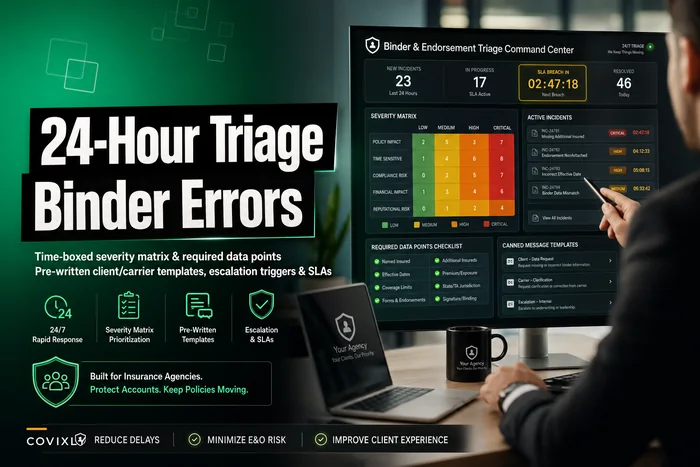
If you only build one verification habit, make it endorsement confirmation. For agencies dealing with a backlog of unconfirmed changes, the 24-hour binder and endorsement error triage approach pairs well with this — triage the open items first, then install the ongoing checklist so the backlog doesn't rebuild.
Process 3: Renewals
Renewals are where E&O exposure accumulates slowly. The trigger is almost always a change the client wasn't told about — a reduced limit, an added exclusion, a carrier form revision, or a coverage that silently dropped off.
Required attachments at renewal
-
Prior-term policy for comparison
-
Renewal policy or renewal offer
-
Documented comparison of material differences (limits, deductibles, forms, exclusions)
-
Client notice flagging any material changes
-
Documentation of any coverage the client declined to renew or add
Verification steps
-
Run a term-over-term diff on limits, deductibles, covered locations/units, and major forms.
-
Flag any new exclusion or reduced limit, and confirm the client was notified in writing.
-
Confirm carrier form edition dates — a changed form edition can alter coverage without any premium signal.
-
Confirm the renewal didn't silently drop an optional coverage the client carried last term.
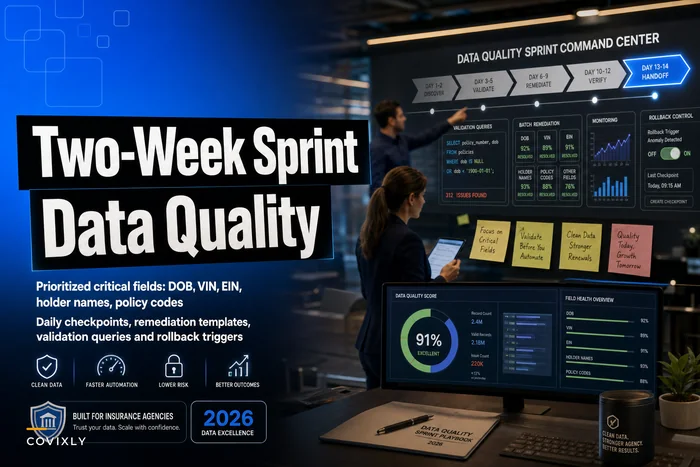
That last one is easy to miss. Optional coverages sometimes don't roll over automatically, and a renewal that "looks clean" can be missing something the client has carried for years. Clean data makes this diff far more reliable — if your limit and coverage fields are inconsistent across terms, a two-week data-quality sprint before you start systematic renewal comparisons will save you from chasing phantom discrepancies.
Mapping it together: triggers, evidence, and where to check
These three processes cover the vast majority of where real claims originate. Putting the triggers, evidence requirements, and verification checkpoints side by side makes it easier to train staff and audit consistently — rather than relying on tribal knowledge about what "done" means for each transaction type.
| Process | Common E&O trigger | Required evidence | Primary verification check |
|---|---|---|---|
| Intake | Undocumented declined coverage | Coverage selection/rejection form, written recap | Every discussed coverage is on policy or documented as declined |
| Intake | Policy doesn't match application | Signed app + bound policy | Field-level match on limits, deductibles, named insureds |
| Endorsement | Requested change never processed | Request + issued endorsement + client notice | Issued endorsement matches request, correct effective date |
| Endorsement | Effective-date mismatch | Timestamped request, issued endorsement | Effective date equals client expectation |
| Renewal | Silent limit/coverage reduction | Prior-term policy, renewal, diff record | Term-over-term diff with written client notice on changes |
| Renewal | Carrier form edition change | Renewal policy, form edition dates | Confirm edition dates and coverage impact |
Keep this table visible to the team. When someone's unsure what "done" means for a given task, the required-evidence column answers it.
Sampling rules: you can't check everything, so check the right things
Full review of every transaction isn't realistic for most agencies, and it isn't necessary. The point of sampling is to catch systemic problems — a producer who consistently skips decline documentation, or a CSR who never confirms endorsements — before they generate multiple claims.
-
Intake Review 100% of new commercial accounts above a premium threshold (agencies often set this around $10k), and a random 10–15% sample of everything else.
-
Endorsements Sample roughly 1 in 10 per CSR per month, but review 100% of coverage-reducing or limit-changing endorsements regardless of volume.
-
Renewals Review 100% of renewals where the carrier changed, premium moved more than ~15%, or a form edition changed. Random-sample 10% of the rest.
The logic: weight your sampling toward high-consequence and high-change transactions, not just high volume. A $500 endorsement that reduces a liability limit is riskier than fifty routine address changes.
Monthly spot-check cadence
The cadence matters as much as the checklist. Spot-checks that happen "when there's time" happen never. Here's a workable monthly rhythm:
-
Week 1 — Endorsement spot-check. Pull the prior month's endorsement sample. Verify request-to-issued matching and client notices.
-
Week 2 — Renewal spot-check. Review the flagged high-change renewals and the random sample. Focus on term-over-term diffs.
-
Week 3 — Intake spot-check. Review new-account documentation, especially declined-coverage evidence.
-
Week 4 — Pattern review. Not a transaction review — a trend review. Which gaps repeated? Which person or process keeps surfacing? Assign fixes.
Week 4 is the one agencies skip and the one that actually reduces exposure. Individual misses are noise. Repeated misses by the same person or process are the signal that predicts your next claim.
Here's a simple workflow visualization of the monthly cadence.
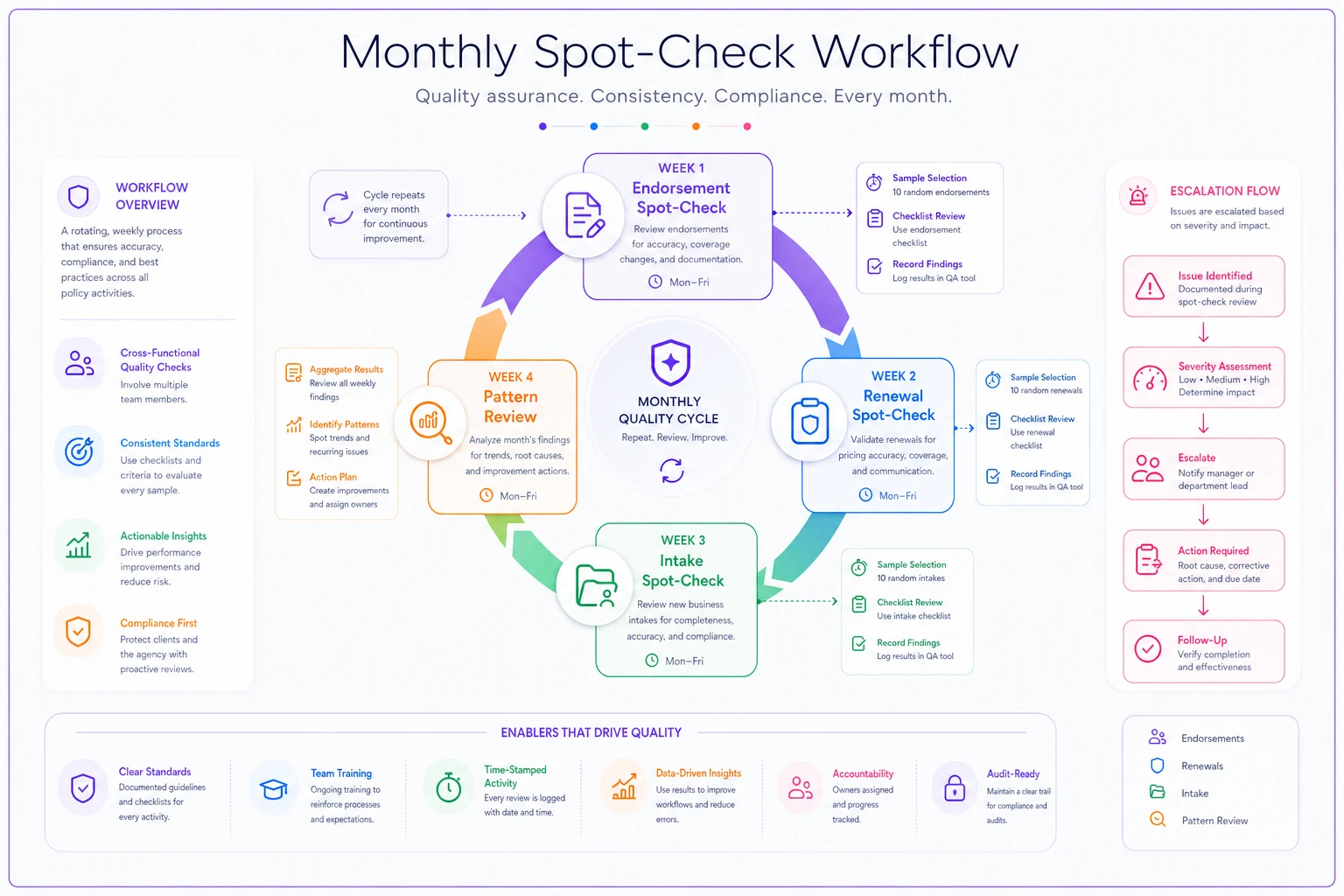
Visualize the cycle and make Week 4 non-optional.
Audit queries to run against your management system
If your agency management system lets you query or export data, these pull the highest-risk items without manual hunting:
-
Endorsements submitted but with no issued-endorsement document attached within X days
-
Policies where bound limits differ from application limits (where both are captured)
-
Renewals processed with no client-contact log entry in the renewal window
-
Accounts with no signed coverage selection/rejection form on file
-
Endorsements where effective date precedes the request date by more than a day (a reliable mismatch indicator)
-
Policies with a changed carrier form edition term-over-term
Run these monthly, before your spot-check weeks, so your sample is informed by actual data rather than random pulls. This is also where workflow software earns its keep quietly — a system that flags "endorsement requested, no confirmation on file after 72 hours" turns a manual audit into a standing exception report. The value isn't the automation itself; it's that the gap surfaces while it's still fixable instead of surfacing during a claim.
Template: Verification evidence record
Keep this attached to each reviewed transaction:
``
TRANSACTION TYPE: [Intake / Endorsement / Renewal]
ACCOUNT:    POLICY #:
REVIEWED BY:    DATE:

REQUEST CAPTURED?        [ ] Yes  [ ] No   Source:
CARRIER CONFIRMATION?    [ ] Yes  [ ] No   Doc ref:
CLIENT NOTICE SENT?      [ ] Yes  [ ] No   Date:
FIELD-LEVEL MATCH?       [ ] Yes  [ ] No   Exceptions:
EFFECTIVE DATE VERIFIED? [ ] Yes  [ ] No
DECLINED COVERAGE DOC?   [ ] Yes  [ ] N/A

GAPS FOUND:
ACTION TAKEN:
FOLLOW-UP NEEDED?        [ ] Yes  [ ] No   Owner:
``
Template: Monthly spot-check report
``
MONTH:    PREPARED BY:

VOLUME REVIEWED
  Intake sampled:         of
  Endorsements sampled:   of
  Renewals sampled:       of

GAPS BY TYPE
  Missing client notice:        __
  Request/issued mismatch:      _
  Missing declined-coverage doc:_
  Effective-date mismatch:      _
  Silent renewal change:        _

REPEAT OFFENDERS (person or process):


ACTIONS ASSIGNED:


OPEN ITEMS FROM LAST MONTH:
  _
``
The spot-check report is deliberately short. A two-page report gets ignored; a half-page report with repeat-offender tracking actually gets read and acted on.
A real scenario
A mid-sized commercial lines agency — around 2,100 active policies, four CSRs, three producers — kept getting surprised by the same kind of E&O near-miss: endorsement requests that clients swore they made but that never showed as processed. No formal claim yet, but two close calls and a lot of nervous phone calls.
They installed the endorsement portion of this checklist first: a required-evidence rule (request + issued endorsement + client notice) and a weekly spot-check on a 1-in-10 sample plus 100% of limit-changing endorsements. In the first month, the spot-check surfaced roughly a dozen endorsements submitted but never confirmed as issued — including two coverage increases the clients assumed were active.
None had become claims yet, which was the whole point. Within a couple of months, the unconfirmed-endorsement count dropped to near zero, mostly because CSRs stopped treating "submitted" as "done." The agency didn't add headcount. They added a definition of done and a cadence to enforce it.
When this level of rigor makes sense — and when it's overkill
This full per-process checklist is worth it when you have multiple CSRs and producers, meaningful commercial volume, or a history of near-misses. The moment more than one person touches a policy, the "I remember doing it" defense disappears, and evidence becomes your only protection.
Probably overkill for a solo agent writing low-complexity personal lines with a tight book — though even then, the endorsement confirmation habit and the declined-coverage email are cheap insurance worth adopting.
Who should not half-implement this: agencies that build the checklist but skip the Week 4 pattern review. Catching individual misses feels productive, but the claims that actually hurt you come from repeated process failures. If you only have bandwidth for one discipline, make it the monthly pattern review — it's the part that turns a checklist into actual risk reduction.
Closing thought
E&O exposure isn't reduced by trying harder or being more careful. Careful people still forget to confirm an endorsement at 4:45 on a Friday. It's reduced by defining exactly what "done" means for each process, requiring evidence that proves it, sampling the high-consequence transactions, and checking on a fixed monthly cadence — then watching for the repeat patterns that predict your next problem.
Start with endorsements, since that's where the fastest wins usually hide. Add renewals next, then intake. Once the evidence standard is in place, the checklist mostly runs itself — and your biggest E&O risks stop being invisible until it's too late.
Ready to transform your insurance agency operations?
Join 500+ agencies using Covixly to reduce manual work, improve client service, and grow their book of business.