

An endorsement typed with the wrong effective date. A binder that shows the wrong additional insured. A liability limit that dropped from $2M to $1M because someone copied the prior term's numbers. These aren't rare events — they're a normal byproduct of high-volume processing, and most of them are fixable if you catch them fast.
The problem isn't that errors happen. It's that agencies have no clock on them. An endorsement error found Tuesday afternoon might not get corrected until Friday because nobody decided how urgent it was, who owned it, or what "fixed" actually means. That gap — between discovery and correction — is where the real damage lives.
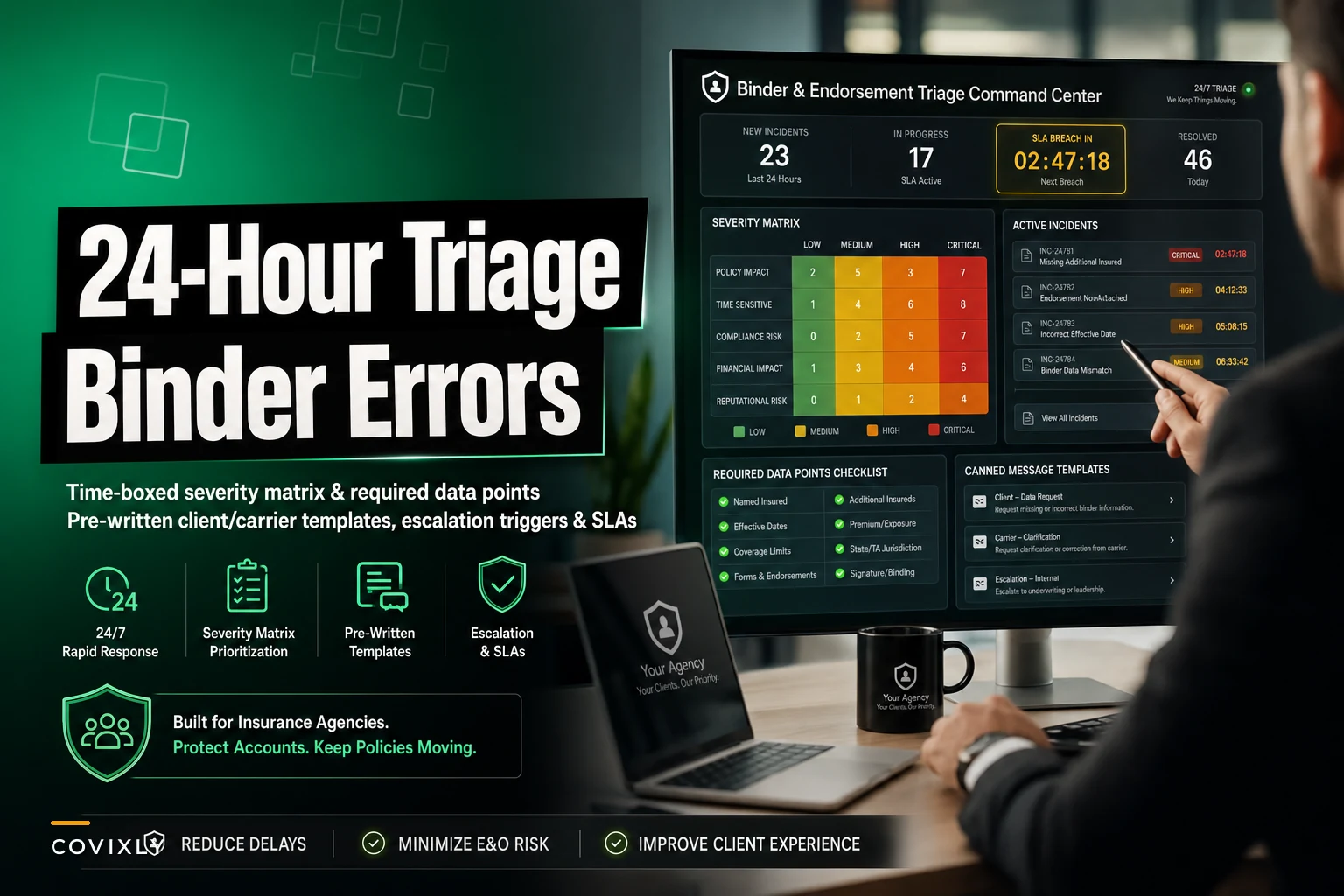
This is a triage system built to close that gap in 24 hours. Not a full quality-control overhaul. A fast, repeatable way to sort errors by severity, gather the exact data you need, and stabilize coverage within a single business day.
Why binder and endorsement errors turn into disasters
Most endorsement errors are small at the moment they're made. The danger is time.
A binder that overstates coverage sits quietly until there's a claim. Then the carrier denies the portion that was never actually bound, and the insured comes back to you holding a document you issued. An endorsement with a wrong effective date creates a coverage gap nobody notices until a loss lands inside that window. A dropped additional insured means a general contractor's certificate is technically wrong for weeks — and you find out when their project owner audits COIs.
In real operations, this usually comes down to three things:
-
No severity sorting. Every error gets treated the same, so a genuinely dangerous one waits in the same queue as a typo on a mailing address.
-
Missing data at discovery. The person who finds the error doesn't have the carrier confirmation number, the original binder, or the policy number handy, so the fix stalls while someone hunts for context.
-
Unclear ownership. The CSR who spots it assumes the account manager will handle it. The account manager assumes it's already reported to the carrier. Nobody owns the clock.
The actual correction usually takes about 20 minutes. The delay is everything that happens before someone sits down to fix it.
The 24-hour triage matrix
The core of the system is sorting by severity the moment an error is discovered — not by who found it or how loud the client is. Severity here means one thing: how exposed is the agency and the insured right now?
Eliminate paperwork bottlenecks and missed deadlines.
Covixly helps you track, manage, and close every policy and claim with confidence and speed.
- Unified policy & claims management
- Automated client notifications
- Agent task coordination
No credit card required
| Severity | Definition | Example | Target stabilization | Owner |
|---|---|---|---|---|
| S1 – Coverage-critical | Error creates a real coverage gap or overstates bound coverage | Binder shows $2M when carrier bound $1M; wrong effective date creating an open window | 2 hours | Account manager + producer |
| S2 – Compliance/contractual | Error breaks a contractual or regulatory requirement but no active gap | Wrong additional insured on a required COI; missing waiver of subrogation | 8 hours | Account manager |
| S3 – Documentation | Error is on issued paper but doesn't affect coverage | Misspelled named insured, wrong mailing address on endorsement | 24 hours | CSR |
| S4 – Cosmetic | No coverage, compliance, or contractual impact | Formatting, agent-of-record display, typo in a description field | Next business day | CSR |
The distinction that matters most is S1 versus everything else. S1 errors are the ones where the document currently in a client's or carrier's hands says something false about coverage. Those don't wait in a queue. They interrupt whatever the owner is doing.
One pattern worth flagging: agencies consistently under-classify errors that overstate coverage. If a binder accidentally shows broader coverage than what was bound, the instinct is "the client's happy, no rush." That's the most dangerous error type you can have — because if a claim hits before you correct it, you've got a document promising coverage that doesn't exist. Overstatements are always S1.
Required data points before anyone starts fixing
Half the delay in error correction comes from missing information. The person fixing it opens the file, realizes they don't have the carrier's binding confirmation, messages someone, waits, gets pulled onto something else, and the clock keeps running.
The fix is a discovery packet — a fixed set of data points that must be attached the moment an error is logged. No packet, no triage. This forces whoever found the error to gather context while it's fresh, instead of dropping a vague "the binder's wrong" note into a queue.
-
Policy number and carrier
-
The specific document in error (binder, endorsement number, COI) attached, not described
-
The correct value vs. the incorrect value — spelled out plainly ("bound limit $1M, binder shows $2M")
-
The source of truth — carrier confirmation, application, signed proposal, or underwriter email proving what the correct value should be
-
Who currently holds the wrong document — client only, certificate holder, mortgagee, carrier, or all of the above
-
Effective date and whether any loss window is open
Attach the carrier confirmation when you log the packet — it usually determines severity faster than anything else.
Those last two are the ones people skip, and they're the ones that decide severity. Knowing who holds the wrong document tells you how many corrected copies need to go out. Knowing whether a loss window is open is the difference between S1 and S3.
The stabilization workflow
Stabilizing an error in 24 hours doesn't mean the file is perfect and closed. It means the exposure is neutralized: the correct coverage is confirmed with the carrier, and everyone holding a wrong document either has the corrected version or written notice that a correction is coming.
-
Log and packet (0–15 min). Whoever finds it attaches the discovery packet. If they can't complete the packet, they escalate to the owner rather than sitting on it.
-
Classify severity (within 15 min). Assign S1–S4 using the matrix. When in doubt between two tiers, take the higher one.
-
Confirm the truth with the carrier (S1/S2 first). Get written confirmation of what's actually bound. This is the anchor for everything downstream — nothing gets corrected until you have the real answer in writing.
-
Issue the correction. Corrected binder, revised endorsement, or reissued COI. Match the correction to what's wrong; don't reissue the whole policy for a mailing-address fix.
-
Notify every holder of the wrong document. Client, certificate holders, mortgagee, carrier — anyone on your "who holds it" list gets the corrected copy or a hold notice.
-
Confirm receipt and close. For S1 and S2, you need confirmation the corrected document was received, not just sent.
Here's a quick visual of the sequence teams should follow to stabilize exposure within a day.
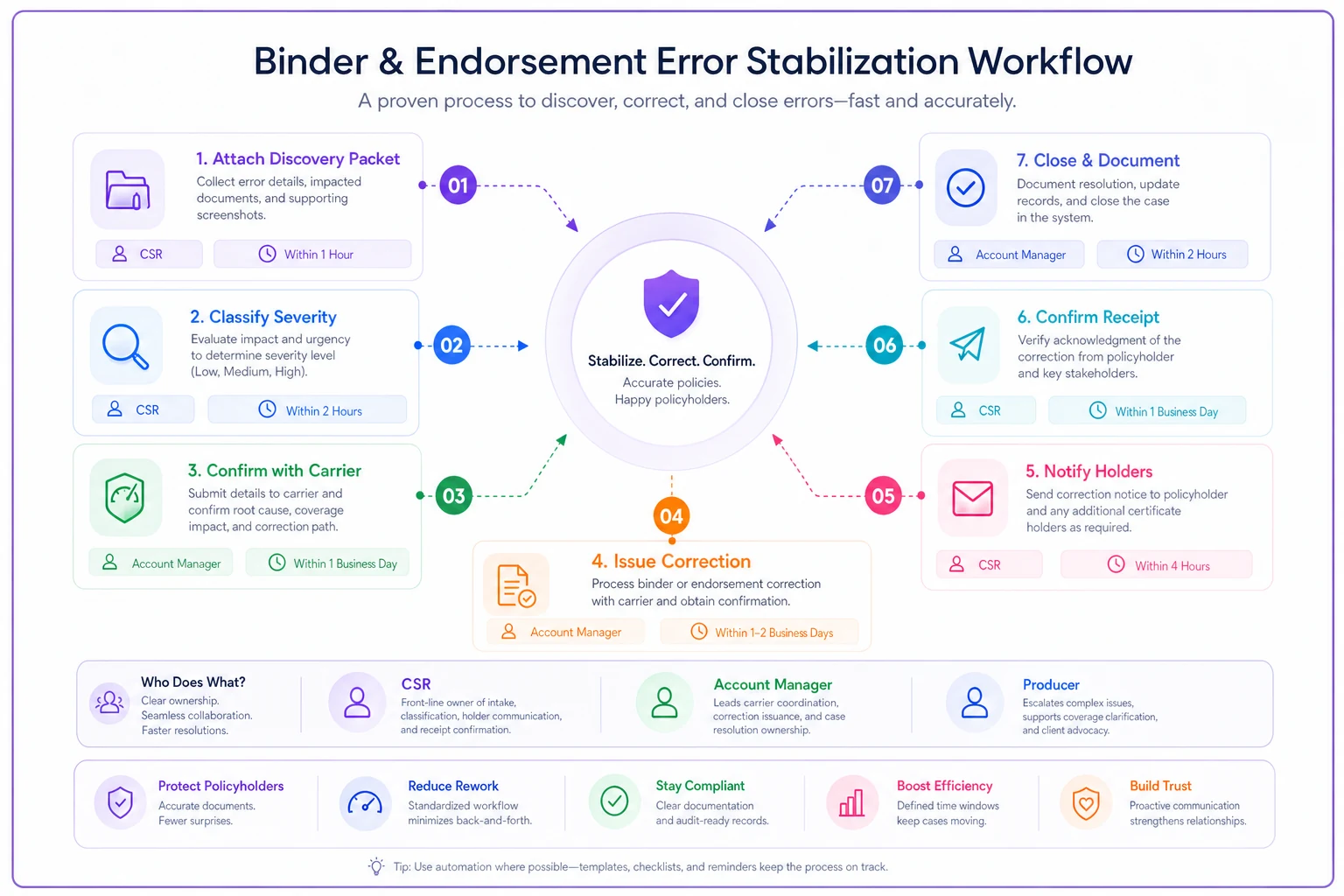
The step agencies most often skip is #5. They correct the file, fix the carrier record, and consider it done — but a wrong COI is still sitting in a general contractor's compliance folder. The correction isn't stabilized until the wrong paper is out of circulation.
This ties directly into how clean handoffs prevent issuance errors in the first place. If your corrections keep tracing back to term changes made during transfers, the renewal transfer protocol is worth building alongside this triage system — one prevents, one contains.
Pre-written templates so nobody drafts under pressure
Corrections stall at the communication step because people don't want to write the message. Telling a client their binder was wrong is uncomfortable, so it gets pushed to "when I have time to word it right." Meanwhile the wrong document is still live.
Write the templates before you ever need them. Three is enough:
Client correction notice (S1/S2). Direct, no over-apology, states the correct coverage and confirms it's now accurate. Something like: "We identified and corrected an error on your recently issued [document]. The correct [limit/effective date/insured] is [X], confirmed with [carrier] on [date]. An updated copy is attached; please replace any prior version. Your coverage is [in force / accurate] as of [date]."
Certificate-holder / third-party notice. For when a wrong COI reached a certificate holder. Neutral and factual — the holder cares about accuracy, not your internal process.
Carrier correction request. Structured to give the underwriter exactly what they need: policy number, the specific correction, the source proving the correct value, and the requested effective date.
A template written calmly in advance always reads better than one drafted by a stressed account manager at 4:45pm. The wording is cleaner, it doesn't over-admit fault, and it doesn't produce a paper trail that looks like panic.
Escalation triggers and SLAs
A 24-hour clock only works if someone's watching it. The escalation rules exist so an S1 error can't quietly sit unowned while everyone assumes someone else has it.
Trigger a manager escalation when:
-
An S1 error isn't packet-complete and carrier-confirmed within 1 hour of discovery
-
Any error's source of truth is unclear — you can't prove what the correct value should be
-
The carrier disputes what your file says was bound
-
The person who found it can't identify who currently holds the wrong document
-
An S2 hasn't been stabilized within its 8-hour window
The "source of truth is unclear" trigger is the most important one. That's the situation that quietly becomes an E&O problem — where the file doesn't clearly prove what was supposed to be bound, so you can't tell whether the error is in the binder or in the underlying request. Those need a manager's eyes immediately, because the fix might involve reconstructing intent from emails and proposals rather than making a clean correction.
For agencies that don't have documented response-time commitments per role, this triage sits naturally on top of a broader SLA framework for agents, CSRs and underwriters. The triage tells you what the deadlines are for errors; the SLA framework tells you who's accountable when they're missed.
Where centralized tracking quietly helps
Most of this system runs on discipline, not software. But one piece tends to break down without the right setup: visibility across everyone holding a wrong document.
When a COI has gone to a client, three certificate holders, and a mortgagee, tracking who's been reissued a corrected copy — across email threads — is exactly where corrections fall through. This is where AI-assisted operational platforms earn their keep: logging each error with its packet, flagging severity based on the fields entered, and keeping a live list of who still holds an uncorrected document until every recipient confirms receipt. The correction doesn't get marked closed until that list is clear.
That's a narrow, practical use — not a reinvention of your workflow. The value is simply that nothing gets marked "fixed" while a wrong document is still sitting in someone's file.
A real scenario
A small commercial agency writing mostly contractor accounts issued a binder showing a $2M general aggregate. The carrier had actually bound $1M — the producer had pulled numbers from the expiring term without confirming the new quote. The error sat for about nine days before a CSR caught it during a COI request.
Under their old process, this would've bounced between the producer and account manager for a few days while everyone figured out what was actually bound and who needed a corrected copy. In that window, the wrong binder had already gone to the insured and two project owners.
With the triage system, it went differently. Classified S1 immediately — overstated coverage. Packet attached within about 15 minutes, including the original quote as source of truth. Carrier confirmed $1M in writing within the hour. Corrected binder issued, and the "who holds it" list flagged the two project owners, who both got corrected copies the same afternoon. Stabilized in roughly three hours instead of three days.
No claim hit that window. But if one had, the difference between a three-hour and a nine-day exposure is the difference between a clean correction and an E&O conversation.
When this system is worth building
If your agency issues more than a handful of endorsements and binders a week, the triage matrix pays for itself the first time it catches an overstated limit before a claim. Volume is what makes errors inevitable and speed valuable.
It's less necessary for very small books where one person touches every document and already knows every account. In that setup, the informal version — fix it the second you see it — genuinely works, because there's no handoff gap for errors to fall into.
Where it becomes essential is the middle: multiple CSRs and producers, shared accounts, high COI volume, enough throughput that no single person has full context on every file. That's where errors get discovered by someone who didn't create them and doesn't have the background to fix them fast — and where a 24-hour clock, a data packet, and clear ownership turn a lurking E&O risk into a routine correction closed before lunch.
The whole point is boring by design: catch it, sort it, prove the truth, correct it, and make sure the wrong paper is out of everyone's hands — all inside one business day, every time, without anyone having to decide from scratch how urgent it is.
Ready to transform your insurance agency operations?
Join 500+ agencies using Covixly to reduce manual work, improve client service, and grow their book of business.