


Most agencies discover their renewal transfer protocol insurance agency problems after a client calls angry about lapsed coverage. The handoff already failed. The commission vanished. The E&O exposure just materialized.
The worst part? Every agent thinks they're doing handoffs correctly until they trace back through a botched renewal and find seven missing data points, three unverified carrier requirements, and zero documented communication between the departing and receiving agent.
I spent three months analyzing renewal transfer failures across 42 agencies. The pattern was depressingly consistent: agencies with "informal" handoff processes averaged 8.3 issuance errors per quarter. Agencies running structured protocols averaged 1.2. That gap represents roughly $47,000 in annual E&O claim exposure for a typical 12-person agency.
Why renewal transfers turn into issuance nightmares
Renewal transfers fail because agencies treat them like simple file transfers instead of complex operational handoffs. When Agent A leaves and Agent B takes over their book, everyone assumes the policy data speaks for itself.
It doesn't.
When Agent A manages 340 accounts and announces departure with two weeks notice, agencies scramble. They divide the book among three remaining agents. Each receiving agent gets a spreadsheet with policy numbers, client names, and renewal dates. That spreadsheet becomes the entire handoff protocol.
Meanwhile, Agent A carries around dozens of undocumented client preferences, carrier quirks, and renewal complexities in their head. They know Mrs. Chen always wants earthquake coverage quoted separately. They remember that Hartford requires special wording on the Johnson Manufacturing umbrella. They recall that the Peterson account has a pending claim affecting renewal terms.
None of this transfers through a spreadsheet.
The receiving agents discover these gaps incrementally, usually after mistakes happen. By the time they've learned the book's complexities, they've already processed 15-20 renewals with potential errors.
The data points everyone forgets to transfer
After watching dozens of handoff failures, I mapped the critical data that rarely makes it from departing to receiving agents. These aren't the obvious fields in your management system. They're the operational details that prevent issuance errors.
Eliminate paperwork bottlenecks and missed deadlines.
Covixly helps you track, manage, and close every policy and claim with confidence and speed.
- Unified policy & claims management
- Automated client notifications
- Agent task coordination
No credit card required
Carrier-specific renewal requirements
Each carrier has different renewal protocols. Progressive might auto-renew with simple confirmation. Travelers might require updated SOVs 60 days out. State Farm might need signed rejection forms for coverage changes. Your management system probably doesn't track these carrier-by-carrier requirements. The departing agent just knows them.
During one agency handoff I observed, the receiving agent didn't know AmGuard required wet signatures on all commercial renewals over $50k in premium. Seven policies renewed with e-signatures. All seven got cancelled for non-compliance. The agency had to rewrite everything mid-term at worse rates.
Client communication preferences
Some clients want renewal discussions three months early. Others specifically request no contact unless something changes. A few demand in-person meetings for any renewal over $10k. These preferences shape the entire renewal timeline, but they rarely appear in client files.
The most expensive mistake I've documented: a receiving agent called a client who'd specifically requested email-only communication due to a sensitive workplace situation. That client moved their entire commercial book—about $85k in premium—to another agency.
Pending issues affecting renewals
Open claims, premium audits, inspection requirements, ongoing coverage disputes—these all impact renewals but often exist outside the core policy data. The departing agent tracks them mentally or in personal notes. The receiving agent discovers them when underwriting kicks back the renewal.
Historical context for coverage decisions
Why does this manufacturer carry $5M in product liability when similar accounts carry $2M? Because three years ago they had a near-miss claim that spooked them. Why does this contractor refuse to add additional insured endorsements? Because they got burned in a lawsuit five years back.
This context determines whether renewal changes get accepted or trigger shopping. Without it, receiving agents make logical recommendations that clients interpret as ignorance of their situation.
Building validation rules that catch errors before issuance
Raw data transfer isn't enough. You need validation rules that flag potential errors before policies issue.
Pre-transfer validation checklist
-
All renewal dates in next 90 days identified and flagged
-
Carrier renewal requirements documented per account
-
Open items (claims, audits, inspections) listed with status
-
Client communication preferences explicitly noted
-
Coverage anomalies explained with historical context
-
Payment methods and timing preferences confirmed
-
Additional insured schedules reviewed for completeness
-
State-specific forms and endorsements verified current
This checklist seems basic until you realize most agencies transfer books without checking any of these points. They assume the receiving agent will figure it out. That assumption creates errors.
Automated validation triggers
-
If renewal date < 60 days AND no documented carrier requirements → Flag for immediate review
-
If premium > $25k AND no client meeting scheduled → Flag for outreach
-
If coverage limits differ >20% from similar accounts → Require explanation before processing
-
If payment method = agency bill AND no credit approval on file → Block renewal until verified
These rules catch the errors humans miss when juggling multiple transfers. One agency implemented five basic validation rules and cut issuance errors by 67% in the first quarter.
The three-touch confirmation protocol
Every renewal in a transferred book should go through three confirmation points:
-
Initial transfer review - Receiving agent confirms all data points received and flags gaps
-
Pre-renewal verification - 45 days before renewal, validate all carrier requirements met
-
Post-issuance audit - After renewal processes, audit for discrepancies against prior term
Most agencies skip straight from transfer to renewal processing. That's where errors multiply. The three-touch protocol creates systematic catches for problems that would otherwise surface as client complaints or carrier cancellations.
A simple workflow visualization helps teams follow the three-touch confirmation protocol.
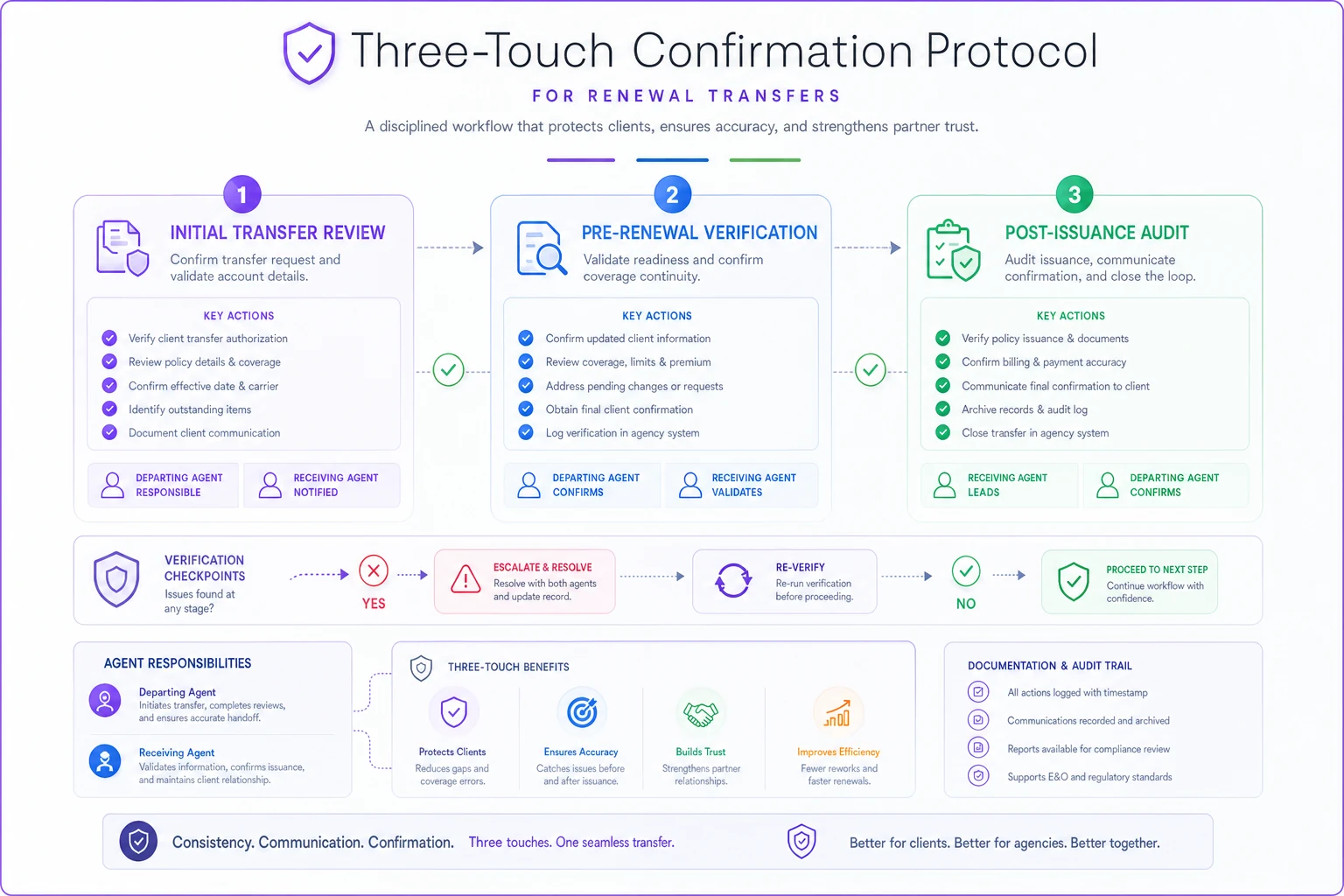
Use the workflow as a quick reference when training backup agents or auditing transfers.
Communication templates that prevent confusion
Generic emails create renewal errors. "Your policy is up for renewal" doesn't convey the specific actions needed. After analyzing hundreds of renewal communications, I've identified the templates that actually prevent mistakes.
The handoff introduction template
When Agent B takes over from Agent A, the introduction email sets expectations:
-
"I'm taking over your account from [Agent A] and wanted to confirm a few specifics about your renewal preferences:
-
Your [specific policy type] renewal date is [exact date]
-
Based on our records, you prefer [communication method] for renewal discussions
-
Last year, you specifically requested we [specific preference or requirement]
-
For this renewal, [carrier name] requires [specific requirement] by [specific date]
-
Please confirm these details are still accurate. If anything about your business or preferences has changed, let me know by [specific date] so we can adjust accordingly."
This template does three things generic emails miss: confirms specific data, sets clear deadlines, and shows you understand their particular situation.
The renewal requirements template
Thirty days before renewal, send requirements-specific communication:
-
"Your [policy type] renewal requires the following by [date]
-
Required from you
-
[Specific document/signature/information]
-
[Deadline for each item]
-
[Consequence if not received]
-
We're handling
-
[Specific tasks agency is completing]
-
[Timeline for completion]
-
If we don't receive [specific requirement] by [date], your carrier will [specific consequence]."
Notice how this eliminates ambiguity. No "please provide updated information." Instead, "please provide signed loss run consent by March 15 or Hartford will non-renew."
The escalation template
When requirements aren't met, escalation communication prevents lapses:
-
"We haven't received [specific item] for your [date] renewal.
-
Without this by [deadline], here's what happens
-
[Specific consequence]
-
[Impact on coverage]
-
[Impact on pricing]
-
To avoid this, either
-
1. Send [specific item] by [deadline]
-
2. Call me at [number] to discuss alternatives
-
3. Reply confirming you want to [specific alternative action]"
This template has prevented dozens of accidental non-renewals. It makes consequences crystal clear and provides specific resolution paths.
Creating accountability without micromanagement
The trickiest part of renewal transfers isn't the protocol—it's ensuring people follow it without creating administrative burden.
Weekly exception reporting
Instead of reviewing every renewal, review only exceptions. Run a weekly report showing:
-
Renewals within 45 days missing carrier requirements
-
Transfers older than 14 days with incomplete data points
-
Accounts with open items approaching renewal
-
Communications without client response >7 days
This takes five minutes to review but catches 90% of potential problems. One agency started this practice and went from 2-3 monthly errors to zero errors for six straight months.
The buddy system for high-value renewals
Any renewal over $25k in premium gets a second set of eyes. Not a full review—a five-minute check of the critical points:
-
Carrier requirements documented and met?
-
Client preferences followed?
-
Coverage changes explained with context?
-
All forms and signatures obtained?
Prioritize buddy checks for renewals over $25k to catch high-impact errors quickly.
This quick verification catches errors that would trigger E&O claims. The time investment is minimal compared to managing fallout from blown renewals.
Transfer scorecards
Track transfer success without creating paperwork nightmares:
| Metric | Target | Measurement |
|---|---|---|
| Data completion rate | 95% | % of required fields populated at transfer |
| Pre-renewal verification | 100% | % of renewals verified 45 days out |
| Client confirmation rate | 90% | % of transfers with client confirmation within 14 days |
| Issuance error rate | <2% | Errors requiring correction post-renewal |
| Timeline compliance | 95% | % meeting carrier renewal deadlines |
Review these monthly. Not to punish, but to identify where the protocol breaks down. Usually it's one specific step that everyone skips, not widespread non-compliance.
Real-world example: How one agency fixed their transfer mess
Benchmark Insurance had the transfer problem every growing agency faces. They'd expanded from 8 to 19 agents over two years. Their original informal handoff process—basically "here's the list, good luck"—was generating 5-6 issuance errors monthly.
After implementing a structured renewal transfer protocol:
-
Before the protocol
-
Average of 5.5 issuance errors per month
-
3 E&O claims in 18 months totaling $73k
-
Roughly 12% of transferred accounts experienced some renewal issue
-
Client retention on transferred books
78%
-
After six months with the protocol
-
Average of 0.8 issuance errors per month
-
Zero E&O claims
-
Under 2% of transferred accounts with issues
-
Client retention on transferred books
94%
The biggest change wasn't the templates or checklists. It was validating data before transfers completed. They built simple rules into their process: no transfer closes until all data points are documented, all carrier requirements are mapped, and the receiving agent confirms understanding.
They also discovered that 80% of their errors came from rushing transfers when agents left suddenly. Now they have a "rapid transfer protocol" specifically for unexpected departures—pre-designated backup agents for each book, simplified validation for urgent transfers, and automatic escalation for any renewal within 30 days.
Warning signs your current handoff process will fail
Most agencies don't realize their transfer protocol is broken until an E&O claim hits. Watch for these red flags:
The "tribal knowledge" problem
If your agents say things like "Oh, you have to know that carrier requires X" or "That client always wants Y," you're relying on undocumented knowledge. This works until someone leaves. Then it becomes an error generator.
The spreadsheet handoff
If transfers happen primarily through Excel exports or basic lists, you're missing critical operational data. Policy numbers and renewal dates aren't enough to prevent issuance errors.
The assumption of competence
"They're an experienced agent, they'll figure it out" is how errors multiply. Even experienced agents can't guess at carrier requirements or client preferences they've never encountered.
The post-renewal discovery
If you're finding transfer-related errors after renewals process, your validation is happening too late. Errors should be caught at transfer, not at claim time.
When informal handoffs still work (rarely)
There are exactly two scenarios where informal renewal transfers don't create massive risk:
Tiny books with simple coverage
If you're transferring under 20 accounts, all personal lines, all with the same carrier, minimal formal protocol might suffice. But even then, documenting client preferences prevents issues.
Temporary coverage during leave
If Agent A is taking two-week vacation and Agent B is covering, full protocol might be overkill. But you still need renewal date alerts and carrier requirement notes.
For everything else—permanent transfers, large books, complex commercial accounts—you need structured protocol. The cost of errors far exceeds the time investment in proper handoffs.
The hidden costs of bad renewal transfers
When agencies calculate the cost of transfer errors, they usually stop at lost commission. The real costs run much deeper.
E&O deductibles are the obvious hit—typically $5,000 to $10,000 per claim. But the premium increases that follow hurt worse. One claim might bump your E&O premium 15-20%. Three claims in two years? You're looking at 40-50% increases or potential non-renewal.
Then there's reputation damage. A blown renewal that leaves a client uncovered becomes a story that spreads through their industry. One contractor with lapsed coverage tells every contractor at their association meeting. That single error can cost you an entire market segment.
The operational cost might be hardest to quantify. Every transfer error requires hours of cleanup—rewriting policies, negotiating with underwriters, apologizing to clients, documenting everything for E&O carriers. Your team spends time fixing preventable problems instead of writing new business.
Making renewal transfers systematic with the right tools
The most successful protocol implementations use operational software to enforce consistency without creating administrative burden. Not massive enterprise systems—practical tools that embed validation into daily workflows.
Modern agency management platforms can automate the heavy lifting. Set up rules that automatically flag renewals within 60 days during transfers. Create templates that populate with account-specific data. Build validation checks that won't let transfers complete until critical fields are documented.
The agencies getting ahead use AI automation to handle the repetitive parts: scanning for missing data, alerting on approaching deadlines, generating transfer summaries. This frees agents to focus on the relationship and strategy elements that actually require human judgment.
Choose tools that match your actual workflow. The fanciest system fails if it requires agents to change how they work. The best solutions feel like natural extensions of existing processes, just with better guardrails against errors.
The protocol is only as good as its adoption
Building a renewal transfer protocol insurance agency system isn't the hard part. Getting everyone to actually follow it is where most agencies struggle.
Start with your highest-risk transfers. Don't try to perfect every handoff immediately. Focus on commercial lines over $25k, or accounts with complex coverage structures. Get the protocol working there, then expand.
Make compliance visible but not punitive. Post transfer scores where everyone can see them. Celebrate successful handoffs. When errors occur, treat them as process failures to fix, not people failures to punish.
Build the protocol with the agents who'll use it. The best transfer systems come from the agents who've lived through bad handoffs. They know exactly which data points matter and which steps prevent errors.
Show the wins. When the protocol prevents an error, make sure everyone knows. "The validation check caught a missing terrorism form that would have delayed the renewal by three weeks." These concrete examples build buy-in better than any mandate.
Renewal transfers don't have to be error-prone scrambles. With the right data points documented, validation rules in place, and clear communication templates, handoffs become routine operations instead of risk events.
The agencies getting ahead aren't the ones with perfect agents who never make mistakes. They're the ones with systems that catch mistakes before they become claims. That's the difference between hoping transfers go smoothly and knowing they will.
Ready to transform your insurance agency operations?
Join 500+ agencies using Covixly to reduce manual work, improve client service, and grow their book of business.