

Stale certificate holders are one of those problems that stay invisible right up until they cost you a client. Everything looks fine in the system. The COI was issued correctly the first time. But six months later the holder's address changed, the required limits went up, the additional insured wording got outdated, or the certificate expired and nobody re-issued it. The holder finds out when they need to prove coverage — usually during a bid, an audit, or a claim — and suddenly your agency is the one explaining why the paperwork is wrong.
This isn't a template problem. If you've already tightened up your issuance side (and if you haven't, the COI paperwork playbook for commercial lines is a good place to start), you know how to generate a clean certificate. The gap is what happens after issuance — the ongoing lifecycle of the holder record itself. Most agencies never build a real process around that part, and it's where the quiet liability piles up.
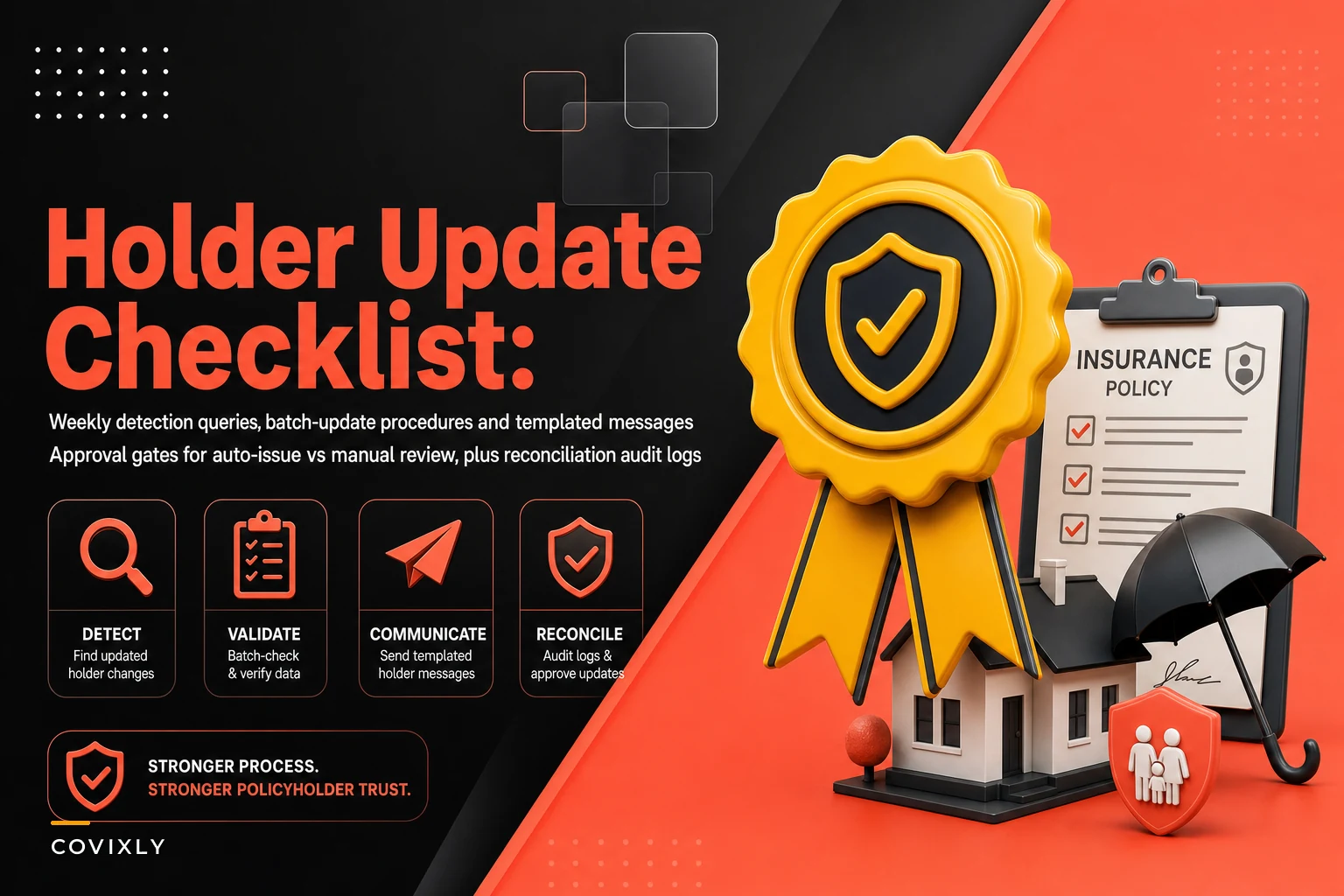
So this is a working checklist for the holder lifecycle: how to detect stale COIs weekly, batch-update them without drowning your CSRs, decide what can auto-issue versus what needs a human, and reconcile everything so nothing slips through.
Why holder records go stale in the first place
A certificate of insurance is a snapshot. It's accurate the day it's issued and starts decaying immediately. Meanwhile, three separate things keep changing underneath it:
-
The underlying policy — renewals, endorsements, limit changes, carrier switches
-
The holder's requirements — a landlord raises required limits, a GC updates their additional insured language, a new contract demands waiver of subrogation
-
The holder's own details — company name changes after an acquisition, new remit address, new project or job number
Most agency workflows only trigger a certificate refresh when someone asks. The holder emails, the insured calls, or a renewal kicks off a manual review. Nobody is watching for the silent drift between those events.
A typical example: a contractor has 40 active certificate holders. The general liability policy renews and the per-occurrence limit gets bumped from $1M to $2M — good news. But of those 40 holders, maybe 12 had contracts specifying "$1M minimum," so those are fine. Another 8 required "$2M minimum" and were technically under-compliant the whole prior year and nobody caught it. The renewal didn't fix that because renewals re-issue based on what's already on file, not on what each holder actually needs. The requirement mismatch just carries forward, year after year.
That's the pattern worth internalizing: stale isn't just expired. Stale means the certificate no longer matches either the policy or the holder's requirement. Expiration is the easy one to catch. The mismatches are the ones that hurt.
The weekly detection pass
You can't fix drift you can't see. The foundation of the whole lifecycle is a recurring detection query that runs against your management system and surfaces holders that need attention — not once a quarter, but weekly, so the list stays small and manageable.
Eliminate paperwork bottlenecks and missed deadlines.
Covixly helps you track, manage, and close every policy and claim with confidence and speed.
- Unified policy & claims management
- Automated client notifications
- Agent task coordination
No credit card required
Below are the detection queries worth running every week. Think of these as saved filters or reports, whether you build them in your AMS, a spreadsheet export, or an operational platform sitting on top of your data.
-
Expiring within 30 days — any certificate whose expiration date falls inside the next 30 days. This is your baseline re-issue queue.
-
Policy-changed, certificate-not-updated — holders attached to a policy that had an endorsement, limit change, or renewal effective date after the last certificate issue date. This is the mismatch catcher.
-
Requirement-above-current-limits — holders whose stored requirement (e.g., "$2M GL, $5M umbrella") exceeds what the current policy actually provides. These need a conversation, not just a re-issue.
-
Holder detail drift — flagged name, address, or project changes that came in through email or the portal but never got applied to the holder record.
-
Orphaned holders — certificates still active on policies that have since been cancelled, non-renewed, or rewritten with a different carrier. These are pure liability with zero benefit.
-
No-activity holders — certificate holders with no issue, update, or touch in over 12 months. Some are legitimately dormant; some are forgotten.
The reason to split these into separate queries instead of one giant "stale COI" report is prioritization. An expiring cert is routine. An orphaned holder on a cancelled policy is an emergency. If they all land in the same undifferentiated pile, your CSR treats them the same — which means the urgent ones wait behind the routine ones.
When you run queries 2 and 5 for the first time, the results are usually alarming. Dozens of holders quietly drifted out of alignment. That first pass is a one-time cleanup. After that, the weekly cadence keeps the numbers manageable — usually a handful per week per book.
Deciding what auto-issues and what gets a human
Once detection surfaces the list, the next question is who touches it. Manually reviewing every holder update is how CSRs lose their afternoons. But auto-issuing everything is how wrong certificates go out the door with your agency's name on them.
The right answer is an approval gate based on risk. Low-risk, mechanical updates flow through automatically. Anything involving judgment, exposure, or a requirement mismatch stops for review.
| Update type | Route | Why |
|---|---|---|
| Address / contact correction on holder | Auto-issue | No coverage impact |
| Routine renewal re-issue, same limits & forms | Auto-issue | Nothing changed except dates |
| Project/job number added, standard wording | Auto-issue | Administrative only |
| Limit increase that now meets holder requirement | Auto-issue with log | Good news, but log it |
| Additional insured wording change | Manual review | Coverage/contract implication |
| Waiver of subrogation request | Manual review | Endorsement dependency |
| Requirement exceeds current policy limits | Manual review | Needs producer conversation |
| Holder on cancelled/rewritten policy | Manual review | Determine cancel vs. re-issue |
| New carrier after rewrite | Manual review | Forms and limits may differ |
The principle: auto-issue when the certificate is just catching up to something that's already been decided and verified. Require a human when the update involves a decision, a contract interpretation, or a coverage gap.
One mistake agencies make when they first set this up is defining "manual review" too broadly out of caution. Within a month the review queue is so backed up that CSRs start rubber-stamping to clear it — which defeats the entire purpose. Keep the auto-issue lane wide for genuinely mechanical stuff so the manual lane stays small enough that reviewers actually read what they're approving.
If your agency deals with a lot of carrier-specific requirement variation, pairing this with standardized carrier requirement profiles makes the auto-issue decisions far cleaner, because the system knows what each carrier's current forms and limits actually are.
Batch-updating without breaking things
When a policy renews or a limit changes, you're rarely updating one holder — you're updating every holder attached to that policy at once. Doing this one certificate at a time is where hours disappear. But batching carelessly is how you accidentally send 40 certificates with the wrong effective date.
-
Pull the affected holder set from the policy change — every holder attached to the policy that just renewed or endorsed.
-
Split by route using the auto-issue vs. manual table above. The mechanical ones batch together; the judgment ones peel off into the review queue.
-
Generate a preview batch, not a send batch. Produce all the draft certificates first and spot-check a sample — the first, the last, and a couple of random ones. Confirm dates, limits, and holder details are pulling correctly before anything goes out.
-
Release the auto-issue batch and log every send.
-
Distribute the review batch to producers/CSRs with the specific reason each one stopped (requirement mismatch, AI wording, waiver, etc.) so they're not hunting for what needs deciding.
The preview-batch step is the one people skip and regret. A single bad merge field — say the umbrella limit didn't map correctly for one carrier — replicates across the whole batch in seconds. Catching it on a three-certificate spot check costs two minutes. Catching it after 40 went out to holders costs you the rest of the week and some credibility.
This diagram shows the core batch-update workflow in one place.
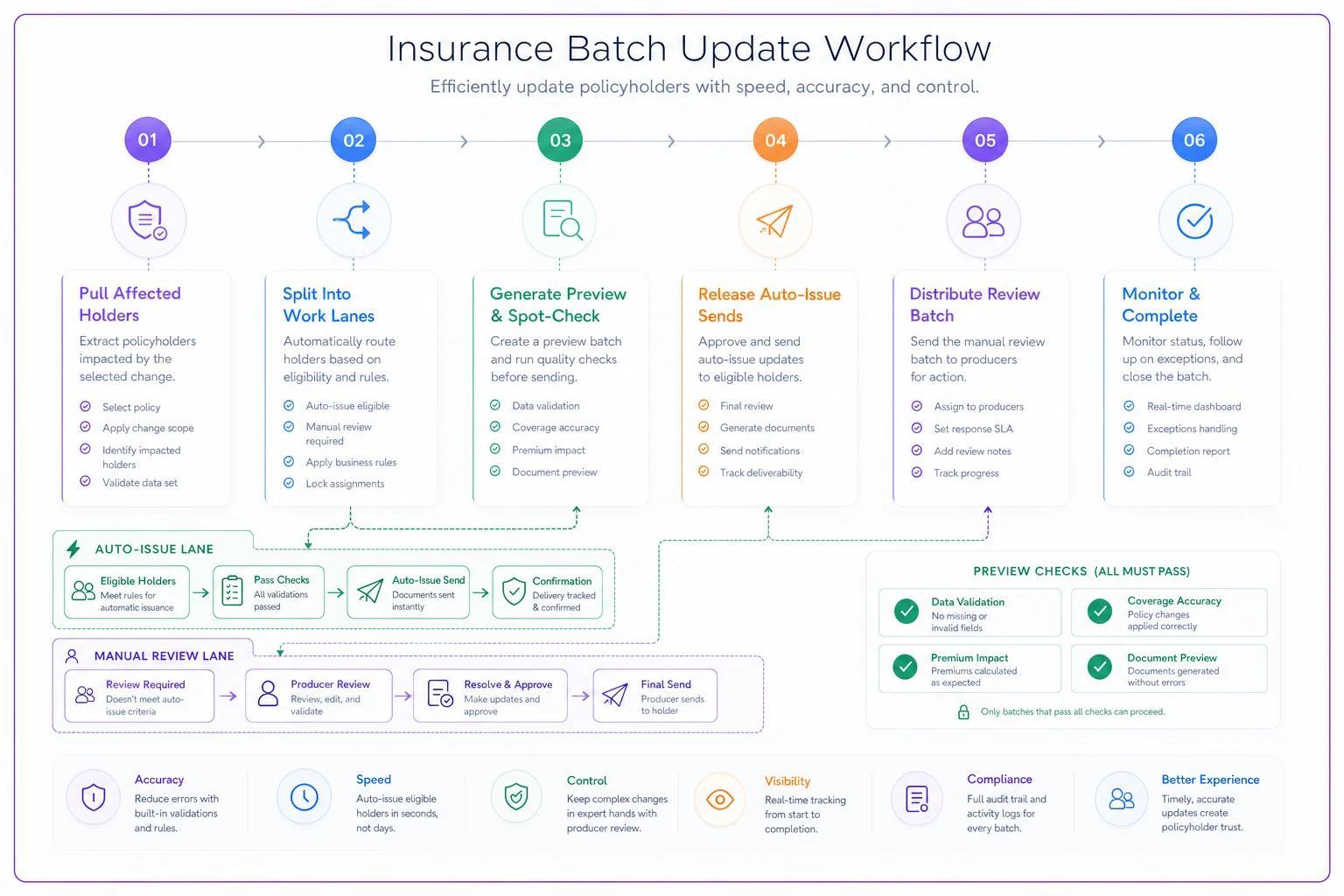
Spot-check the first, last, and a couple random certificates in the preview batch before releasing anything.
Templated holder-update messages
-
Routine renewal "Your updated certificate is attached reflecting the [effective date] renewal. Coverage and limits remain the same. No action needed."
-
Limit increase "Attached is an updated certificate reflecting an increase in [coverage] limits, effective [date]. This certificate supersedes the prior version."
-
Requirement gap (internal-facing first) goes to the producer, not the holder — "Holder [X] requires $2M GL; current policy provides $1M. Recommend discussing endorsement or informing holder before re-issue."
-
Detail correction "We've updated your certificate to reflect [corrected name/address]. Please replace the prior version on file."
Keeping these templated does two things: it removes the "what do I write" hesitation that makes CSRs delay sends, and it keeps the language consistent so a holder who gets certificates from you across multiple insureds sees the same professional format every time.
Reconciliation and the audit trail
Detection finds drift. Batch-updating fixes it. Reconciliation proves you actually closed the loop — and gives you something to hand an auditor or E&O carrier when they ask how you manage certificate holders.
The reconciliation pass is a monthly (or per-renewal-cycle) check that every holder flagged by detection actually got resolved. Not "we sent a batch" — but "for every item on the stale list, here's the outcome: re-issued, cancelled, escalated, or intentionally left dormant with a note."
A simple reconciliation checklist:
-
Every expiring certificate from the month either re-issued or explicitly marked non-renewed
-
Every policy-change flag reconciled against an issued update
-
Every requirement-mismatch escalation has a documented producer decision
-
Every orphaned holder either removed or confirmed re-issued under the new policy
-
Every auto-issue send logged with timestamp, user (or system), and version
-
Zero items sitting in the "detected but untouched" state for more than one cycle
That last line is the real metric. The health of your holder lifecycle isn't how many certificates you issue — it's how few flagged items are sitting unresolved. In a well-run book, that number should be close to zero every cycle. When it starts climbing, it's usually an early warning that detection is finding more than your team can process — either a big policy event just happened or the review side is understaffed.
The audit log is non-negotiable. Every issue, update, and cancellation should carry a timestamp, the responsible party, the reason, and a link to the specific certificate version. This is what turns "we think we handle this well" into "here's the record." When an E&O question comes up — did the agency issue a certificate showing coverage that didn't exist? — the log is the difference between a defensible position and a guess.
Where operational software fits — and where it doesn't
You can run this entire lifecycle manually. Plenty of agencies do, with saved AMS reports and disciplined CSRs. The detection queries can be spreadsheet filters. The audit log can be a shared tracker. It works, right up until volume outgrows attention.
Where an AI-assisted operational platform earns its keep is in the parts that are pure repetition: running the weekly detection queries automatically instead of relying on someone remembering, flagging policy-vs-certificate mismatches the moment an endorsement posts, routing updates through the auto-issue/manual gate without a human sorting them, and building the audit log as a byproduct of normal work rather than a separate chore. The judgment calls — requirement conversations, coverage decisions, contract wording — still belong to your people. The software just makes sure nothing reaches your people late or falls off the list entirely.
The distinction that matters: automation handles catching drift and processing the mechanical updates well. It doesn't decide whether a landlord's new $5M requirement is worth writing an umbrella for. Keep it in the detection-and-routing lane, and it removes the invisible-liability problem without pretending to make underwriting decisions.
A quick real scenario
A mid-size commercial agency — roughly 600 active COIs across their contractor and habitational book — kept getting caught by expired and mismatched certificates during client audits. They weren't sloppy; they just had no systematic way to catch drift between renewals. Certificates got fixed when someone complained.
Their first full detection pass turned up around 70 holders that were stale in some way — expired, orphaned on rewritten policies, or under the holder's required limits. Cleaning that up took the better part of two weeks. Once the weekly detection cadence was running, the recurring list dropped to somewhere around 8–15 items a week, which one CSR handles in under an hour.
The measurable change wasn't dramatic revenue — it was fewer fire drills. Certificate-related urgent requests dropped noticeably, the E&O reviewer had a clean audit trail to look at, and the agency stopped discovering requirement mismatches during a client's bid deadline. That last part is the one that actually protects the relationship.
Bringing it together
The reason stale certificate holders keep biting agencies is that issuance and lifecycle get treated as the same problem, when they're not. Issuing a clean COI is a one-time task. Keeping 600 of them accurate as policies, requirements, and holder details all shift underneath is an ongoing operational discipline — and it needs its own detection, routing, batch handling, and reconciliation process.
Run the weekly queries. Split auto-issue from manual with a clear risk gate. Batch carefully with a preview step. Reconcile every cycle so nothing sits untouched. Keep the audit log tight, because eventually someone will ask you to prove it. Build that loop once, keep the weekly list small, and the certificate-holder update checklist stops being a scramble and turns into something your agency barely has to think about — which is exactly where you want it.
Run the weekly queries. Split auto-issue from manual with a clear risk gate. Batch carefully with a preview step. Reconcile every cycle so nothing sits untouched. Keep the audit log tight, because eventually someone will ask you to prove it. Build that loop once, keep the weekly list small, and the certificate-holder update checklist stops being a scramble and turns into something your agency barely has to think about — which is exactly where you want it.
Ready to transform your insurance agency operations?
Join 500+ agencies using Covixly to reduce manual work, improve client service, and grow their book of business.