



Ask any commercial CSR what eats their afternoon, and certificates come up fast. Not the complicated policy work. The certificates. A contractor emails at 4:47pm needing a COI for a job that starts tomorrow morning, the GC wants the additional insured endorsement referenced by form number, and the CSR is now hunting through the policy PDF to confirm whether CG 20 10 or CG 20 37 applies. Multiply that by twenty requests a day and you understand why COI handling quietly becomes one of the most expensive low-value tasks in a commercial book.
The frustrating part is that most of these requests aren't unique. They repeat. Same insured, same holder, same wording, month after month. Yet agencies keep treating each one like a brand-new project. This post is about fixing that — certificate of insurance automation for commercial lines — using three things that actually move the needle: a real template library, triggers for recurring requests, and approval gates that catch the requests that genuinely need a human eye.
Where COI issuance actually breaks down
Before building templates, it helps to be honest about why certificates take so long. It's rarely the act of generating the certificate. Filling out an ACORD 25 takes a couple minutes. The time disappears in everything around it.
A typical request goes something like this. The holder sends requirements — sometimes a clean contract clause, sometimes a screenshot, sometimes a vague "we need proof of insurance." The CSR reads it, figures out what the holder actually needs, checks whether the policy supports it (blanket additional insured? waiver of subrogation? primary and non-contributory wording?), pulls the endorsement forms, drafts the certificate, then decides whether they can send it or needs someone to approve it. If anything's unclear, they email the insured or underwriter and wait.
That waiting is the real cost. Actual keystrokes account for maybe 15% of total time on a certificate. The rest is interpretation, verification, and back-and-forth. Automating the "filling out the form" part barely helps. You have to attack interpretation and repetition.
There's also a quieter failure mode: inconsistency. Two CSRs handle the same holder's requests differently. One references the correct blanket endorsement, the other manually types additional insured language that doesn't match the policy. Both certificates go out. One is technically inaccurate, and nobody notices until there's a claim and the GC's attorney is reading it word for word.
The three-part fix, and why order matters
Most agencies try to solve this by getting faster. More people, more hours, a shared certificate inbox. That scales cost, not efficiency. The better approach is removing decisions from the process wherever the decision is already known.
Eliminate paperwork bottlenecks and missed deadlines.
Covixly helps you track, manage, and close every policy and claim with confidence and speed.
- Unified policy & claims management
- Automated client notifications
- Agent task coordination
No credit card required
Three components do that, and they build on each other:
-
A template library — so the wording, forms, and holder-specific quirks are decided once, not every time.
-
Recurring triggers — so certificates that renew or repeat generate themselves instead of waiting for someone to remember.
-
Approval gates — so the small number of genuinely risky or unusual requests get reviewed, while routine ones flow through untouched.
Skip step one and the other two just automate mistakes faster. Skip step three and you either approve everything (risky) or approve nothing (slow). The sequence is the whole point.
Building a template library that people actually use
The mistake most agencies make is building templates around policies when they should be built around situations. A template tied to "General Liability" is too broad to be useful. A template tied to "GC requires blanket AI + waiver of subrogation + primary/non-contributory for ongoing operations" is something a CSR can grab and trust.
Start by pulling your last 200–300 certificate requests and sorting them. You'll find that a surprisingly small set of scenarios covers most of the volume. In real operations, roughly 70–80% of certificate requests fall into fewer than a dozen recurring patterns — construction GCs, landlords requiring proof for a lease, vendors needing a COI to onboard, municipalities with their own required language, and so on.
Sorting your recent requests by holder and required wording quickly reveals the handful of templates you'll actually need.
-
The exact certificate holder formatting the holder demands (many reject certificates over a wrong suite number)
-
The endorsement forms referenced by form number and edition date
-
The additional insured wording, pulled from the actual endorsement — never retyped from memory
-
Whether the holder requires the endorsement forms attached, not just referenced
-
Any description-of-operations language the holder insists on
Here's a comparison of the two approaches:
| Aspect | No template / ad hoc | Situation-based template |
|---|---|---|
| Time per certificate | 12–20 min | 3–5 min |
| Wording consistency | Varies by CSR | Identical every time |
| Endorsement accuracy | Depends on who's checking | Locked to policy forms |
| Holder rejection rate | Higher (formatting errors) | Low |
| New-hire ramp time | Weeks | Days |
The single biggest unlock in a template library isn't speed — it's that a newer CSR can produce the same certificate as your most experienced one. That consistency is where accuracy actually comes from.
Recurring triggers: stop re-requesting what you already know
A large share of commercial certificates aren't one-offs. A janitorial company sends the same COI to the same building manager every year. A subcontractor needs the same certificate for the same GC on every job. These are predictable, and predictable work should not depend on someone's memory or the holder emailing a reminder.
Recurring triggers handle two situations:
Renewal-driven certificates. When a policy renews, every holder who needs an updated certificate should be flagged automatically. The classic failure is a building manager who requires a current COI on file — the policy renews, nobody reissues the certificate, and three weeks later the insured gets locked out of a jobsite because their "proof of insurance expired." That call lands on your CSR, now framed as an emergency.
Scheduled recurring requests. Some holders require certificates on a set cadence regardless of renewal. A trigger can generate the draft, attach it to the correct template, and queue it for review before the deadline instead of after the complaint.
The workflow in plain terms:
-
A policy renews
-
The system checks which holders are linked to that policy
-
For each holder, it pulls the matching template
-
Generates the draft certificate with updated dates and limits
-
Routes it based on the approval rules
Nobody had to remember anything. The CSR's job shifts from building the certificate to confirming it.
This is where certificate of insurance automation stops being a buzzword and becomes a scheduling problem you've already solved for renewals elsewhere. If you've worked through renewal transfer or renewal scheduling issues before, recurring COI triggers are the same discipline applied to a different artifact.
A visual of that workflow:
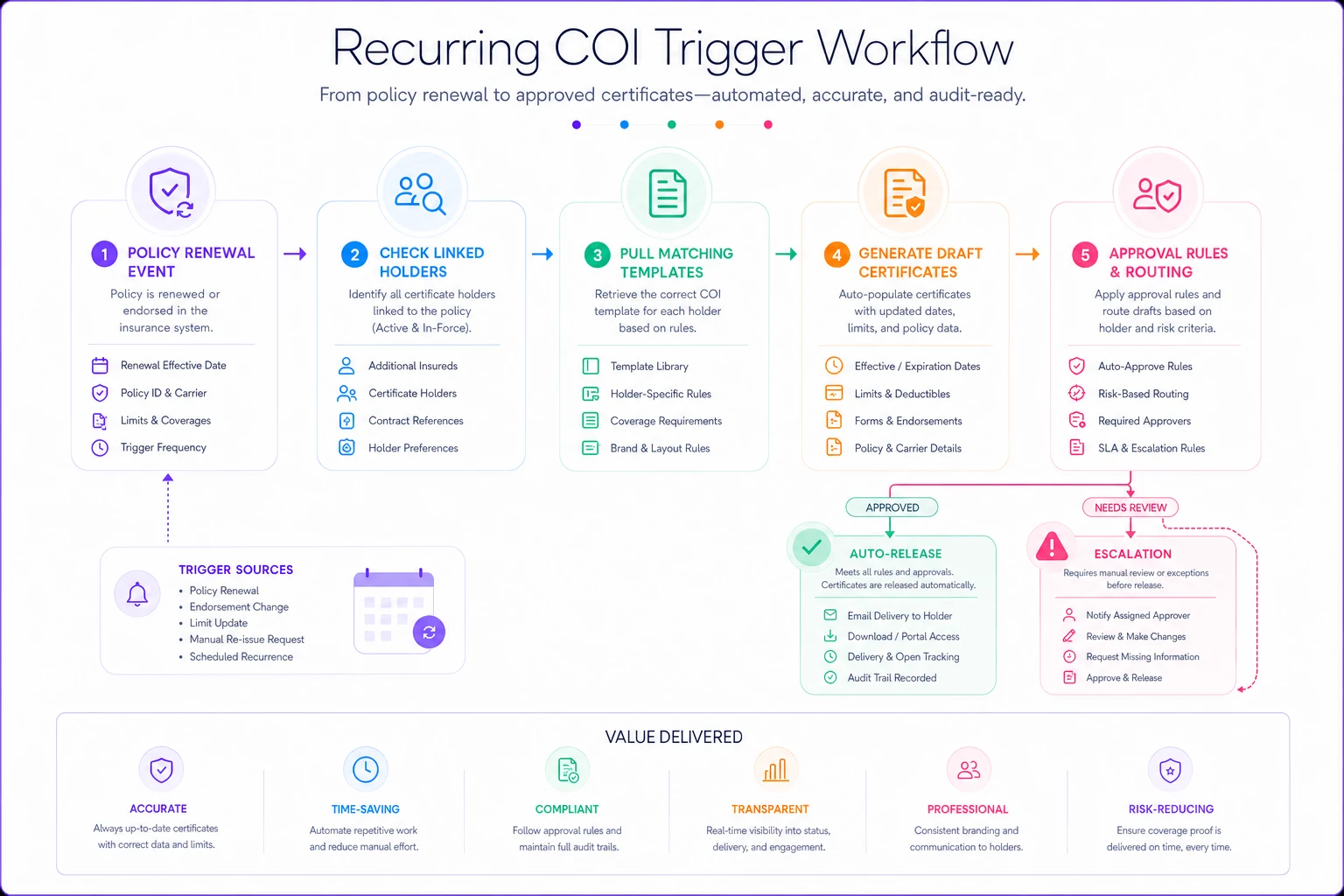
One caution worth stating plainly: don't auto-send recurring certificates blindly. Limits change, endorsements get non-renewed, a carrier drops a form. Auto-generate, yes. Auto-send without a review gate on anything that changed, no.
Approval gates: reviewing the risky ones, releasing the routine ones
This is the piece agencies get wrong most often. They land in one of two ditches — either everything requires manager sign-off (which recreates the bottleneck you were trying to kill), or nothing does (which is how inaccurate certificates go out the door).
The fix is a tiered gate. Route certificates by risk, not by habit.
A workable tiering looks like this:
-
Auto-release (no approval) Request matches an existing template exactly, policy is active with unchanged limits and forms, holder is already on file. This is most of your volume and it should flow with zero human touch beyond a glance.
-
CSR confirmation only Recurring certificate where dates or limits changed at renewal but the coverage structure is identical. A quick verify-and-send.
-
Senior review required New additional insured wording the template doesn't cover, requests for coverage the policy may not actually provide, waiver of subrogation where the endorsement isn't confirmed, or any holder language that implies contractual obligations beyond the policy.
-
Producer/underwriter escalation The holder is demanding coverage or wording the policy doesn't support. This isn't a certificate problem — it's a coverage conversation, and issuing the certificate anyway is how E&O claims start.
The top tier is there to protect you. The most dangerous certificate is the one where a CSR, trying to be helpful and beat a deadline, types in additional insured language or checks a box for coverage that doesn't exist on the policy. The certificate looks fine. It's a misrepresentation. Gates exist specifically to stop that one request before it goes out. This kind of escalation logic is exactly what high-risk commercial accounts need baked into how work gets handled.
A real scenario
A mid-size commercial agency — around 1,400 commercial accounts, heavy on contractors — was running certificates through a shared inbox handled by three CSRs. Volume was roughly 350–400 certificate requests a month. Turnaround averaged most of a business day, and rush requests were constant. Two or three times a quarter a certificate went out with wording that didn't match the policy, caught later, usually after some tense emails.
They didn't buy anything exotic. They sorted three months of requests, found that about 75% mapped to nine repeat scenarios, and built templates for those nine. They set renewal-linked triggers so holders needing updated COIs were flagged the day a policy renewed. Then they added the tiered gate — routine certificates auto-released, anything with new wording or coverage questions kicked to a senior CSR.
After a couple months, average turnaround on routine certificates dropped to under an hour, most of them same-morning. The mismatched-wording incidents essentially stopped, because the risky ones were the only ones a human was reviewing closely. The CSRs didn't get less busy in some vague way — they got their afternoons back for actual servicing work instead of certificate triage.
Nothing about that is magic. It's just deciding once instead of every time, and only spending human attention where the risk actually lives.
When this makes sense — and when it doesn't
This whole approach pays off when you have volume and repetition. If you're issuing 200+ commercial certificates a month with a recognizable set of repeat holders, templates and triggers will save real time almost immediately.
When it's a bad idea to over-automate: a small book with mostly one-off certificates and highly varied holder requirements. If every request is genuinely different, templates give you less leverage, and you're better off investing in a strong reference sheet and one well-trained person. Forcing automation onto low-volume, high-variation work just creates templates nobody trusts.
Who should not skip the approval gate: anyone writing complex commercial risks, construction, or accounts with aggressive contractual insurance requirements. The speed is tempting, but for these books the gate isn't overhead — it's your E&O protection.
The one thing to get right
Separate the routine from the risky, and only spend human judgment on the risky. Templates handle the wording. Triggers handle the remembering.
Gates handle the accuracy. The reason certificates feel overwhelming isn't the volume — it's that agencies treat all of it as equally demanding when 80% of it is repetitive and safe to standardize.
Get the boring 80% flowing automatically and correctly, and your team suddenly has the time and attention to handle the 20% that genuinely needs a person. That's not faster paperwork for its own sake. It's putting your best people on the requests where a mistake actually costs something.
Ready to transform your insurance agency operations?
Join 500+ agencies using Covixly to reduce manual work, improve client service, and grow their book of business.