



Most agencies don't lose carrier appointments because of bad producers or bad loss ratios. They lose them because someone forgot a production threshold, missed a contingency reporting window, or discovered a commission schedule change three quarters too late. The rules were always knowable. Nobody was tracking them as a system.
That's the real gap. Carrier relationships get treated like a relationship — something the principal "handles" — instead of a set of contractual obligations with deadlines, thresholds, and actual financial consequences. Relationships live in someone's head. When that person is on vacation, out sick, or gone, the whole thing quietly falls apart.
This playbook is about converting carrier contract management from tribal knowledge into an operational program — standardized profiles, negotiation scorecards, reconciliation triggers, and a weekly monitoring rhythm. Not a binder that gets updated once a year. A living system.
Why carrier requirements quietly break at every agency size
There's a pattern worth naming. Small agencies with three or four carriers get away with informal tracking because the volume is low enough that the principal genuinely remembers most of it. Then they add carriers. They grow past a few million in written premium. Suddenly there are 12 appointments, each with its own production minimum, profit-sharing formula, binding authority limits, and reporting cadence — and the informal system that worked at four carriers is leaking money in ways nobody can see.
This usually happens when growth outpaces documentation. The agency signs a new appointment during a busy Q2, the terms get skimmed once, the contract goes into a folder, and everyone moves on. Eighteen months later a carrier rep mentions the agency is "close to falling below the production requirement" and it's the first anyone's heard of it.
-
Contracts are read once and never operationalized. The obligations inside them never get converted into calendar events, thresholds, or owner assignments.
-
The obligations are spread across departments. Production minimums touch sales, loss ratios touch service and claims, commission accuracy touches accounting. No single person sees the whole picture.
-
The financial impact is invisible until it's a crisis. A slowly deteriorating loss ratio or a slipping production number doesn't trigger any alarm until the carrier does.
The failure isn't a lack of information — it's a lack of structure around information that already exists.
The standardized carrier profile: your single source of truth
Before you can monitor anything, every carrier needs a profile that looks the same as every other carrier's profile. This sounds obvious and almost nobody does it. Most agencies have carrier information scattered across email threads, PDF contracts, a spreadsheet someone started three years ago, and the memory of whoever manages that relationship.
Eliminate paperwork bottlenecks and missed deadlines.
Covixly helps you track, manage, and close every policy and claim with confidence and speed.
- Unified policy & claims management
- Automated client notifications
- Agent task coordination
No credit card required
A standardized profile forces every carrier into the same shape so you can compare them, monitor them, and hand them off without losing anything. Here's what belongs in one:
-
Appointment basics — effective date, contract renewal/review date, territory, lines authorized
-
Production requirements — minimum written premium, minimum policy count, ramp period for new appointments, and the exact measurement window (calendar year vs. rolling 12 months matters enormously)
-
Loss ratio thresholds — the number that triggers a review, the number that triggers non-renewal of the appointment, and how they measure it
-
Commission schedule — base rates by line, any tiered bonuses, and the effective dates of the current schedule
-
Contingency / profit-sharing terms — the formula, the qualifying period, minimum volume to qualify, and the payout timing
-
Binding authority limits — dollar limits, class restrictions, referral requirements
-
Reporting obligations — what the carrier expects from you and when
-
Relationship contacts — marketing rep, underwriting contact, commission/accounting contact, with backups
The insight here isn't the list — most people could piece that together. It's the standardization. When every profile has identical fields, you can build monitoring on top of it because the system knows exactly where to look for the loss ratio threshold on every single carrier. If your profiles are inconsistent, every monitoring routine turns into a manual scavenger hunt, which means it won't happen consistently.
This connects directly to how the rest of your operation runs. If you've mapped your policy lifecycle with clear roles and stage KPIs, the carrier profile becomes the layer that sits above it — the contractual constraints your lifecycle has to operate within.
Negotiation scorecards: knowing which carriers actually earn their slot
Which of your carriers is actually worth the shelf space? Not gut feel — a scored, comparable answer.
A negotiation scorecard turns "we like our rep" into a defensible ranking you can bring into a contract review. It matters most before renewal conversations, when you want better commission tiers or relaxed production requirements, and when you're deciding whether to consolidate volume into fewer carriers to hit contingency thresholds.
Score each carrier on a consistent set of dimensions. A simple version looks like this:
| Dimension | What you're measuring | Weight |
|---|---|---|
| Commission economics | Effective commission rate across your book with them | High |
| Contingency realized | Actual profit-sharing paid vs. potential | High |
| Loss ratio headroom | How far you are from their trigger | Medium |
| Ease of doing business | Underwriting turnaround, binding flexibility, service | Medium |
| Book concentration | % of your premium tied to this carrier | Medium |
| Growth appetite | Are they hungry for your business or capping you? | Low |
Score each 1–5, apply the weighting, and you get a number. Do it for every carrier and the picture shifts pretty fast. A common example: an agency assumes their largest carrier by premium is their best partner, then scores them and realizes the effective commission is below average, contingency almost never pays out because they're spread too thin, and they're one bad year from a loss ratio review. Meanwhile a mid-sized carrier they treated as secondary scores highest on nearly everything.
That changes negotiation posture. Instead of walking into a review defensive about production numbers, you walk in knowing exactly where you have leverage and where you should be shifting volume. Premium volume with a carrier tells you almost nothing about whether that carrier is actually good for your agency. The scorecard tells you.
Commission reconciliation triggers: catching leakage before it compounds
Commission errors are rarely dramatic. A rate that's half a percent off on one line, a contingency that should have paid and didn't, a schedule change that took effect but never got applied on your side. Individually small. Across a book and across a year, they add up — and because each one is small, nobody catches them.
The difference between an agency that catches leakage and one that doesn't isn't diligence. It's triggers. A trigger is a specific condition that forces a reconciliation check instead of relying on someone to remember to look. Build these into your workflow:
-
New business bound → verify the commission rate applied matches the carrier profile's current schedule for that line.
-
Commission statement received → compare received amount against expected, flag any variance above a set threshold (anything over $50 or 3%, for example).
-
Carrier announces a schedule change → update the profile and audit the next two statements to confirm the change applied correctly.
-
Contingency qualifying period closes → run the formula yourself before the statement arrives so you know what to expect.
-
A policy cancels or is rewritten → confirm chargebacks are correct and not duplicated.
Treat carrier schedule-change notices as immediate audit triggers.
Triggers beat a monthly audit alone because of timing. A monthly audit catches errors after the fact, sometimes months late. Triggers catch them at the moment they occur, when the context is fresh and the fix is a phone call instead of a six-week investigation. If you already run a monthly commission audit — and you should — triggers are what make that audit fast, because most discrepancies have already been flagged and resolved before you sit down to reconcile the month.
Schedule changes are the highest-value trigger and the most commonly missed. Carriers change commission structures more often than agencies expect, and the notice usually arrives as one line in an email or bulletin. Without a trigger that forces a profile update and a two-statement audit, you'll keep booking the old rate for months.
The weekly monitoring routine that holds it all together
Profiles, scorecards, and triggers are components. The weekly routine is what turns them into a program. Without a rhythm, all of the above becomes a project you did once and slowly abandoned.
The routine doesn't need to be long. Thirty to forty-five minutes a week, one owner, same time every week. Here's a workable structure:
Weekly (30–45 min):
-
Review any carrier bulletins or notices received this week; update profiles for any changes
-
Check production pacing against thresholds for any carrier within 15% of a minimum
-
Clear any commission variance flags raised by triggers
-
Confirm no reporting deadlines fall in the next two weeks that aren't already assigned
Monthly (extend the weekly session):
-
Reconcile all commission statements received
-
Update loss ratio figures and flag any carrier moving toward a trigger
-
Review binding authority usage for any near-limit situations
Quarterly:
-
Refresh negotiation scorecards
-
Review production pacing projected to year-end and act early on any carrier at risk of missing minimums
Not everything needs weekly attention, but a few things absolutely do — and those are exactly the things that cause the worst surprises when ignored. Production pacing is the big one. If a carrier requires around $500k in written premium for the year and you're pacing at $380k with four months left, you want to have known that in month six, not month eleven. By month eleven there's nothing you can do. By month six you can redirect submissions.
This monitoring layer also protects you during transitions. When a producer leaves or a book moves between agents, carrier obligations tied to that book are exactly the kind of thing that falls through the cracks. A solid renewal transfer protocol combined with an active carrier monitoring routine means the appointment obligations don't walk out the door with the person who used to remember them.
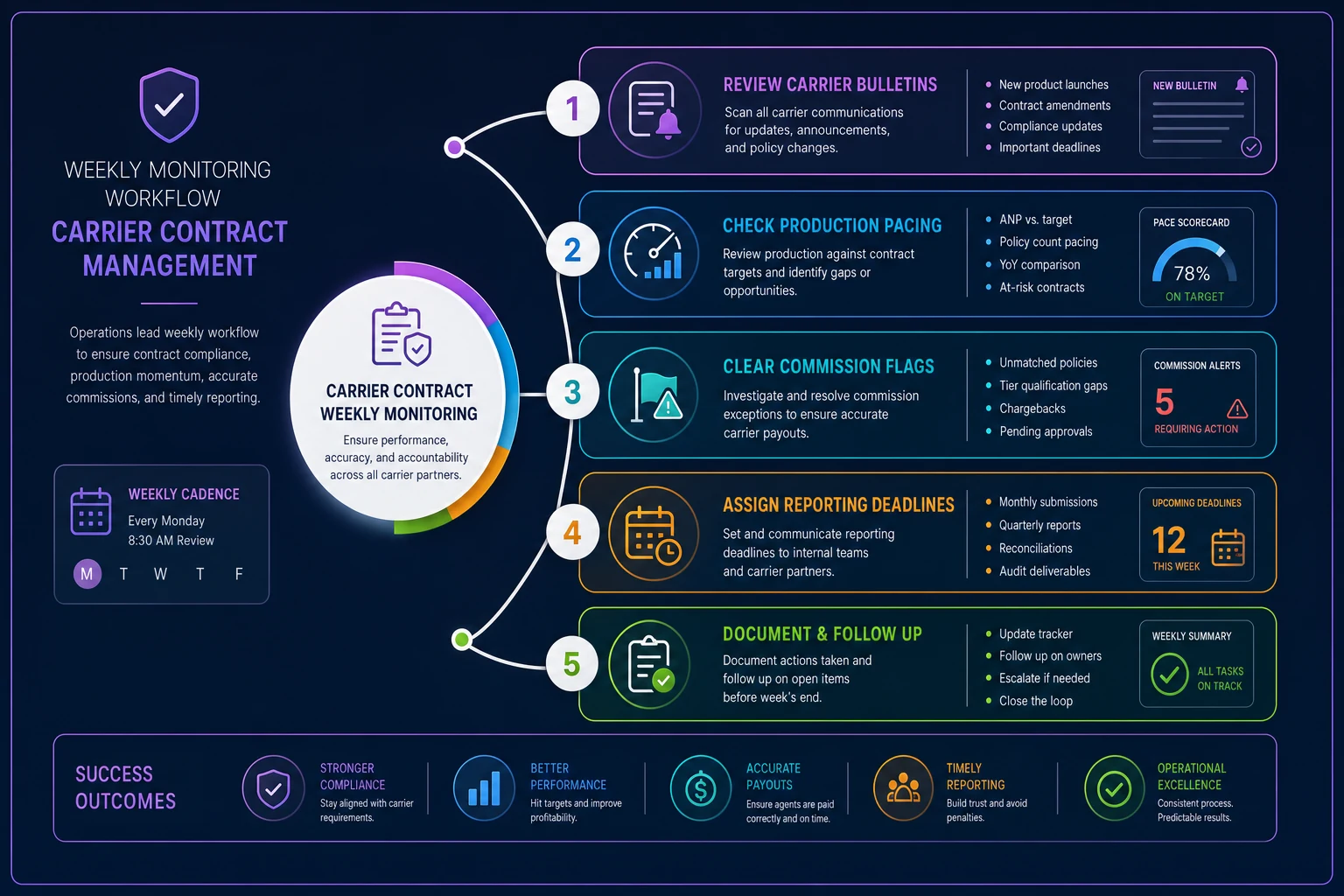
A simple visual like this helps the team see the weekly flow at a glance.
Where software actually helps — and where it doesn't
Most of this can start in a spreadsheet, and for an agency with a handful of carriers, that's the right place to start. Don't buy a platform to solve a problem you haven't structured yet. Structure it first, prove the routine sticks, then look at tooling.
Where tooling earns its keep is at scale and around triggers. Once you're past eight or ten carriers, the manual version of trigger-based reconciliation gets heavy — someone has to remember to check the rate on every new bind, watch every statement for variance, and track production pacing across every appointment. That's exactly the kind of repetitive, condition-based work that gets dropped when the week gets busy.
Operational platforms with automation built in can watch those conditions for you: flag a commission statement variance the moment it's imported, alert you when production pacing crosses a threshold, surface a reporting deadline before it's late. The value isn't intelligence — it's consistency. The system doesn't get busy, doesn't take vacation, and doesn't forget where the loss ratio field lives on every profile. That said, the judgment — which carrier to push volume toward, how to negotiate, when to walk away from an appointment — stays with you. Automation handles the watching; you handle the deciding.
A real scenario
A commercial-lines agency writing around $6M in premium across 11 carriers ran carrier management entirely through the principal's memory and a partial spreadsheet. Over about a year, three things bit them: one carrier's commission schedule dropped on two lines and they kept booking the old rate for roughly five months before noticing, a contingency they'd assumed they'd qualified for didn't pay because they'd fallen just under the volume threshold, and one appointment landed on a production-review watchlist they didn't know existed.
They rebuilt the system over about six weeks — standardized profiles for all 11 carriers, scored them, set up reconciliation triggers, and started a weekly 40-minute monitoring session owned by their operations lead. Within the first quarter the routine caught a rate discrepancy worth a few hundred dollars a month before it compounded, and the production pacing view let them redirect submissions to protect two appointments that were drifting toward minimums. The recovered leakage and protected contingencies landed somewhere in the low five figures over the year — but the bigger win, in their words, was that carrier obligations stopped being something they found out about from the carrier.
When this program makes sense — and when it's overkill
When to build the full program: You're managing eight or more carrier appointments, you have contingency and profit-sharing terms with real dollars attached, or carrier obligations currently live in one person's head. Any of those three and you're carrying risk you can't see.
When a lighter version is fine: Three or four carriers, low complexity, principal-run with real visibility into the book. Build standardized profiles and a monthly check-in, skip the heavy weekly routine until you grow into it.
Who should not over-invest here: A brand-new agency with a couple of appointments and no contingency terms shouldn't build a six-week program. Get the profiles down, know your production minimums, and revisit when you add carriers. Structure should match complexity.
The core idea underneath all of this: carrier requirements aren't a relationship you maintain, they're a set of obligations you operate against. Agencies that treat them as an operational program — with profiles that are standardized, carriers that are scored, reconciliation that's triggered, and monitoring that runs on a rhythm — stop getting surprised. And in this business, not getting surprised by your carriers is worth a lot more than most owners realize until the surprise arrives.
Ready to transform your insurance agency operations?
Join 500+ agencies using Covixly to reduce manual work, improve client service, and grow their book of business.