

Most agencies hire reactively. The team is drowning, someone quits, or a book of business doubles after a big commercial win, and suddenly there's a scramble to post a job, interview for three weeks, and onboard someone who won't be productive for another two months. By the time that new CSR is fully ramped, the pressure that triggered the hire has either passed or gotten so bad that two more people burned out.
The problem isn't that owners don't know they need help. It's that they're reading the wrong signal. "I feel like we're busy" is not a capacity plan. Agency capacity planning done right means you can look at your production metrics in March and already know you'll need to start recruiting a commercial lines CSR by mid-May — before anyone has to pull a weekend to keep binders moving.
This article walks through how to build that forecasting muscle: what to measure, how to account for the seasonal lumps every agency has, and the specific thresholds that should trigger a hire before service quality quietly falls apart.
Why agencies consistently miss the capacity signal
There's a structural reason agencies get caught flat-footed, and it has to do with how the work actually arrives.
Insurance work isn't evenly distributed. A personal lines book tied to auto and home has renewal clusters. A commercial book has effective-date concentrations, often around January 1 and July 1 because that's when a lot of policies were originally written. Then layer on open enrollment if you touch benefits, plus the Q4 crunch where renewals, endorsements, and new business all stack up at once.
So you get this pattern: for most of the year, the team handles volume fine. Capacity looks healthy. Then a seasonal wave hits, and the same team that looked comfortable in February is 40% underwater in November. Owners see the November chaos and either over-hire — carrying dead payroll through the quiet spring — or under-hire and eat the service damage.
The deeper issue is that most agencies measure output, not capacity. You know how many policies you wrote. You don't know how much headroom each person actually had while writing them. Those are different numbers, and the gap between them is where burnout and attrition live.
A useful way to think about it: output tells you what happened; capacity tells you what could happen before something breaks. Capacity planning is the discipline of watching the second number.
The production metrics that actually predict capacity
Before you can forecast anything, you need a clean baseline of what each role can realistically handle. Not the theoretical max — the sustainable number, the one that doesn't produce errors and overtime.
Eliminate paperwork bottlenecks and missed deadlines.
Covixly helps you track, manage, and close every policy and claim with confidence and speed.
- Unified policy & claims management
- Automated client notifications
- Agent task coordination
No credit card required
-
Active policies per CSR (split personal vs. commercial — they are not interchangeable)
-
Service transactions per CSR (endorsements, COIs, ID cards, billing questions, service calls)
-
New business items processed per producer or account manager
-
Renewal volume handled per person per month
-
Average handle time by transaction type
-
Error/rework rate (this is your early-warning light — it climbs before anything else does)
That last one matters more than people expect. Rework rate is usually the first metric to move when a team crosses its capacity line. Errors on endorsements creep up. Certificates go out with the wrong holder. A renewal slips. The team is still "getting it all done," but quality is already eroding — you just don't see it in the production count.
A typical example of healthy baselines for a mid-size agency might look like this:
| Role | Sustainable Load | Stress Zone | Hire Trigger |
|---|---|---|---|
| Personal Lines CSR | ~1,200–1,500 policies | 1,500–1,700 | sustained >1,650 for 2 months |
| Commercial Lines CSR | ~250–400 accounts | 400–475 | sustained >450 for 2 months |
| Account Manager (mid-market) | ~80–120 accounts | 120–140 | sustained >135 |
| Producer (service load) | varies by book | — | service % of time >25% |
These numbers aren't gospel — commercial complexity swings them wildly. A book full of contractors with weekly COI demands behaves nothing like a book of small retail GL. The point is to establish your baselines by actually measuring, then watch for drift.
If you haven't set these reference points yet, the companion piece on building the agency owner's KPI dashboard is a good place to start — capacity planning sits directly on top of those same metrics.
Adjusting for seasonality so you don't over-hire
Raw monthly numbers lie if you don't deseasonalize them. If your commercial book spikes every December and January, a December that's 30% above your annual average isn't a capacity problem — it's just how December works.
The fix is to build a simple seasonality index. You don't need a data scientist. Here's the process:
-
Pull 24 months of monthly transaction volume by role or department. Two years smooths out one-off anomalies.
-
Calculate the average monthly volume across all 24 months.
-
For each calendar month, divide its average volume by the overall average. That ratio is your seasonal index. A January index of 1.35 means January runs 35% hotter than normal.
-
Apply the index to your forecast. If your baseline capacity is 300 transactions per CSR and January runs at 1.35, you need roughly 405 transactions' worth of capacity that month.
-
Flag the months where seasonal demand exceeds standing capacity. Those gaps are where you either need temporary help, pre-loaded prep work, or a permanent hire.
A one-month spike is a staffing flex problem — overtime, temp support, or pulling prep forward into the quiet months. A multi-month spike, or a baseline that's creeping up every quarter regardless of season, is a hiring problem.
Review your seasonal index for outlier months (major client onboarding or one-off marketing wins) before locking it into hiring decisions.
The mistake agencies make is treating every busy stretch as a reason to hire. If December and January are brutal but March through September are calm, adding a permanent full-timer means you're paying roughly $55k–$70k a year for someone who's genuinely needed about two months. Better to smooth the seasonal peaks with process — move renewal prep earlier, batch certificate updates ahead of effective dates — and reserve permanent hires for sustained baseline growth.
Separating a flex problem from a hiring problem
This distinction is the heart of good capacity planning.
-
Seasonal demand — predictable, recurring, temporary
-
Baseline growth — the book is genuinely getting bigger, month over month
-
Process drag — the team is busy but a chunk of that busy is rework, duplicate entry, or manual steps that shouldn't exist
Each one has a different answer, and confusing them is expensive.
If it's seasonal, you flex. If it's baseline growth, you hire. If it's process drag, hiring is the worst possible move — you'd be paying a new person to do the same broken workflow, just faster into the same wall.
A quick diagnostic: look at your error/rework rate and handle times alongside volume. If volume is flat but handle time and rework are climbing, you don't have a capacity problem, you have a workflow problem. This shows up as a team that feels slammed during a month that isn't even seasonally high and where the policy count barely moved. That's drag, not demand.
Agencies that have tightened their service workflows — clear ownership, defined handoffs, enforced response windows like those in a lightweight SLA framework for agents, CSRs and underwriters — often find their "capacity problem" was half process the whole time. Clawing back 15–20% of effective capacity without adding a single seat is more common than most owners expect.
A sample forecasting model you can build this week
A lightweight model that works in a spreadsheet, no fancy tools required.
Step 1 — Establish per-role capacity. From your baselines, set a sustainable transaction load per person per month. Say a commercial CSR handles around 320 service transactions sustainably.
Step 2 — Forecast demand by month. Take your trailing growth rate (e.g., book is growing ~1.5% a month) and project forward 6–12 months. Multiply each month by its seasonal index.
Step 3 — Convert demand to required headcount. Divide projected monthly demand by per-person capacity. If March projects to 1,350 transactions and one CSR handles 320, you need 4.2 CSRs that month.
Step 4 — Compare required vs. actual. You have 4 CSRs. March needs 4.2. That's a small overflow — manageable with overtime. But if April needs 4.5 and May needs 4.8, the trend line is telling you to recruit now so someone's ramped before summer.
Step 5 — Set the hire trigger. The rule: when projected required headcount exceeds actual by more than ~0.5 FTE for three consecutive months, start recruiting. The 0.5 buffer accounts for the fact that nobody runs at 100% capacity indefinitely without errors climbing.
The chart below visualizes required vs actual headcount and the hire trigger.
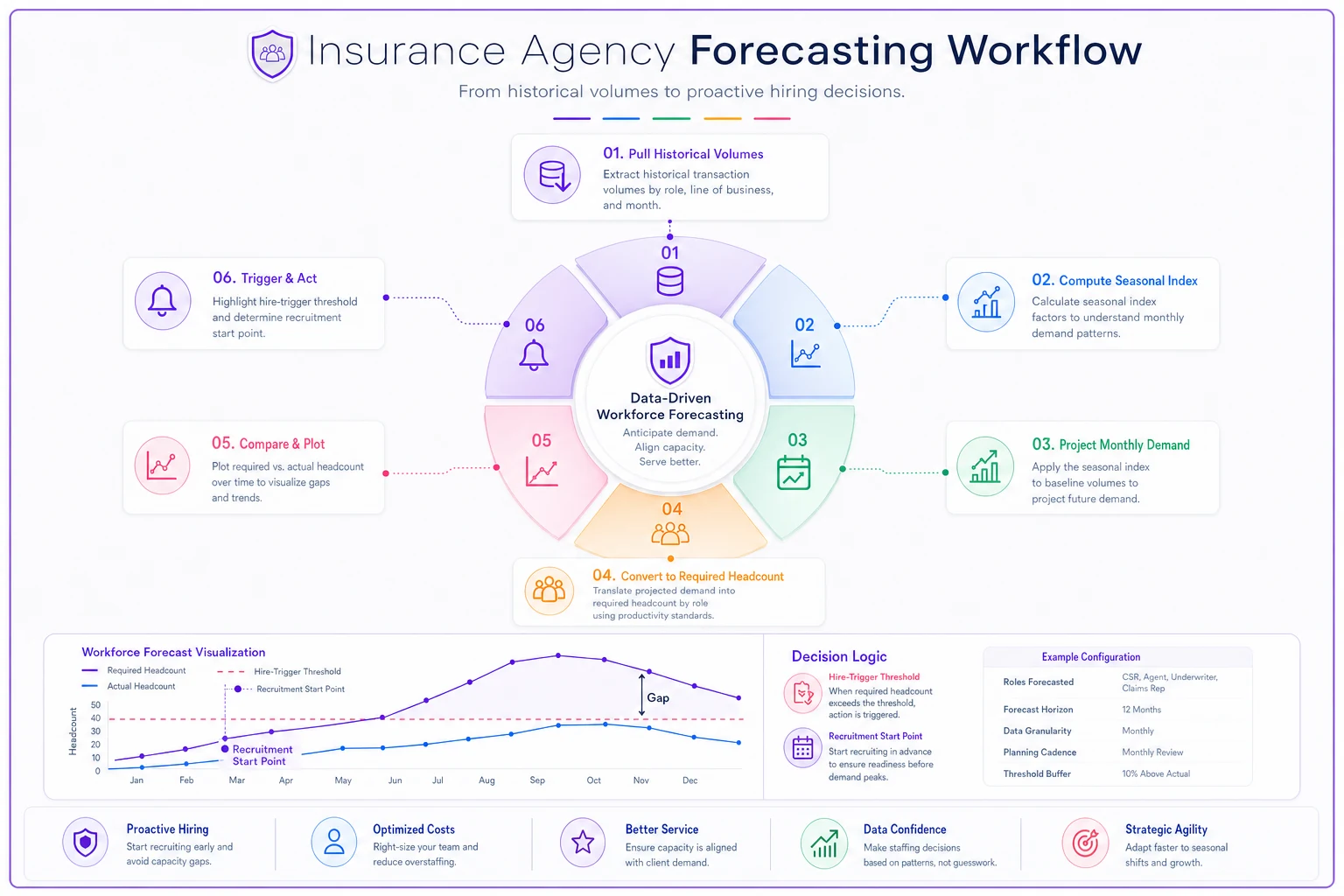
A worked example. A commercial-focused agency with 4 CSRs saw trailing growth at about 2% monthly after landing a few contractor accounts. Deseasonalized, their baseline demand was climbing steadily — not just spiking. The model showed required headcount crossing 4.5 by month four and staying there. They started recruiting in month two instead of waiting for the November wall. The new CSR was productive by the time peak hit, rework rate stayed flat instead of climbing to the 8–10% it usually hit during crunch, and nobody worked a Saturday to close out binders. The cost of hiring early was maybe six weeks of mild overstaffing. The cost of hiring late, in prior years, had been two resignations.
Hiring triggers by role
Not every role fires on the same signal. Here's a practical set of triggers:
-
Personal Lines CSR sustained policy count above the stress zone for 2+ months, or rework rate above ~5% for a full quarter.
-
Commercial Lines CSR / Account Manager account load in the stress zone for 2 months, or average new-business turnaround slipping past your SLA consistently.
-
Producer (when service load crowds out selling) when producers spend more than ~25% of their time on service, you don't need another producer — you need service support to free them up. This one gets missed constantly. Owners see declining new business and hire another producer, when the real fix is taking service off the producers they already have.
-
Operations / Processing support when handle time climbs across the board and the bottleneck is clearly data entry, document handling, or repetitive processing rather than judgment work.
That last category is worth a note. A lot of what pushes teams over their line isn't the valuable, judgment-heavy work — it's the repetitive processing underneath it. This is where modern operational platforms earn their keep: when document handling, data entry, and routine status updates are handled by automation, the same headcount absorbs meaningfully more volume before a hire is justified. The point isn't to replace people. It's to make sure the capacity you're measuring reflects people doing work that actually needs a human, so your hiring triggers fire on real demand instead of avoidable busywork.
When this model makes sense — and when it doesn't
When it makes sense: You have at least a year of clean transaction data, a book that's growing or seasonally lumpy, and more than a handful of staff. The model pays off most when a wrong hiring decision costs real money — either carrying dead payroll or eating service damage during peaks.
When it's overkill: A two-person agency doesn't need a seasonality index. You know when you're drowning because you're the one drowning. Build this discipline when you hit roughly 5–6 staff and the owner can no longer feel every person's workload directly.
Who should not lean on this blindly: Any agency in the middle of an acquisition or a major book transition. During those stretches, your historical baselines are unreliable because the work mix is changing underneath you. Forecast conservatively, overweight the error-rate signal, and revisit your baselines once the dust settles.
Pulling it together
Capacity planning isn't really about spreadsheets or indices — those are just the instruments. The real shift is in the question you're asking. Instead of "are we busy?" you start asking "how much headroom does each role have, where will that run out, and is the pressure seasonal, structural, or self-inflicted?"
Agencies that build this habit stop lurching between understaffed and overstaffed. They recruit on a trend line instead of a crisis, protect service quality through the peaks, and stop losing good people to burnout that was visible months in advance if anyone had been watching the right number. Start by measuring real per-role capacity for one quarter, deseasonalize it, and set your triggers.
The first time the model tells you to hire before you feel the need, you'll understand why it's worth doing.
Ready to transform your insurance agency operations?
Join 500+ agencies using Covixly to reduce manual work, improve client service, and grow their book of business.