

Most agencies don't lose policies at renewal. They lose them quietly, mid-term, when a draft fails or a carrier mails a cancellation notice that lands in a paper inbox nobody checks until Thursday. By the time someone notices, the grace period is half gone and the client has already mentally moved on.
The frustrating part is that almost every one of these is recoverable. A failed ACH draft, an expired card on file, a non-pay notice with a 10-day cure window — these aren't underwriting rejections. They're administrative hiccups. The policy is still active. The relationship is still intact. You just have about 72 hours of real working time before things get ugly.
This playbook is about building a detection-and-response system tight enough that a non-pay cancellation becomes a routine save instead of a lost account.
The detection problem nobody talks about
Agencies obsess over new business and renewals. Mid-term cancellations fall into a blind spot because the signals come from too many directions at once.
-
A carrier portal status change from "Active" to "Pending Cancellation"
-
A download file flag in your AMS that nobody mapped to an alert
-
A physical cancellation notice mailed to the agency
-
A failed draft notification buried in a carrier email digest
-
The client calling, confused, two days before the drop date
None of these are synchronized. The carrier portal might flip on Monday, the download might hit Wednesday, and the mailed notice might show up the following Tuesday. If your team is watching the mail pile instead of the earliest signal, you're already behind.
The pattern that shows up most often: agencies react to the latest signal instead of the earliest one. The mailed notice feels official, so that's what triggers action. But the carrier status change — which usually happens first — is the real starting gun. Build your detection around the earliest reliable signal, not the most tangible one.
What actually triggers a mid-term cancellation
Roughly speaking, the bulk of recoverable mid-term cancellations fall into a handful of buckets:
Eliminate paperwork bottlenecks and missed deadlines.
Covixly helps you track, manage, and close every policy and claim with confidence and speed.
- Unified policy & claims management
- Automated client notifications
- Agent task coordination
No credit card required
| Trigger | How it shows up first | Typical cure window | Recoverability |
|---|---|---|---|
| Failed ACH / card draft | Carrier billing alert or portal flag | 10–20 days | Very high |
| Expired payment method | Draft failure, then non-pay notice | 10–20 days | Very high |
| Missed installment | Non-pay notice | 10–15 days | High |
| NSF / returned payment | Carrier billing notice | 10–20 days | High |
| Underwriting / UW conditions | Formal carrier notice | Varies | Low to medium |
| Client-requested cancel | Signed request or call | N/A | Medium (rewrite/retain) |
The top three rows are where almost all the easy saves live. They're not credit problems or risk problems — they're a card that got replaced after a fraud alert, or an account that dipped below balance for one cycle. Those clients want to stay insured. They just need a nudge and a clear path forward.
Why these slip through
Detection is boring and spread across systems, so it gets deprioritized until it becomes an emergency.
In real operations, this usually plays out three ways:
Ownership is fuzzy. Nobody actually owns "watching for cancellations." The CSR assumes billing handles it, billing assumes the account manager is checking the portal, and the producer assumes the system would've flagged anything serious. So it sits.
Detection queries run reactively, not on a schedule. Teams log into carrier portals when a specific client comes up, not as a daily sweep. A policy heading toward cancellation only surfaces if someone happens to open that account first.
Notice volume creates fatigue. A mid-size agency might get dozens of billing and status notices a week, most routine. When everything looks like noise, the one that actually matters gets the same glance as the rest.
There's a related failure worth naming: agencies that do detect early but have no defined response. The CSR sees the flag, makes a mental note, gets pulled into a claim, and the save window closes while the information sits in someone's head. Detection without a cadence is almost as useless as no detection at all.
What a lost mid-term policy actually costs
The commission on a single personal auto policy might look modest — but that's never the real number.
Consider a commercial account paying around $4,800 in annual premium at 12% commission. That's roughly $575 a year walking out the door. But a mid-term cancellation rarely stays contained to one policy. The client who loses auto often has a homeowners policy with you too. The small commercial client dropped for non-pay tells two other business owners about the experience.
There's also the re-acquisition math. Replacing a lost account costs multiples of what it takes to save an existing one — new quoting time, new onboarding, new relationship-building. A save that takes 20 minutes of CSR time protects revenue that would otherwise cost hours to replace, if you can replace it at all.
And then there's E&O exposure. A client who lapses, has a claim during the gap, and later argues the agency should have warned them — that's a conversation no agency owner wants. Early detection isn't just about retention.
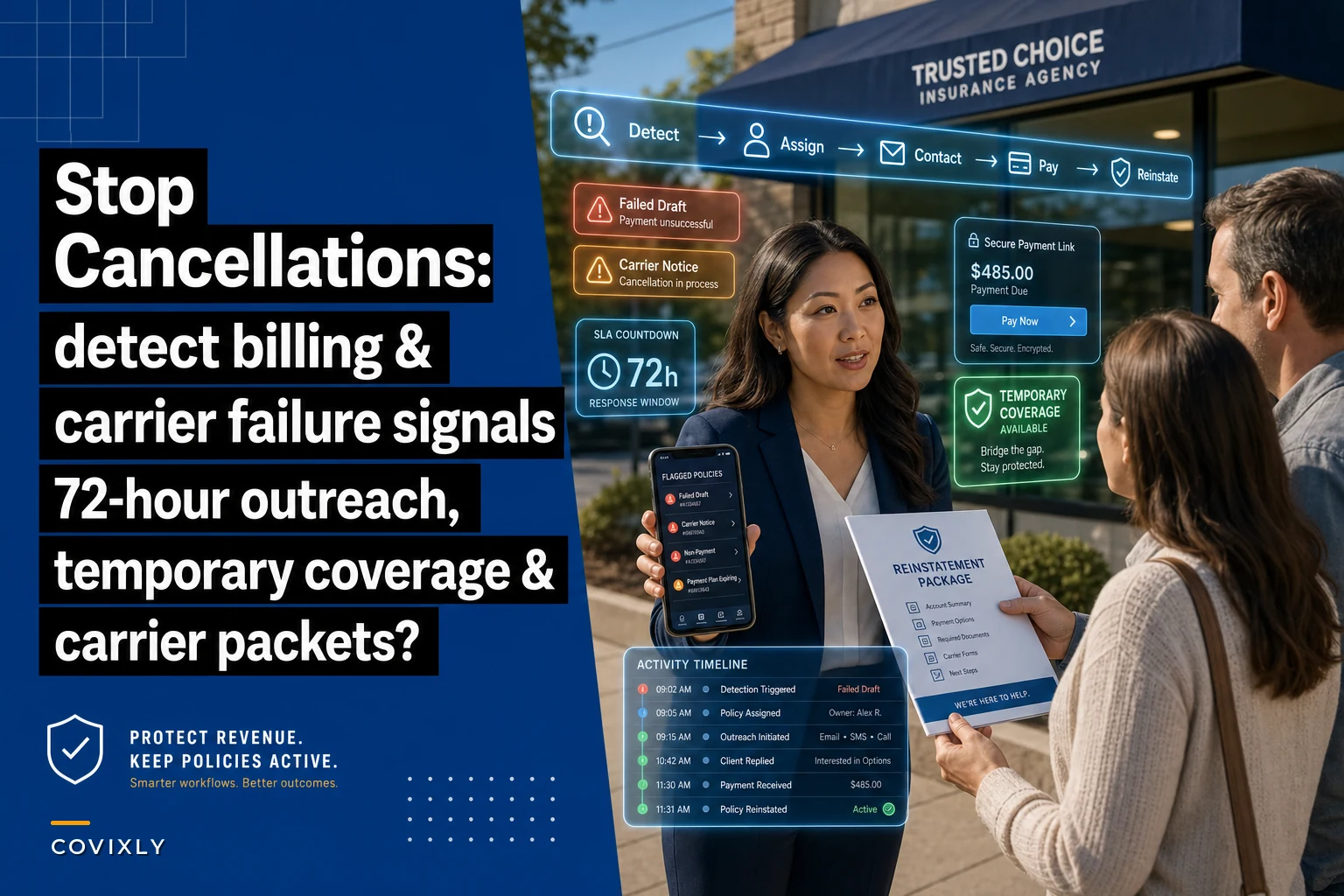
The 72-hour reinstatement cadence
Once a recoverable cancellation signal is confirmed, the clock is what matters. The window feels longer than it is because grace periods are measured in calendar days while your team works in business hours. A "10-day cure window" starting on a Thursday before a holiday weekend is really five or six working days at most.
-
Hour 0–4
Confirm and classify.
Verify the cancellation reason against the carrier source. Classify it as recoverable (billing/payment) or non-recoverable (UW, client-requested). Pull the exact cure date and amount due. Assign a single owner by name. -
Hour 4–24
First contact, multi-channel.
Call the client. If no answer, leave a voicemail and send a text and an email — same message, three channels. The goal is a reply, not a polished outreach sequence. -
Hour 24–48
Resolve the payment path.
Get the payment made, set up a new payment method, or arrange the carrier's reinstatement-with-payment process. This is where most saves actually close. Have the carrier's reinstatement requirements ready before the client calls back so there's no second delay. -
Hour 48–72
Escalate and document.
If still unresolved, escalate to the producer for a personal call and confirm whether temporary coverage is needed to avoid a gap. Document every attempt in the account. -
Post-72
Decision point.
Either the policy is reinstated, or you move to a defined fallback — rewrite with another carrier, temporary binder, or a documented non-save with the client notified in writing.
Have common carriers' reinstatement requirements pre-loaded so CSRs can act immediately when a client calls back.
Here's a quick visual of the 72-hour workflow.
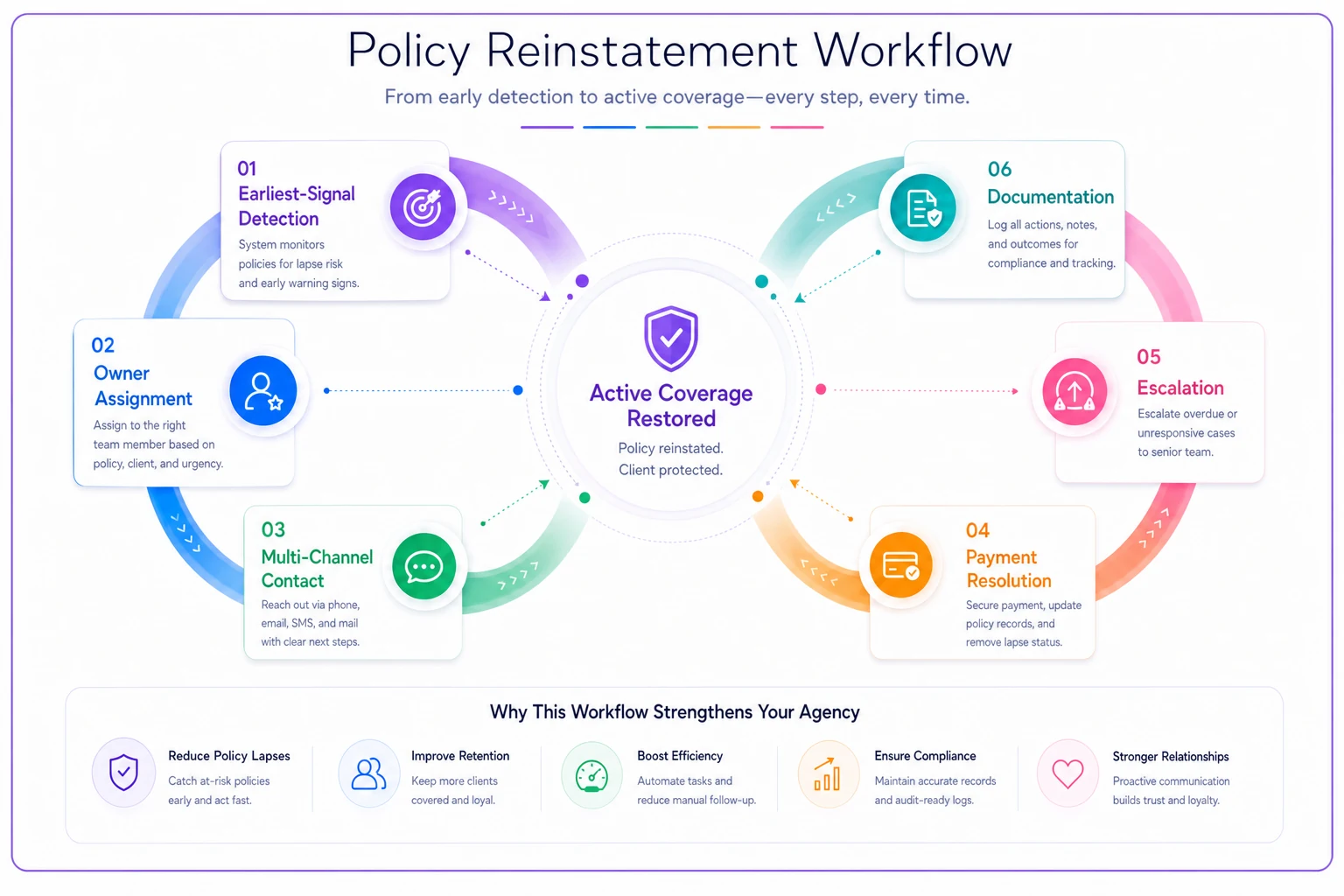
The reason this works is that it removes the ambiguity that kills saves. There's no "I'll follow up later." There's a named owner, a next action, and a deadline tied to the actual cure date.
Outreach that actually gets a response
Scripts matter here because tone determines whether the client panics, ignores you, or just fixes it. The best outreach is calm, specific, and makes the fix feel easy.
Voicemail (keep it under 20 seconds):
> "Hi [Name], this is [Your Name] at [Agency]. Quick heads up — the payment on your [policy type] didn't go through this cycle, and there's a short window to keep it active. Nothing's wrong on your end, it happens. Call me back at [number] and we'll sort it in five minutes."
Text:
> "[Agency] here — your [policy type] payment didn't process and we want to keep it active before [cure date]. Easy fix. Reply or call [number]."
Email subject line:
> "Action needed: quick payment fix to keep your [policy] active"
Two things make these work. First, the "it happens" framing lowers the embarrassment that makes people avoid calling back. Second, every message names the specific policy and specific deadline — generic "please contact us" messages get ignored.
For commercial clients, add the stakes without fear-mongering: a reminder that a lapse could affect their ability to meet contract or lease insurance requirements usually gets a same-day callback.
Temporary coverage and the carrier packet
Sometimes the cure window closes before you reach the client, or the carrier won't reinstate without a fresh application. That's when temporary coverage and a clean carrier packet keep the client from going bare.
-
Carriers that allow reinstatement-with-lapse within X days (know each one's specific rule)
-
Which carriers permit a new-business bind effective immediately to bridge a gap
-
Binder authority limits by line, so the CSR knows what they can issue without underwriting sign-off
The mistake agencies make is figuring out the reinstatement rules during the emergency. Every carrier handles lapse, reinstatement, and backdating differently. That reference should already exist. If you've built out standardized carrier reference material for other workflows, this slots right in.
A reinstatement carrier packet should include, ready to send:
-
Client name, policy number, and exact lapse/cure date
-
Reason for non-pay and confirmation of resolution
-
Proof of payment or new payment authorization
-
Signed no-loss / no-known-loss statement (critical — most reinstatements require it)
-
Updated payment method details if changed
-
Any carrier-specific reinstatement form, pre-filled
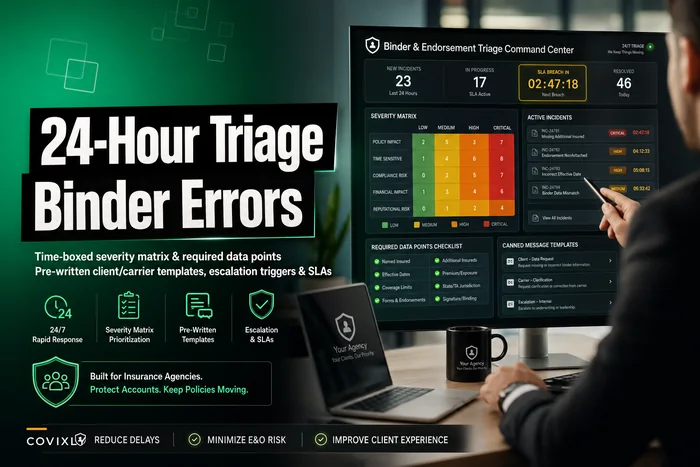
Having the no-loss statement template ready is the single biggest accelerator. Reinstatements stall constantly because that one document wasn't collected up front. The same discipline that speeds up a 24-hour binder and endorsement error triage applies directly — pre-built templates turn a scramble into a routine.
A real scenario
A small commercial-focused agency — around 1,400 active policies, two CSRs, and an owner-producer — was losing roughly 8 to 12 mid-term policies a month to non-pay, most never flagged until the mailed notice arrived.
They changed two things. First, one CSR ran a daily 15-minute sweep of carrier billing and status flags every morning before anything else. Second, they adopted the 72-hour cadence with named ownership and pre-built no-loss and reinstatement templates.
Within about three months, the monthly loss dropped to roughly 3 to 4 policies, and most of those were genuine client-requested cancellations rather than recoverable non-pays. The daily sweep took one person about an hour a week total. The saved premium — somewhere in the range of $20k–$30k annualized — came almost entirely from catching failed drafts before the notice ever hit the mailbox.
The owner's comment was the telling part: nothing about the system was clever. It just made someone responsible for looking, every day, and gave them a clear script for what to do next.
Reducing the manual load
The detection sweep is the part that quietly eats time and gets skipped when the week gets busy. This is where a good management system earns its keep.
The useful move isn't anything dramatic — it's routing the earliest signals into one place so a human isn't logging into five portals every morning. Download flags, billing-failure notices, and status changes can feed a single daily work queue, sorted by cure-date urgency, with recoverable non-pays separated from everything else. Operational platforms that pull carrier status and billing alerts into one prioritized list turn the "did anyone check the portals?" question into a standing queue that's simply there when the team logs in.
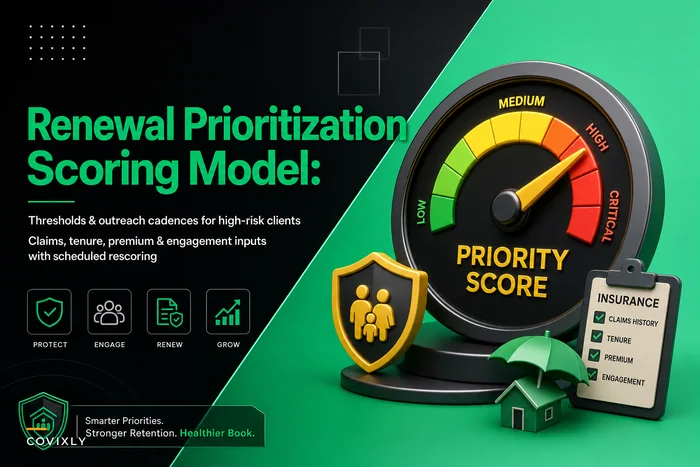
The judgment stays human — the calls, the no-loss statements, the decision to rewrite versus reinstate. The software just makes sure nothing lapses silently because someone was buried in a claim. That same prioritization logic pairs naturally with a renewal prioritization scoring model, so your highest-value at-risk accounts surface first whether the threat is a failed draft or an upcoming renewal.
When this playbook makes sense — and when it doesn't
Worth building if: you have more than a few hundred active policies, multiple payment-plan clients, and you're seeing mid-term losses you can't fully explain. The ROI shows up fast because most of what you're catching is genuinely recoverable.
Less useful if: your book is almost entirely annual-pay-in-full with no installment plans. Your mid-term cancellation volume is probably low enough to handle case by case.
Who should skip the full cadence: a solo agent with under 150 policies who personally knows every client. The structure matters most when policies outnumber the people who can hold them in their heads — which is exactly the point at which silent lapses start happening.
The bottom line
Mid-term cancellations are the quietest leak in most agency books because they don't announce themselves at a predictable moment the way renewals do. They show up as a failed draft on a random Tuesday and disappear into a pile of routine notices.
The fix isn't complicated. Watch the earliest signal every day, assign a name to every at-risk policy, run a 72-hour cadence with scripts and templates already built, and keep temporary coverage and carrier reinstatement rules documented so you're never improvising during the cure window. Do that, and most of what used to be lost accounts becomes a five-minute phone call — the kind the client barely remembers, and the kind that keeps them with you for years.
Ready to transform your insurance agency operations?
Join 500+ agencies using Covixly to reduce manual work, improve client service, and grow their book of business.