
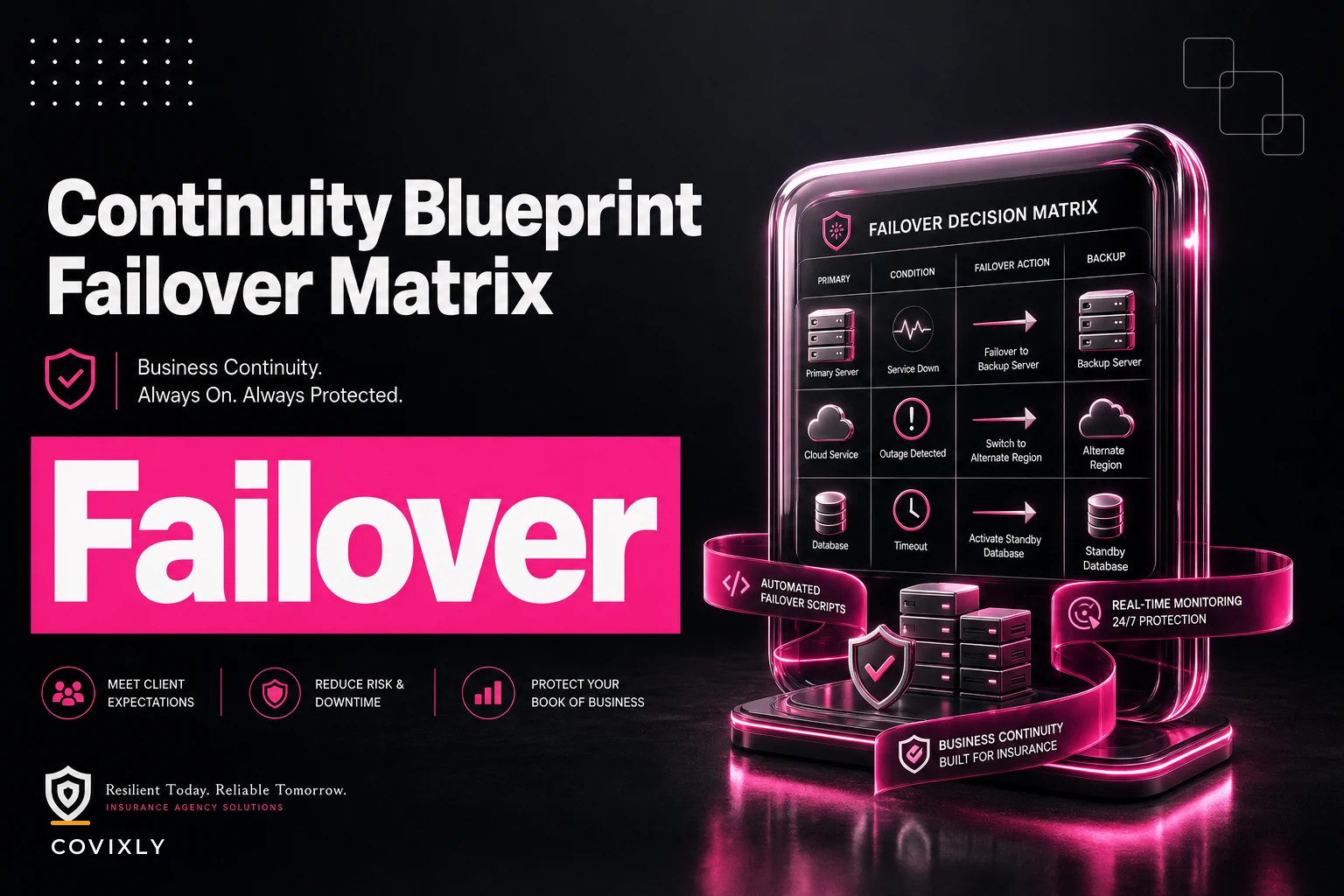

Most agency continuity plans die in a Word doc nobody opens. They're 40 pages long, written by someone who left two years ago, and built around the assumption that the AMS is the only system that matters. Then the carrier portal goes down on a Friday at 3pm during renewal week, nobody knows who's supposed to do what, and three CSRs end up calling the same underwriter while a binder sits unissued.
The problem isn't that agencies don't have continuity plans. It's that the plans aren't operational. They don't map to who does what on a normal Tuesday, and they've never been tested under any condition resembling reality.
This is a tighter approach: a one-page matrix, real recovery targets you can actually defend, written fallback scripts for the three things that will genuinely hurt you (bind, claims, payroll), and a quarterly tabletop checklist that ties every system back to the person who owns it day-to-day.
Start with the one-page critical-systems matrix
Forget the long document. What you actually need pinned above someone's desk is a single page that answers three questions for every system: what breaks, who owns it, and what we do while it's down.
Here's the pattern that works. For each critical system, you list the daily operational owner — the person who touches it most, not whoever signed the vendor contract — the recovery time objective, the recovery point objective, and the name of the fallback script.
| System | Daily owner | RTO | RPO | Fallback script |
|---|---|---|---|---|
| AMS (policy/data of record) | Operations lead | 4 hrs | 1 hr | "AMS-down binder log" |
| Email / comms | Office manager | 1 hr | 15 min | "Personal-cell client contact tree" |
| Carrier portals (bind) | Senior CSR | 2 hrs | N/A | "Manual bind by carrier desk" |
| Carrier portals (claims FNOL) | Claims coordinator | 1 hr | N/A | "Direct FNOL hotline sheet" |
| Payroll / accounting | Owner + bookkeeper | 24 hrs | 24 hrs | "Off-cycle payroll approval" |
| Phone system | Office manager | 1 hr | N/A | "Call forward to mobile" |
A few things about this that people consistently get wrong.
The daily owner column is the most important and the most skipped. A continuity plan that says "IT will restore the AMS" is useless when you have no internal IT and your MSP answers tickets in four hours. The owner should be a real person at the agency who notices when the system is down before a vendor dashboard tells them.
Also notice that RPO doesn't apply to everything. For carrier portals, you're not storing data there you'd lose — you're losing access to a transaction channel. That changes the fallback entirely. For your AMS, though, RPO matters a lot. A one-hour RPO means you can tolerate losing up to an hour of data entry. If your AMS backs up nightly, your real RPO is closer to 24 hours, and you need to know that before you write "1 hr" on the sheet and lie to yourself.
Setting RTO and RPO targets you can actually defend
This is where most agencies either overpromise or never decide. They write "RTO: immediate" for everything, which is meaningless, or they never put a number down at all and default to "whenever it comes back."
Eliminate paperwork bottlenecks and missed deadlines.
Covixly helps you track, manage, and close every policy and claim with confidence and speed.
- Unified policy & claims management
- Automated client notifications
- Agent task coordination
No credit card required
The honest way to set these is to work backward from the cost of being down.
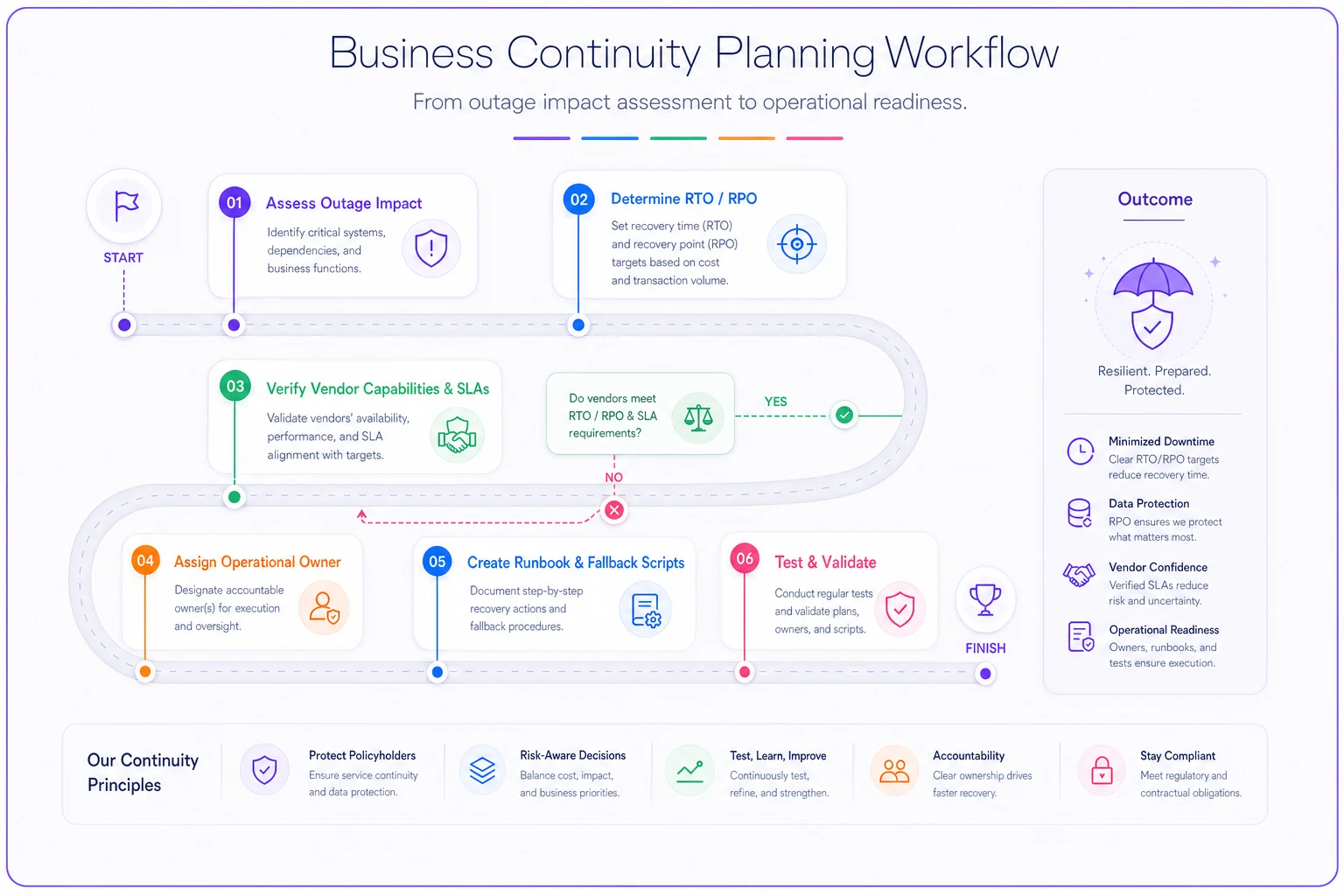
This diagram illustrates the workflow for setting and validating RTO/RPO based on outage cost and vendor capabilities.
For each system, ask: what breaks for every hour it's offline, and at what point does that become a client-losing or compliance-triggering problem?
A typical example: if your carrier bind portals are down for two hours on a slow Tuesday, you queue the binds and issue them when access returns — mild annoyance. If they're down for two hours on the 29th of the month during a surge of effective-date-sensitive binds, you've got coverage gaps, angry clients, and possibly an E&O exposure. So your RTO for bind access isn't a flat number — it's "2 hours normally, 30 minutes during month-end," and your fallback script needs to activate faster in that second case.
RPO is simpler but gets ignored. It's purely: how much recent work can we afford to re-enter by hand? If your team enters roughly 40–60 new applications a day across producers, a 24-hour RPO means a full day of re-keying if your AMS corrupts. Painful but survivable. A 1-hour RPO means almost no rework but requires near-continuous backup, which costs more. Pick based on volume and actual tolerance, not on what sounds impressive.
One thing worth flagging: agencies consistently set aggressive RTO/RPO numbers they have no technical ability to hit. If your backup runs nightly and your AMS is cloud-hosted by a vendor whose SLA is "best effort," your real recovery window is whatever they decide. Write down what your infrastructure can actually deliver, then negotiate the vendor side separately. The agency technology change management playbook is a useful companion here — the time to pin down vendor recovery commitments is during contract selection and renewal, not during an outage.
Alternate-process scripts: bind, claims, payroll
These three cause the most damage when systems fail because they're time-sensitive and they touch money or coverage directly. A continuity plan without specific written fallbacks for these is just a document about backups.
Each script should be short enough to execute from a printed page or a phone. Here's what each one needs.
Bind fallback (carrier portal down)
-
Confirm the portal is actually down (check two browsers, try another user) before activating fallback — half of "outages" are a single stale session.
-
Pull the carrier's manual bind desk number from the fallback contact sheet.
-
Call to bind verbally. Record the underwriter name, time, and verbal bind confirmation number in the AMS-down binder log (a shared spreadsheet or paper log).
-
Send a confirming email the moment email is available, referencing the verbal bind.
-
When the portal returns, enter the bind formally and reconcile against the log so nothing gets double-bound or missed.
The reconciliation step is the one people skip, and it's exactly how you end up with duplicate coverage or a bind that never made it into the system of record.
Claims / FNOL fallback (portal or AMS down)
-
Keep a one-page sheet of each carrier's direct FNOL phone and email, updated quarterly.
-
When a claim comes in and your normal intake is down, take the loss details on a standard paper intake form (same fields as your digital one), then call or email the carrier directly to open the claim.
-
Log the claim number and carrier contact in the manual claims log.
Backfill into the AMS once it's restored, using the same stage definitions you use normally so the claim doesn't fall out of your tracking. If your claim stages and ownership are clearly defined — which they should be per your policy lifecycle operational blueprint — the backfill is clean because everyone already knows which stage a backlogged claim re-enters at.
Payroll fallback (accounting system or bank portal down)
-
Keep a current roster with pay amounts stored outside the payroll system (encrypted, access-limited).
-
Have a pre-agreed off-cycle approval path
who can authorize a manual or wire payroll run if the normal system can't process on time.
-
Document the manual run so when the system recovers, you reconcile and don't double-pay.
Payroll continuity isn't really about speed — it's about authorization clarity. The reason manual payroll runs go wrong is nobody's sure who can approve a check outside the normal flow, so it either doesn't happen or three people approve different versions of the same run.
The quarterly tabletop test — and why most never happen
A plan you've never tested is a guess. Tabletop tests are cheap — an hour, a conference room, a scenario read aloud — and they surface the gaps that look fine on paper.
The reason they don't happen is boring: nobody owns scheduling them, so they slip. The fix is to attach the test to an existing quarterly rhythm you already run (QBR, compliance review, whatever) so it's not a standalone thing someone has to remember to book.
Attach the tabletop to an existing quarterly rhythm so it doesn't become somebody's optional extra task.
-
- [ ] Pick one realistic scenario this quarter (rotate
AMS outage, carrier portal down during month-end, email/phone down, ransomware lockout, payroll system failure).
-
- [ ] Gather every daily owner listed on the matrix for that scenario — not just leadership.
-
- [ ] Read the scenario cold. Don't pre-warn people on details.
-
- [ ] Have each owner walk through their first three actions from memory, then check against the written script.
-
- [ ] Time it. Did the team hit the RTO on the matrix, or was the number fantasy?
-
- [ ] Note every "we don't actually have that number / sheet / access" gap.
-
- [ ] Verify the fallback contact sheets (carrier bind desks, FNOL lines) are still accurate — these go stale fast.
-
- [ ] Assign each gap an owner and a fix-by date before anyone leaves the room.
-
- [ ] Update the one-page matrix same day if any owner, RTO, or script changed.
The most valuable output of a tabletop isn't confirming the plan works. It's the list of things that don't work: the carrier number that's been disconnected, the backup owner who left in March, the RPO that assumed real-time backup you never actually purchased.
A realistic example of what a test surfaces
A mid-size commercial agency — roughly 14 staff across two office locations — ran its first real tabletop on a carrier-portal-down-during-month-end scenario. On paper, their bind RTO was two hours. In the exercise, it took the team about 40 minutes just to agree the portal was genuinely down versus a local login issue, because nobody owned that call. Then two CSRs started phoning the same underwriter independently.
The fixes were small: they named the senior CSR as the single person who confirms an outage, built a one-page carrier bind-desk sheet, and added a shared binder log so parallel calls couldn't happen. The next quarter's test on the same scenario cleared the confirm-and-activate step in under ten minutes. No software purchased, no heroics — just clarity about who does what and a sheet of phone numbers that actually worked.
When this level of planning makes sense — and when it's overkill
When it's worth it: You're issuing enough daily volume that an outage during a peak window creates real coverage or compliance exposure. You have multiple people touching bind and claims, so coordination failures are likely. You handle commercial lines where effective-date gaps have teeth.
When it's overkill: If you're a solo producer with a cloud AMS and a personal cell, you don't need a tabletop rotation. Your continuity plan is three sticky notes: carrier bind numbers, FNOL numbers, and your bookkeeper's cell. Writing a formal matrix for a one-person shop is theater.
Who should not do this yet: Agencies whose underlying data and process ownership is a mess. If you can't say today who owns a claim at each stage, a continuity runbook will just document chaos. Fix the daily operating model first, then build the failover layer on top of it — the fallback scripts only work when they map to real, agreed-upon daily ownership.
Keeping the runbook alive
The matrix, the scripts, and the test all decay if they're not maintained. The quarterly tabletop is what keeps them current, but between tests, build in a trigger: any time you change your AMS, switch carriers, or lose someone who's a named owner on the matrix, the runbook gets a five-minute update. Attach that to your existing change process so it's not optional.
The agencies that survive outages well aren't the ones with the thickest plans. They're the ones where the office manager knows to forward phones to mobile within the hour, the senior CSR knows to confirm an outage before the team scatters, and there's a current sheet of carrier bind-desk numbers taped inside a drawer. One page, real owners, tested quarterly. That's the whole thing.
The agencies that survive outages well aren't the ones with the thickest plans. They're the ones where the office manager knows to forward phones to mobile within the hour, the senior CSR knows to confirm an outage before the team scatters, and there's a current sheet of carrier bind-desk numbers taped inside a drawer. One page, real owners, tested quarterly. That's the whole thing.
Ready to transform your insurance agency operations?
Join 500+ agencies using Covixly to reduce manual work, improve client service, and grow their book of business.