



Most agency owners treat hiring like an emergency room. Someone quits, the pipeline backs up, and the next warm body who can spell "endorsement" gets an offer. Then eighteen months later that same person is either gone or coasting, and nobody can explain why. The pattern repeats until the owner concludes "good people are hard to find" — which is only half true. Good people are hard to keep when the system around them is improvised.
Hiring, ramp, pay, and retention aren't four separate problems. They're one system with four visible surfaces. When you fix one in isolation — say, you finally write a real job description — the others quietly sabotage it. A great hire lands into a mushy ramp plan, hits a pay ceiling nobody explained, and starts browsing job boards by month nine. So this is less a "how to hire" piece and more a look at how the whole talent machine connects, where it snaps under scale, and what a saner version looks like.
Why agency hiring quietly falls apart
A two-producer shop with a couple of CSRs runs on relationships. The owner knows everyone's strengths, fills gaps by feel, and coaches over lunch. It works. Then the agency doubles. Now there are twelve people, three of whom the owner barely interacts with day to day, and the informal system that ran on proximity has nothing to stand on.
What breaks first is usually hiring consistency. Two managers interviewing for the same CSR role are measuring completely different things — one cares about carrier experience, the other about phone warmth — and they don't know they disagree until the new hire underperforms and they blame each other. Second to break is ramp. The old "shadow Karen for a week" plan falls apart when Karen is now buried and there are three new people trying to shadow her at once. Third is pay, which becomes a mess of legacy raises and one-off counteroffers with no logic anyone can defend. And by the time retention becomes the visible problem, it's actually a symptom of the first three.
None of this is a people failure. It's what happens when a business grows past the point where memory and goodwill can hold the process together. A real insurance agency talent strategy is just the set of written rules that replace the owner's intuition once intuition can't scale.
Start with a hiring rubric, not a gut feeling
A profile-based hiring rubric sounds bureaucratic until you've sat through a hiring debrief where three interviewers "really liked" a candidate and then hired a disaster. The point isn't to remove judgment — it's to make everyone judge the same things so your signal isn't drowned in noise.
Eliminate paperwork bottlenecks and missed deadlines.
Covixly helps you track, manage, and close every policy and claim with confidence and speed.
- Unified policy & claims management
- Automated client notifications
- Agent task coordination
No credit card required
Build the rubric around the actual competencies the role requires, weighted by what actually predicts success. For a commercial lines CSR, that might look like:
| Competency | Weight | What "strong" looks like | Red flag |
|---|---|---|---|
| Policy accuracy under pressure | 30% | Catches a coverage gap in a sample account without prompting | Rushes, misses obvious exclusions |
| Carrier/system fluency | 20% | Learns a new AMS screen in one walkthrough | Needs the same instruction repeated |
| Client communication | 20% | Explains a deductible change plainly, no jargon | Defaults to "I'll have to check" for everything |
| Follow-through / ownership | 20% | Tracks their own open items without being chased | Waits to be told what's next |
| Coachability | 10% | Asks a sharp follow-up when corrected | Gets defensive or nods without absorbing |
The weights matter more than the categories. If you can't articulate why accuracy is worth more than fluency for this role, you don't understand the role well enough to hire for it. And notice coachability is deliberately low — it matters, but agencies routinely over-index on "nice, eager, teachable" and end up with a team that's pleasant and permanently mid.
One mistake worth calling out: don't score candidates after the interview from memory. Score each competency during the conversation, on a shared form. When scoring happens later, it collapses into overall gut impression and the rubric becomes theater. Score live, then debrief. The disagreements you surface in that debrief are the single most useful hiring signal you'll get.
When a rubric is overkill
If you're hiring your second employee ever, skip the formal rubric — you'll interview them five times and know them better than a form ever could. The rubric earns its keep once multiple people are interviewing, or once you're hiring the same role repeatedly and want consistency across cohorts. It's a scale tool, not a startup tool.
Ramp milestones tied to competency, not the calendar
Most agencies run a 30-day onboarding and then quietly assume the person is "ramped." They aren't. Thirty days gets someone comfortable with logins and where the coffee is. It does not make them independently productive on renewals or complex commercial accounts. If you want a solid day-by-day foundation for those first weeks, the 30-day agent onboarding plan covers the shadowing and manager checkpoints in detail — but the real trap is treating day 30 as the finish line.
Actual competence for most agency roles lands somewhere between 90 and 180 days, depending on line complexity. The ramp plan has to extend well past the first month, and it should be tied to demonstrated competency, not elapsed time. Two people hired the same day do not ramp at the same speed, and pretending they do punishes your fast learner and hides your slow one.
A structure that works across most agency roles:
-
Days 1–14 — Systems and orientation. Master the AMS, carrier portals, and internal naming conventions. Milestone: can independently pull up an account, read the coverage summary, and locate the last three touchpoints without help.
-
Days 15–45 — Guided production. Handle real work under review. Milestone: processes routine endorsements and COIs with under a 10% rework rate on a sample audit.
-
Days 46–90 — Supervised independence. Owns a small book or queue with a manager spot-checking. Milestone: manages their own open-item list, escalates appropriately, hits SLA on standard tasks.
-
Days 91–180 — Full ownership. Handles complexity, needs no hand-holding. Milestone: performance on their book is indistinguishable from a tenured peer on comparable accounts.
Use your SLA definitions as the milestone gates so ramp decisions are objective and tied to service standards.
The milestone at each stage is a gate, not a suggestion. If someone hasn't cleared the days 15–45 rework gate, you don't advance them to owning a queue — you diagnose why. Maybe they need more reps, maybe they were mis-hired, but shoving them forward on schedule guarantees errors that your renewal and claims teams inherit.
This is also where your service standards do double duty. If you've already defined what "good" looks like in your SLA framework for agents, CSRs and underwriters, your ramp milestones basically write themselves — the SLA is the definition of full competence. Ramp is just the on-ramp to those numbers.
Pay progression that people can actually see
Most agencies leak good people here without realizing it. Pay is a black box. New hires have no idea what they need to do to earn more, so "getting a raise" feels like a mix of tenure, boldness, and whether they caught the owner in a good mood. That ambiguity is a slow-motion retention killer, because your best people — the ones with options — are precisely the ones who won't tolerate an unclear path.
Tie pay progression to the same competency milestones you use for ramp. Not to time served. A CSR who clears the "full ownership" gate at day 110 should hit that pay band whether it took them 110 days or 200. This does two things: it rewards the fast learners you most want to keep, and it removes the resentment that builds when someone watches a less capable peer get the same annual bump just for showing up.
A workable structure looks like tiers, each with a defined competency bar and a pay band:
-
Tier 1 (ramping) base band, cleared through day 45 milestones
-
Tier 2 (independent) modest step up, cleared through day 90 gate — owns a queue, hits standard SLAs
-
Tier 3 (proficient) meaningful step, handles complex accounts, low rework, mentors juniors informally
-
Tier 4 (expert/lead) top band, owns hard book segments, becomes a go-to resource, may carry some review responsibility
The critical rule: publish the bands and the bars internally. Not necessarily the exact dollar figures for every person, but the criteria for each tier and the range attached to it. When people can see the ladder, they climb it. When they can't, they assume there isn't one and start looking elsewhere.
When this backfires
If your bands are too narrow, you create a treadmill where people hit the ceiling of a tier and stall out with nowhere to go for two years. And if you promote purely on the milestone checklist without any judgment, you'll occasionally advance someone who games the metrics but can't actually handle the harder accounts. The rubric informs the decision; it doesn't replace the manager. Keep a human gate on the top two tiers especially.
Retention as an experiment, not a hope
Retention is where agencies get fatalistic. "People leave, it's the industry, nothing we can do." That's a story owners tell themselves because measuring retention properly is uncomfortable. But retention responds to specific interventions, and the only way to find out which ones work in your shop is to run small, measurable experiments instead of guessing.
The setup is simple. Pick one lever, define a metric, change it for part of the team, and compare against the rest over a fixed window. A few that tend to move the needle:
-
Structured 1
1 cadence.
Do biweekly 30-minute manager check-ins reduce voluntary turnover in the first year versus ad-hoc conversations? Measure it. -
Early workload calibration. New hires who get overloaded in months 2–3 quit at higher rates. Test capping their queue and watch the 6-month retention difference.
-
Career-path clarity. Give one cohort a written tier ladder at hire; give the other the old vague version. Compare engagement and stay rates.
-
Mentorship pairing. Pair half of new hires with a tenured peer. Track ramp speed and retention.
Track voluntary turnover by tenure band (0–6 months, 6–12, 12–24) so you can see when people leave. Most agencies discover their bleed is concentrated in one window — usually months 3–9 — and that window points straight at a broken ramp or an invisible pay path, which brings the whole thing full circle.
A real scenario: the mid-size agency that stopped the churn
A commercial-lines agency, roughly 18 staff, was losing about a third of its CSR hires inside the first year and couldn't figure out why. Hiring was inconsistent — three managers, three unwritten standards. Ramp was "shadow someone until you seem fine." Pay raises happened during annual reviews with no stated criteria. Every symptom was there.
They didn't overhaul everything at once. They started by writing a real hiring rubric and forcing live scoring, then extended their ramp plan from 30 days to a 120-day milestone structure with two hard competency gates. The pay bands got documented and shared internally so people could actually see the ladder. Then they tracked turnover by tenure band to see if anything moved.
Over the following year, first-year voluntary turnover dropped from roughly a third to somewhere around 12–15%. The bigger surprise was ramp speed — new CSRs were hitting independent-queue competence noticeably faster once the milestones were explicit, because "what does good look like" stopped being a mystery. Nothing here was exotic. They replaced a system that ran on the owner's memory with one that ran on written rules, which is the entire job once you outgrow the small-team stage.
Where the whole thing connects
Here's a simple visual of the talent pipeline and how the stages connect.
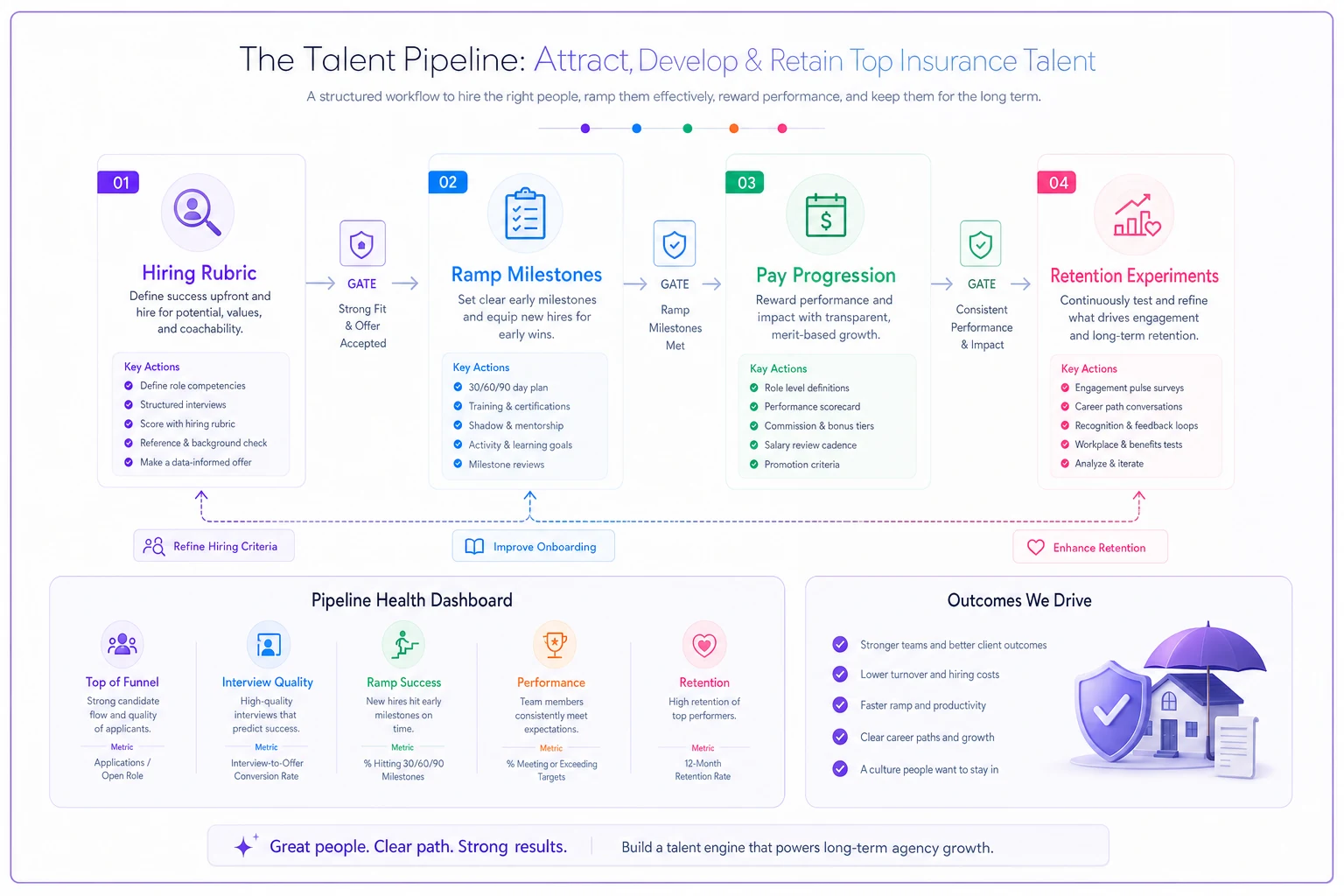
None of these four pieces stands alone. The hiring rubric feeds the ramp plan — you can't measure ramp progress against competencies you never defined at hire. The ramp milestones feed the pay ladder — the gates are the promotion criteria. And the pay ladder feeds retention — the number-one reason your months-3-through-9 people leave is that they can't see a future you never bothered to draw. Fix hiring in isolation and you'll ramp great candidates into a fog. Fix pay in isolation and you'll reward tenure over skill and watch your best people plateau.
The agencies that get this right stop thinking about talent as a series of emergencies and start thinking about it as a pipeline with defined stages, gates, and feedback loops — the same way you already think about a policy or a claim moving through its lifecycle. Keeping the definitions, milestones, and turnover data in one shared place rather than scattered across a manager's inbox and a spreadsheet nobody updates is what lets the system actually hold as you add people. The tooling matters less than the discipline.
But the discipline only survives scale when it's written down, visible, and consistent — because the one thing that definitely doesn't scale is remembering it all in your head.
Ready to transform your insurance agency operations?
Join 500+ agencies using Covixly to reduce manual work, improve client service, and grow their book of business.