

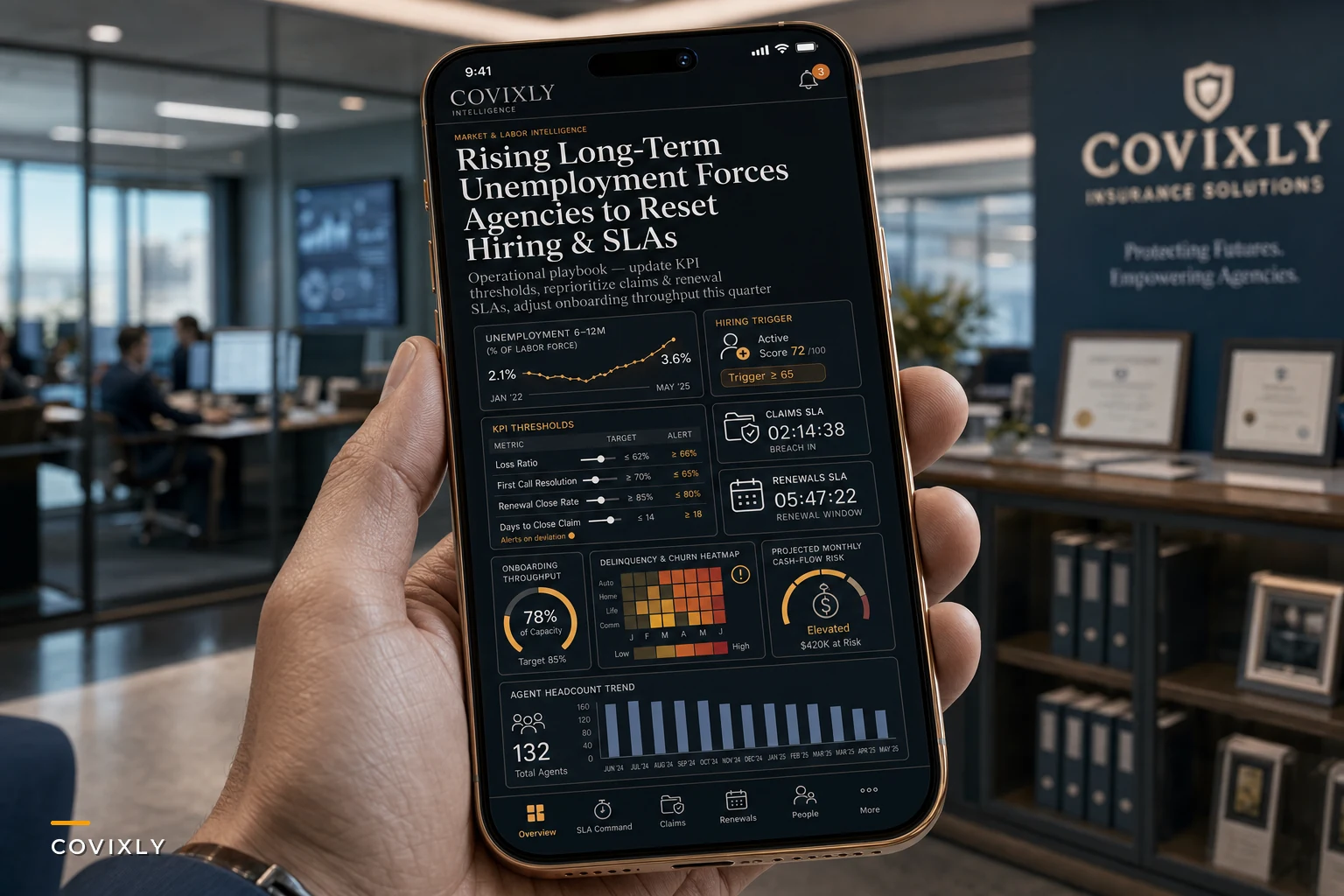

The labor market just flipped. After three years of fighting over talent, agencies suddenly have breathing room—but also a massive operational headache nobody saw coming.
Last week's data painted a clear picture. CNBC reported that long-term unemployment hit 1.8 million Americans, the highest we've seen since early 2022. Meanwhile, Reuters noted initial jobless claims jumped to a four-month high. The tight labor market that forced you to overpay for CSRs? Gone. The desperation hiring of anyone with a pulse who could fog a mirror? Over.
Your entire operational structure was built for a different world. Your SLAs assume full staffing. Your renewal workflows depend on experienced agents who know their book. Your hiring triggers were calibrated when candidates had three offers before lunch.
Now you're stuck between two terrible options: keep your expensive team while premium revenue drops, or cut staff and watch service levels crater right when clients need the most hand-holding.
The hidden operational chaos of a cooling job market
Most agency owners think a softer labor market means easier hiring. They picture a line of qualified candidates begging for work. The reality hits different.
Your best performers—the ones you desperately want to keep—they're suddenly nervous. They see unemployment rising and start hoarding work, refusing to delegate, creating bottlenecks you never had before. That senior CSR who usually trains new hires? She's now "too busy" because job security means being indispensable.
Meanwhile, your client base gets shakier by the week. Commercial accounts that never missed a payment suddenly request payment plans. Personal lines clients let policies lapse, then scramble to reinstate after their mortgage company threatens them. Your team spends twice as long on each renewal because every conversation becomes a negotiation about coverage limits and deductibles.
The math gets ugly fast. One agency I worked with in Tampa saw their premium-per-CSR drop from $1.8M to $1.4M in four months—not because they lost accounts, but because clients downgraded coverage and stretched payments. Their carefully calibrated staffing model fell apart. They had built their KPI dashboard and hiring triggers around steady growth assumptions that suddenly looked ridiculous.
Why standard insurance agency hiring strategies fail in this environment
The traditional approach—hire when busy, fire when slow—destroys agencies during labor market transitions. You can't just flip a switch between growth mode and survival mode without breaking your entire operation.
Eliminate paperwork bottlenecks and missed deadlines.
Covixly helps you track, manage, and close every policy and claim with confidence and speed.
- Unified policy & claims management
- Automated client notifications
- Agent task coordination
No credit card required
Consider what happens to your claims processing when you start cutting staff. Those 24-hour SLA commitments for initial contact? They stretch to 48 hours, then 72. Clients who are already stressed about money get even angrier about slow service. Your Google reviews tank. New business dries up because prospects see those one-star rants about unreturned calls.
Or take the opposite approach: keep everyone on payroll while revenue drops. Your expense ratio explodes. You burn through reserves. Six months later, you're forced into panic cuts that are way deeper than if you'd adjusted gradually.
The agencies that survive this transition do something counterintuitive. They restructure their operations before they touch headcount. They change how work flows through the office, not just who does it.
Restructuring claims SLAs without destroying service
Your claims SLAs were probably written when you had full staffing and growing premium volume. Time to face reality: those commitments will bury you in a downturn.
Start with segmentation. Not all claims deserve equal urgency. A commercial property claim for roof damage needs immediate attention—that client's business operations might be shut down. A minor fender bender with no injuries can wait an extra day for follow-up. But most agencies treat every claim like a five-alarm fire.
Works like this:
Tier 1 (Same Day Response):
-
Commercial property with business interruption
-
Injuries requiring medical attention
-
Total losses (fire, theft, severe accidents)
-
Claims with immediate safety concerns
Tier 2 (24-48 Hour Response):
-
Standard auto claims with vehicle damage only
-
Homeowner claims under $10k estimated
-
Commercial auto without injuries
-
Minor commercial liability incidents
Tier 3 (72 Hour Response):
-
Glass-only claims
-
Comprehensive claims (hail, minor vandalism)
-
Subrogation-likely scenarios
-
Policy clarification requests
The trick is building this into your intake process. Your first-notice-of-loss form needs checkboxes that automatically route claims to the right tier. No human decision needed. The client calling about a cracked windshield gets an automated text confirming receipt and expected timeline. Your adjuster doesn't even see it until day two.
Automate routing rules so simple claims bypass manual triage and reduce handle time.
One agency in Phoenix restructured their claims flow this way and cut their average handle time by 35% without adding staff. They just stopped treating every claim like an emergency.
The renewal workflow trap nobody talks about
Renewals are where agencies bleed out during economic downturns. Not because clients leave—because the renewal process itself becomes a resource vampire.
In good times, renewals are glorified paperwork. Send the renewal notice, collect the premium, move on. Maybe 10% need real attention. During a downturn? Every renewal becomes a save-the-account drill. Clients want to reduce coverage, switch payment plans, argue about rate increases. What took five minutes now takes thirty.
Most agencies respond by throwing more people at renewals. Bad move. You're solving the wrong problem.
You're treating all renewals equally when they're not. A personal auto policy worth $1,200 annually doesn't deserve the same effort as a commercial package worth $50k. Yet most agencies use the same renewal process for both.
Build a renewal scoring system:
-
Annual premium (40% weight)
-
Payment history (20% weight)
-
Claims frequency (20% weight)
-
Years as client (20% weight)
Score each renewal 60 days out. Top 20% get white-glove service—personal calls, coverage reviews, maybe even in-person meetings. Middle 60% get standard automated outreach with the option to request a call. Bottom 20% get purely automated renewal unless they specifically ask for help.
This isn't about abandoning small clients. It's about matching effort to impact. That bottom tier renewal that wants to leave? Let them. You just freed up 30 minutes to save three better accounts.
Building hiring triggers that actually work in volatile markets
Static hiring triggers—like "hire a CSR at 150 accounts per person"—assume stable conditions. They break immediately when the market shifts.
You need dynamic triggers that adjust to reality:
Instead of: "Hire when personal lines CSR handles 200+ accounts per person" Use: "Hire when personal lines response time exceeds 4 hours for 3 consecutive days"
Instead of: "Add producer at $3M book" Use: "Add producer when new business close rate exceeds 35% for 30 days"
Instead of: "Hire claims coordinator at 50 monthly claims" Use: "Hire when Tier 1 claims miss SLA more than twice weekly"
The difference? You're measuring actual operational strain, not arbitrary thresholds. This prevents both over-hiring in good times and under-staffing when things get tight.
Track these metrics daily, but make decisions weekly. Daily data is too noisy—you'll whipsaw yourself. Monthly is too slow—you'll miss inflection points. Weekly gives you the right balance.
Visual workflow for triggers:
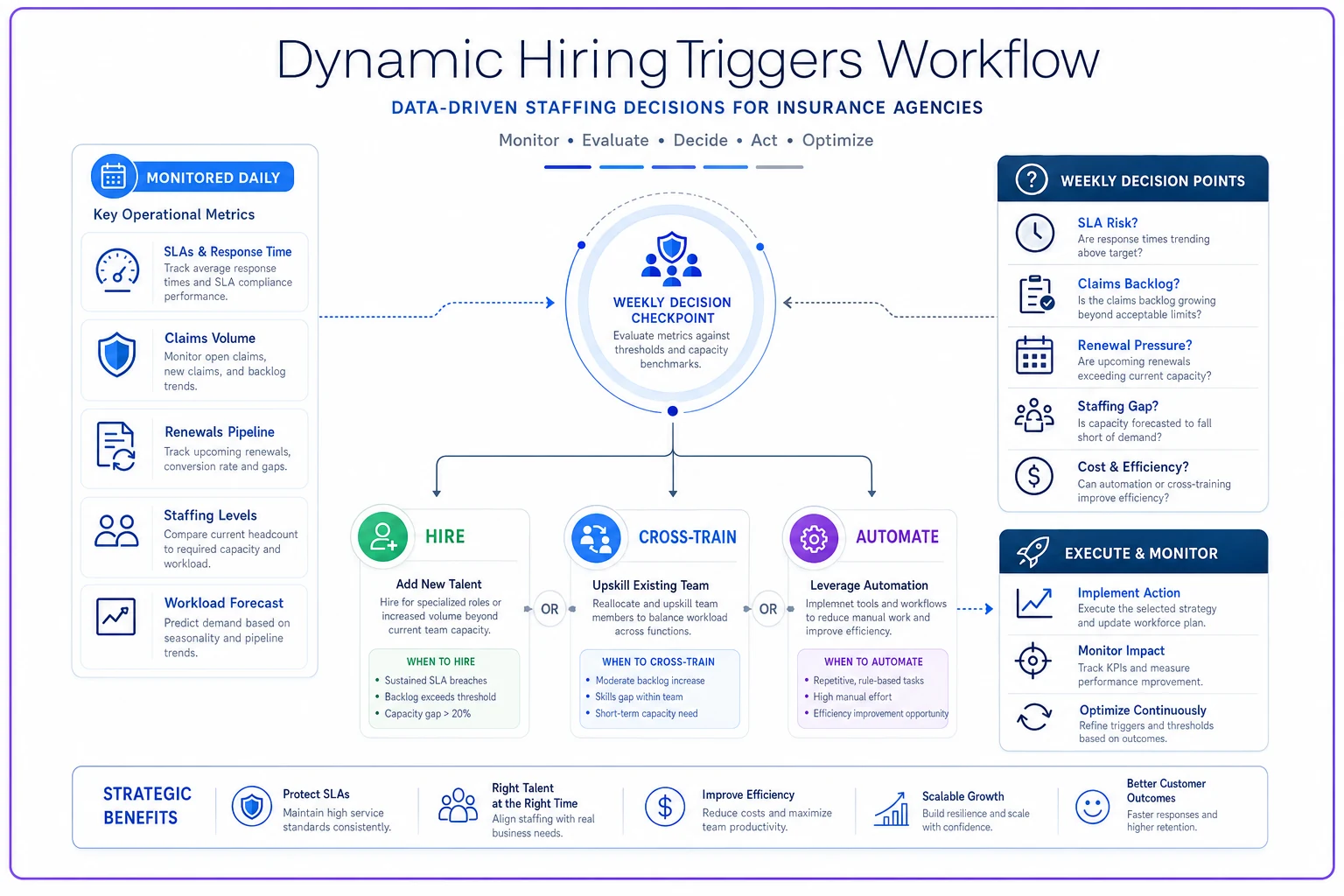
Track these metrics daily, but make decisions weekly. Daily data is too noisy—you'll whipsaw yourself. Monthly is too slow—you'll miss inflection points. Weekly gives you the right balance.
When to pause hiring (and when you absolutely shouldn't)
The knee-jerk reaction to economic uncertainty is a hiring freeze. Seems logical. It's usually wrong.
Freezing all hiring treats every role equally. But some positions become more critical during downturns, not less. Your retention specialist who saves wavering accounts? Worth their weight in gold when everyone's shopping coverage. That part-time data analyst who spots payment default patterns? They'll save you more than their salary in prevented losses.
Pause these:
-
New producer roles (unless replacing departed staff)
-
Administrative positions that don't touch clients
-
Management layers that don't directly produce or service
-
Any role where current staff has under 70% utilization
Never pause:
-
Roles that directly retain revenue
-
Positions that improve cash collection
-
Technology/automation specialists who reduce manual work
-
Compliance roles (penalties don't pause for recessions)
The math is straightforward. Calculate the revenue impact of the role. If they retain or collect more than 3x their loaded cost, keep hiring. If they're a pure expense with no measurable revenue connection, pause.
The non-payment tsunami (and your three-week window to prevent it)
When unemployment rises, premium payments get deprioritized. The data shows a three-week lag between job loss and first missed insurance payment. Once they miss that first payment, 65% never fully catch up.
You have a narrow window to intervene. Most agencies don't even know who's at risk until the cancellation notice goes out. By then, it's too late.
Build an early warning system:
Week One Indicators:
-
Payment method change requests
-
Coverage reduction inquiries
-
Unusual login frequency to client portal
-
Multiple quote requests for same coverage
Week Two Indicators:
-
Missed automatic payment (first attempt)
-
Request for payment plan modification
-
Deductible increase inquiries
-
Removal of comprehensive/collision
Week Three Indicators:
-
Second failed payment attempt
-
Formal payment arrangement request
-
Policy cancellation question
-
Mortgage company verification calls
Once you spot two indicators from any week, trigger proactive outreach. Not a collections call—a "coverage review" to "ensure you're not overpaying." You'd be surprised how many clients will open up about job loss when you approach it as helping them save money rather than collecting debt.
Offer temporary solutions before they ask:
-
Two-month payment deferrals (not forgiveness)
-
Temporary coverage reductions with automatic restoration dates
-
Split monthly payments to bi-weekly
-
Liability-only options with easy full coverage restoration
Most agencies wait for the client to beg. By then, they've usually already mentally written off the policy. Proactive intervention saves about 40% of at-risk policies that would otherwise cancel.
Reallocating your existing team (without the morale disaster)
Cutting staff is expensive and destructive. Reallocating existing staff is complex but preserves capability. The challenge: doing it without triggering a revolt.
Start with voluntary cross-training. "Who wants to learn claims processing?" sounds better than "We're moving you to claims." Offer a small monthly bonus for maintaining dual capabilities—cheaper than hiring and firing.
Map your workload variability:
| Department | Monday Peak | Tuesday Peak | Wednesday Peak | Thursday Peak | Friday Peak |
|---|---|---|---|---|---|
| New Business | 8am-12pm | 9am-11am | 1pm-4pm | 10am-12pm | 8am-10am |
| Renewals | 1pm-3pm | 2pm-5pm | 9am-11am | 2pm-4pm | 3pm-5pm |
| Claims | 10am-2pm | 8am-10am | 11am-2pm | 8am-11am | 1pm-3pm |
| Service | 3pm-5pm | 11am-1pm | 8am-10am | 3pm-5pm | 10am-12pm |
Now you can see the puzzle. Monday morning Claims is slammed while Renewals is dead. Friday afternoon New Business is empty while Service drowns. Start moving people for just those peak hours. "Help Claims on Monday mornings" is easier to swallow than "You now work in Claims."
After a month, extend the temporary shifts. After three months, make them permanent. The gradual transition prevents the "they're taking my job" panic that kills morale.
Technology changes that make sense (and the ones that don't)
Every software vendor is pushing AI automation as the solution to staffing challenges. Most of it is expensive noise. But some genuinely helps during transitions.
Worth implementing now:
-
Automated payment retry sequences (not just single attempts)
-
Chat-based first notice of loss for simple claims
-
Document extraction for routine endorsements
-
Automated renewal questionnaires with exception routing
Not worth it during uncertainty:
-
Full AI underwriting systems
-
Complex claims adjustment automation
-
Predictive analytics for cross-selling
-
Voice AI for inbound calls
The difference? The first list reduces repetitive work without changing core processes. The second list requires massive process reengineering while you're trying to survive a downturn.
One mid-size agency in Denver implemented automated payment retry sequences and saved 15 hours weekly in manual follow-up. Cost: about $400 monthly. They tried implementing AI chat for all inbound service requests and spent three months fixing the disaster it created. Cost: $30k and two lost clients.
During transitions, boring automation beats exciting AI every time.
The timeline that actually matters
Everyone wants to know how long this lasts. The honest answer: longer than you think, but not forever.
Based on previous cycles:
Months 1-3: Denial Phase
-
Premium payments still mostly normal
-
Hiring still follows old patterns
-
Everyone expects quick recovery
Months 4-6: Reality Phase
-
Payment defaults spike
-
Renewal negotiations increase
-
Hiring freezes everywhere
Months 7-9: Adjustment Phase
-
Operations restructuring begins
-
Weak players exit the market
-
Automation investments increase
Months 10-12: Stabilization Phase
-
New operational normal emerges
-
Metrics stabilize at lower levels
-
Selective hiring resumes
Months 13-18: Recovery Phase
-
Growth slowly returns
-
Capacity constraints appear
-
Strategic hiring accelerates
The agencies that thrive are already in Adjustment Phase while competitors are still in Denial. They're restructuring operations in Month 2, not Month 8. They're building early warning systems before the defaults hit, not after.
Making the hard calls nobody wants to make
Some decisions can't wait for perfect information. The labor market has shifted. Your operations need to shift with it. Not in six months when things are "clearer"—now, while you still have room to maneuver.
Start with the least disruptive changes. Segment your claims SLAs. Build early warning systems for payment defaults. Create voluntary cross-training programs. These changes position you for whatever comes next without betting everything on a single scenario.
Then make the harder calls. Pause non-essential hiring. Restructure renewal workflows. Implement boring but effective automation. These moves might feel premature, but premature beats too late every single time in operational transitions.
The agencies that struggled in previous downturns all had one thing in common: they waited for certainty that never came. By the time the picture was clear, their options had evaporated. The successful ones moved fast on partial information, adjusted as needed, and emerged stronger.
Your insurance agency hiring strategy can't be static anymore. The labor market just proved that. Build systems that flex with reality, not fight it. Create triggers that measure actual operational strain, not arbitrary benchmarks. Most importantly, restructure operations before you touch headcount—it's cheaper, faster, and preserves the capability you'll need when growth returns.
The cooling labor market isn't just about unemployment statistics or jobless claims. It's about fundamental shifts in how insurance agencies need to operate. The playbook from the tight labor market is dead. The question isn't whether you'll adapt your operations—it's whether you'll do it proactively or reactively.
The choice is yours, but the timeline isn't. The market already moved. Your operations need to catch up.
Ready to transform your insurance agency operations?
Join 500+ agencies using Covixly to reduce manual work, improve client service, and grow their book of business.