

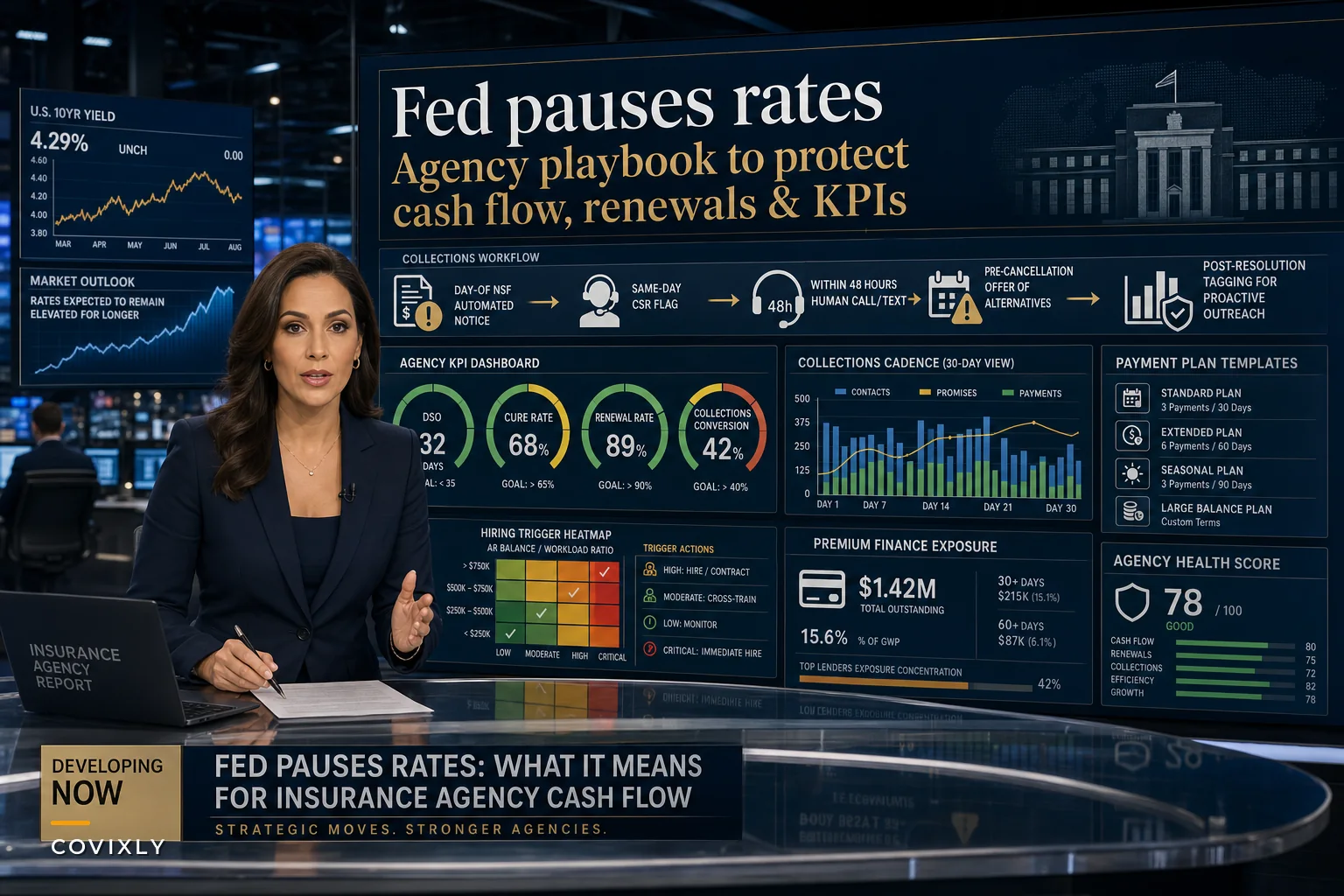

The most recent read on rate policy is pretty clear. According to a Reuters report from mid-August, most economists now expect the Federal Reserve to hold benchmark rates steady through the rest of 2026. Not a dramatic headline on its own. But for agency owners, a sustained pause is a very different animal than a temporary one.
A hold means borrowing costs stay elevated. Auto loans, mortgages, credit card balances, premium finance rates — none of it eases up. Consumers who were quietly hoping for relief in Q4 aren't getting it. And that reality flows straight into your book — into how customers pay, whether they renew, and how quickly your commission dollars actually land in the bank.
This isn't about predicting the Fed. It's about the operational adjustments that separate agencies who coast into a squeeze from the ones who see it coming in their numbers first.
The part most agencies underestimate: cash *timing*, not cash *amount*
When people talk about insurance agency cash flow and Fed rates, they usually jump to premium volume — will customers buy less, will they downshift coverage. That matters, but it's the slow-moving problem. The faster problem is timing.
In a higher-for-longer environment, more customers push toward monthly pay plans and premium financing instead of paying annual up front. That's rational for them. Financing a $2,800 commercial auto premium at elevated rates still beats draining working capital. But every customer who shifts from paid-in-full to a finance plan changes when your commission recognizes and how exposed you are to mid-term cancellation.
A typical example: an agency with a book that was roughly 40% paid-in-full drifts to around 25% over two or three renewal cycles. Nothing broke. No customers left. But the agency's cash arrives later, cancellation-driven chargebacks tick up, and suddenly the owner is asking why revenue looks flat while the phones are just as busy. The volume didn't change. The timing did.
That's the underlying issue a rate pause exposes. Most agencies track how much they earn far better than they track when they get paid — and how likely that payment is to reverse.
Where the pressure actually shows up in your book
Not every customer feels a rate hold the same way. The affordability squeeze concentrates in specific segments, and those are the ones worth watching closely.
Eliminate paperwork bottlenecks and missed deadlines.
Covixly helps you track, manage, and close every policy and claim with confidence and speed.
- Unified policy & claims management
- Automated client notifications
- Agent task coordination
No credit card required
| Customer segment | Why the rate hold hits harder | Early warning sign |
|---|---|---|
| Newer monoline auto (personal) | Payment-sensitive, low switching cost | First-installment NSF, coverage-lowering calls |
| Small commercial with financed premiums | Cash-tight, exposed to APR on finance | Late payments on finance company, requests to re-quote |
| Recently-moved homeowners | Stretched by higher mortgage carry | Escrow disputes, questions about deductible increases |
| Multi-vehicle families | Total household payment stack rising | Dropping vehicles, asking to remove coverages |
The pattern worth naming: customers most likely to lapse rarely call to cancel. They call to adjust first — lower the coverage, raise the deductible, drop a vehicle. Those adjustment calls are the leading indicator. By the time you see an outright cancellation request, you've already missed the window where a retention conversation actually works.
Tag coverage-reduction calls as retention signals and review them weekly.
Most agencies treat coverage-reduction calls as routine service. In a tightening environment, they're a retention signal that should be tagged and reviewed weekly.
Reforecast before the quarter, not after
If your cash-flow forecast still assumes the payment mix and chargeback rate you had eighteen months ago, it's already wrong. The fix isn't complicated, but it does need to be deliberate.
-
Pull your actual pay-plan mix by line for the last three renewal cycles. Look for drift toward monthly and financed plans — even a 5–8 point shift changes your cash timing meaningfully.
-
Calculate your real chargeback rate on cancellations, separated by segment. Blend rates hide the problem; the pain is concentrated in a few segments.
-
Map commission arrival against your fixed obligations (payroll, rent, carrier remittances). The question you're answering: in which weeks does cash get thin?
-
Stress-test one bad month. Model what happens if cancellations rise 15% in your most rate-sensitive segment. If that single scenario threatens payroll, you have a buffer problem, not a growth problem.
-
Set a minimum cash floor and tie it to a specific action — pause a discretionary spend, delay a hire, accelerate a collections push.
Agencies that do this quarterly instead of annually tend to catch the drift while it's still a nudge instead of a wall.
Tighten collections without torching relationships
Collections is where good agencies quietly lose money, because the process is usually reactive. A payment fails, a notice goes out on the carrier's timeline, and by the time anyone at the agency intervenes, the policy is already in cancellation status.
The better approach treats the first missed installment as the moment of action, not the third. A short workflow that works well in practice:
-
Day of NSF or missed installment
automated notice plus a same-day flag to the assigned CSR
-
Within 48 hours
a real human touch — call or text, not just another email
-
Before the cancellation clock runs out
offer a concrete alternative (payment date shift, plan restructure, or a re-quote if coverage is genuinely unaffordable)
-
After resolution
tag the account so repeat offenders get proactive outreach next cycle, before the miss happens
The mistake is treating every late payer as a collections problem. Many of them are a timing problem — their pay date and installment date don't line up. A five-minute conversation to move an installment two days after payday saves the policy and the chargeback.
This kind of repetitive, deadline-driven monitoring is where AI-assisted operational platforms earn their keep. Flagging the missed installment the moment it happens, routing it to the right CSR, surfacing repeat-risk accounts before the next cycle — your team spends its time on the conversation, not hunting through the system to find who's late.
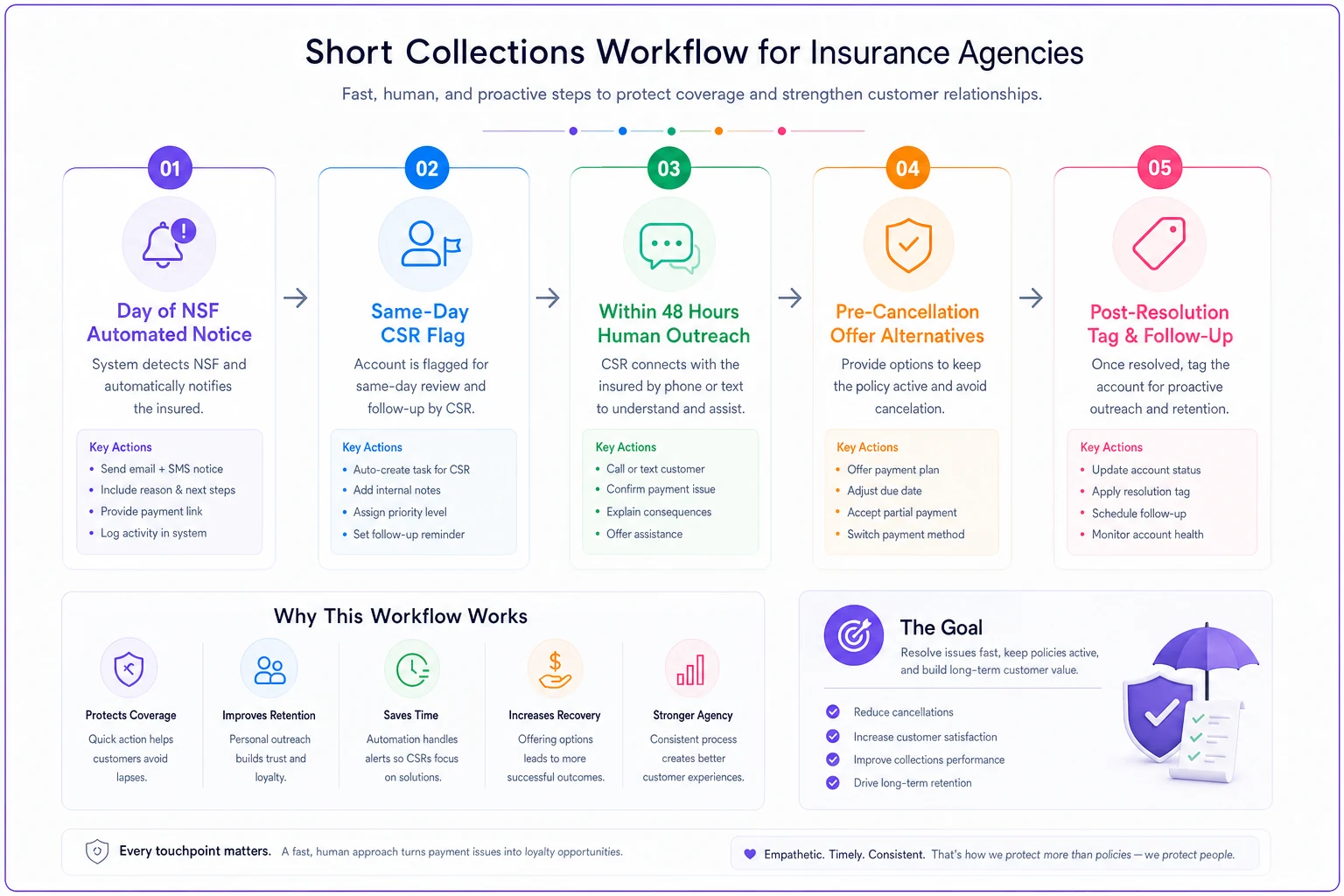
The flow shows where human follow-up intersects with automated flags so teams focus on conversations, not searching for late accounts.
Reprioritize renewals by rate sensitivity, not just expiration date
Most renewal workflows are calendar-driven. Everything expiring in the next 45 days gets worked in roughly the same way. In a stable market that's fine. In a squeeze, it wastes your best retention effort on customers who were never going to leave while under-serving the ones on the edge.
-
High touch rate-sensitive segments, prior adjustment calls, financed premiums, any late-pay history. These get a proactive call before the renewal offer lands, ideally with an option already in hand.
-
Standard stable payers, paid-in-full or long-tenured. A clean renewal notice and a light check-in.
-
Low touch multi-policy, high-tenure, sticky accounts. Automate the routine and don't burn labor here.
The real gain isn't just retention — it's labor allocation. Your CSR hours are finite. Pointing them at accounts that will actually respond to a conversation is how a smaller team holds retention in a tougher year.
A real scenario
A mid-sized independent agency — roughly 3,100 policies, mostly personal lines with a growing small-commercial book — noticed something odd heading into a renewal-heavy quarter. Retention on paper looked fine, around 88%, but cash was tightening and chargebacks were creeping up.
When they pulled the numbers apart, the story got clearer. Their financed-premium share had drifted from about 30% to the low 40s over the prior year. Chargebacks on cancelled financed policies were running noticeably higher than their blended rate suggested — the pain was concentrated in newer commercial auto and a slice of payment-sensitive personal auto.
They made three changes. They started flagging first-missed installments for same-day CSR outreach instead of waiting on carrier notices. They tagged coverage-reduction calls as retention signals and worked them within a week. And they re-cut their renewal queue by rate sensitivity so proactive calls hit the high-risk accounts before the offer went out.
Nothing exotic. Over the next two quarters, cancellation-driven chargebacks came down by roughly a third, and cash arrived on a steadier cadence because fewer financed policies were cancelling mid-term. Retention barely moved on paper — but the quality of the retained book, and the predictability of the cash, improved considerably.
Update your KPI thresholds and hiring triggers
This is the piece that gets missed most often. When the environment shifts, your dashboard thresholds should shift with it — but most agencies leave them frozen at last year's assumptions.
If your hiring trigger was "add a CSR when service volume hits X," but a chunk of that volume is now collections and retention work rather than new business, you might be about to hire against the wrong signal. In a squeeze, the metrics that deserve tighter thresholds are AR aging, chargeback rate, first-installment failure rate, and the volume of coverage-adjustment calls. Those are your early-warning system right now, and they should carry more weight in staffing and cash decisions than raw policy count.
A well-built metrics dashboard pays off not for reporting, but for making faster decisions. If you're rethinking which metrics drive your cadences and hiring calls, the breakdown of the agency owner's KPI dashboard walks through prioritizing metrics and setting the right triggers by role. In a higher-for-longer year, the revenue and AR metrics on that dashboard deserve a fresh look and probably tighter bands.
KPI thresholds aren't set-and-forget. A rate environment shift is exactly the kind of external change that should prompt you to revisit them.
When to act aggressively — and when not to overreact
Not every agency needs to overhaul everything. A little judgment matters here.
Move aggressively if: your financed-premium share is climbing, your chargeback rate is above your blended commission cushion, or a single bad month would threaten payroll. Those are structural exposures, and a rate hold makes them worse over time.
Don't overreact if: your book skews high-tenure, multi-policy, paid-in-full, with stable payment behavior. Ripping up a working renewal process to chase a squeeze that won't hit your particular customer base just creates churn in your own operation. Tighten monitoring, but don't rebuild what isn't broken.
One thing to be careful about: don't let a collections tightening turn into a service reputation problem. Agencies that get this wrong swing too hard toward automated notices and cancellation pressure, and end up pushing out good long-term customers who just needed a payment date moved. The goal is earlier, softer intervention — not harder enforcement.
The takeaway for the months ahead
A rate pause isn't a crisis. But it removes the "relief is coming" cushion a lot of customers and agencies were quietly counting on. The agencies that come through it well aren't the ones with the most sophisticated forecast — they're the ones watching the right early signals: the coverage-reduction call, the first missed installment, the drift in payment mix.
Get those signals in front of the right people quickly, keep your KPI thresholds honest, and treat cash timing as seriously as cash amount. That's most of the work. The rest is just doing it before it shows up in your AR aging report instead of after.
Ready to transform your insurance agency operations?
Join 500+ agencies using Covixly to reduce manual work, improve client service, and grow their book of business.