



The September reading landed hard. The Conference Board reported a 6.7-point drop in the Consumer Confidence Index to 81.9, the weakest print since 2014, with Reuters noting it's sitting near a 12-and-a-half-year low driven mostly by labor-market worries. For most industries this is a demand story. For agencies, it's a cash-timing story — and those are different problems that need different reflexes.
Most agency owners wait for retention numbers to drop before reacting. By then you're already two or three billing cycles behind the problem. Confidence drops show up in your book weeks before they show up in any KPI dashboard — in partial payments, premium-finance inquiries, clients calling to "ask about cheaper options." Those are the early tremors. This playbook is about reading them early and acting in the right order.
Start by understanding what actually breaks first
When confidence falls this sharply, the damage doesn't hit your book evenly. It moves in a pretty predictable sequence, and knowing that sequence lets you put effort where it actually matters instead of spreading panic everywhere at once.
The first thing to go isn't cancellations. It's payment behavior. Clients who used to pay in full start asking about monthly. Clients already on monthly start paying late. Then premium-finance volume spikes, which quietly increases your exposure to NSF cancellations a few months down the road. New-business conversion slows next — especially on anything discretionary, like umbrella policies, higher limits, that commercial package upgrade someone was "thinking about." Actual non-renewals come last, usually 60 to 90 days after the confidence shift.
| Signal | Typical timing | What it actually means | Priority to act |
|---|---|---|---|
| Shift from annual to monthly pay | 0–2 weeks | Household liquidity tightening | High |
| Rising late payments | 2–4 weeks | Cash stress, not yet shopping | Critical |
| "Can we lower coverage?" calls | 3–6 weeks | Downgrade risk, retention salvageable | High |
| Premium-finance inquiries up | 4–6 weeks | NSF cancellation risk building | Medium-High |
| Non-renewal / shop-around | 60–90 days | Already too late to be cheap about it | Varies by client value |
So if your response plan is built around preventing cancellations, you're defending the wrong gate. The leverage is upstream, in payment friction and conversation timing.
Move 1: Re-forecast cash on a 13-week horizon, not a quarterly one
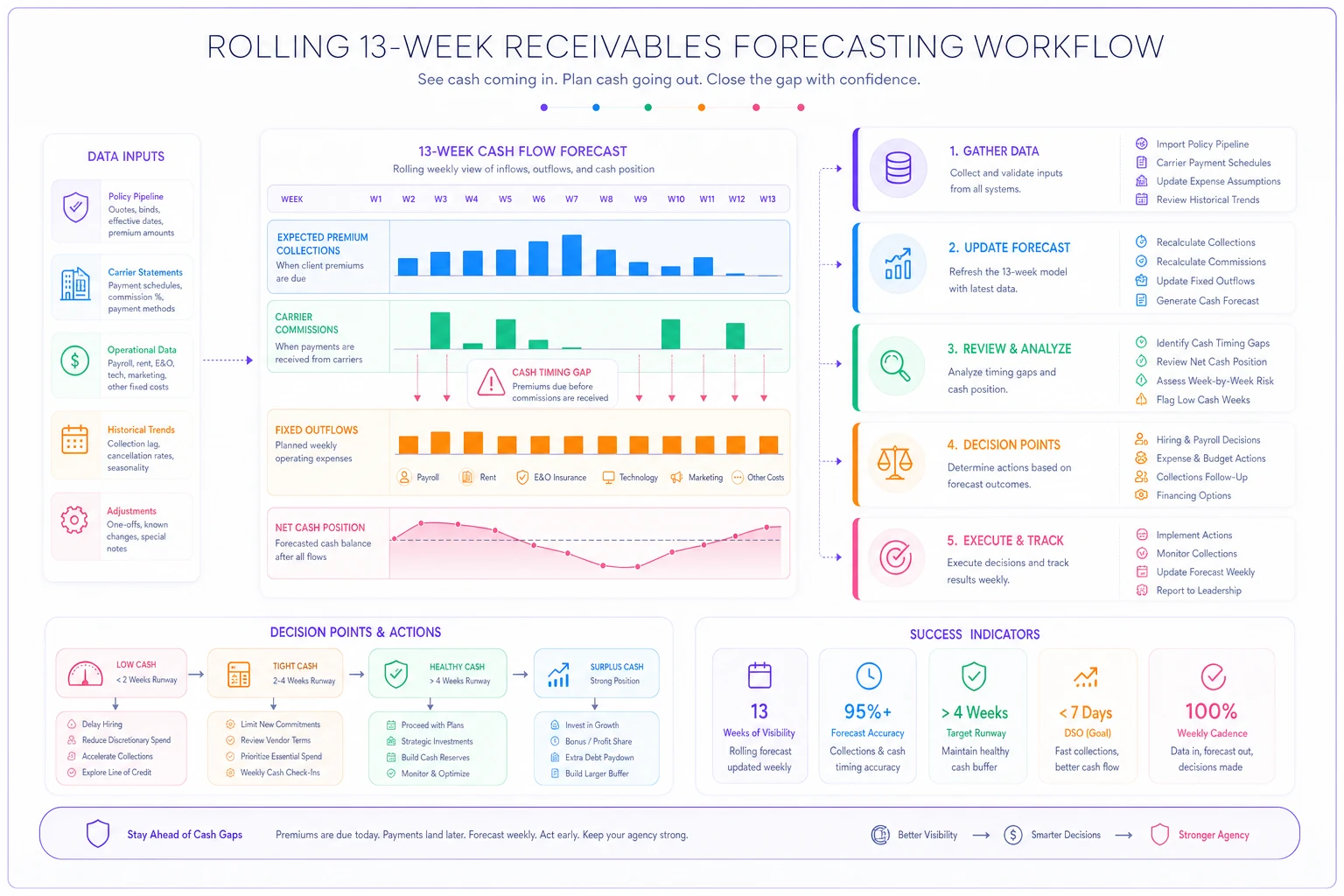
Monthly P&L forecasting is too coarse for a demand shock. When payment behavior shifts, you need to see the problem in weeks, not months. Pull together a rolling 13-week receivables view: expected premium collections, commission timing from carriers, and your fixed outflows — payroll, rent, E&O, tech stack.
Eliminate paperwork bottlenecks and missed deadlines.
Covixly helps you track, manage, and close every policy and claim with confidence and speed.
- Unified policy & claims management
- Automated client notifications
- Agent task coordination
No credit card required
The number you're looking for is the gap between when premiums are due and when they actually land. In normal conditions that gap might be a few days. Under confidence stress it can stretch to two or three weeks as late payments pile up — which means an agency that looks profitable on paper can hit a real cash pinch around week six or seven without seeing it coming.
Here's a simple visual of the rolling 13-week receivables workflow.
If you haven't already decomposed where your margin actually lives, do it now. Our agency P&L playbook that breaks down profitability by product, producer and channel is worth running before you make any cuts. The instinct during a scare is to trim broadly, and broad trimming almost always clips something that was quietly carrying your book.
Move 2: Segment your renewals by *value at risk*, not by renewal date
Most agencies work renewals chronologically — whatever's up next gets the outreach. That's fine in calm periods. Right now it means your best CSR hours go toward low-premium, low-risk accounts while high-value clients drift toward the shop-around window without a single real touch.
-
Account value — annual commission, not premium. A $14k commercial package matters more to your survival than four $900 personal auto policies.
-
Stress exposure — industries or client segments most exposed to the labor concerns driving this drop. Hospitality, construction, retail, and discretionary-spend small businesses tend to feel it first.
Accounts in the high-value, high-stress quadrant get a real human conversation before the renewal notice goes out — not after. The low-value, low-stress quadrant can run on your standard automated renewal flow. A decent agency management system earns its keep here by tagging accounts so the renewal queue sorts itself instead of your team eyeballing a spreadsheet every Monday.
Move 3: Rewrite the downgrade conversation before clients force it
When a client calls asking to "lower coverage to save money," the untrained reflex is to reduce limits immediately. That's a retention loss disguised as a save — and it exposes them, and you on the E&O side, if a claim later lands above their new limit.
A better approach for that call:
-
Acknowledge the pressure directly. Don't pretend nothing changed in their world.
-
Reprice before you reduce. Re-shop carriers, check for missed discounts, adjust deductibles before touching limits.
-
If coverage must drop, document the decline. Put the recommendation and the client's choice in writing, every time.
-
Set a re-review trigger — a note to revisit in 90 days when their situation stabilizes.
The agencies that keep clients through downturns treat the downgrade call as a retention opportunity instead of an order-taking task. The ones that lose clients process the reduction silently, never follow up, and six months later that client — feeling no relationship — shops the whole policy.
Move 4: Tighten receivables monitoring before it becomes collections
There's a real operational difference between monitoring receivables and collecting on them. Monitoring is cheap and preserves relationships. Collections is expensive and damages them. The whole goal during a confidence dip is to catch slippage early enough that you never cross into collections mode.
-
Day 3 past due soft automated reminder, friendly tone, easy pay link.
-
Day 7 second reminder plus a note flagging the account for CSR awareness.
-
Day 10–12 personal outreach from the account's CSR — offer finance or split-pay before the cancellation clock forces the issue.
-
Pre-cancellation window owner or manager review for any account above your value threshold.
Trigger the personal outreach automatically at day 10 to prevent NSF cancellations.
Most agencies have reminders. Very few have the personal touch triggering automatically at day 10–12, which is exactly the moment a two-minute human call prevents an NSF cancellation. Letting software manage the reminder cadence frees your CSRs to spend time on the accounts where a human voice actually changes the outcome.
Move 5: Re-check your SLAs against the new reality
Claims and service volume often rises during economic stress — more questions, more coverage-review requests, more "what does my policy actually cover" calls. If your SLA commitments were set in a calmer period, you might be about to miss them exactly when clients are most anxious and most likely to leave over a slow response.
Two things to pressure-test:
Response-time SLAs under a 15–20% volume increase. Does your current staffing still hit them? If not, decide now whether you flex hours, reprioritize queues, or bring in contract help — not when you're already mid-crisis.
Claims communication cadence. A claim going quiet for a week feels catastrophic to a stressed policyholder. Proactive status updates — even "no change yet" — hold retention more than most agencies expect.
Move 6: Freeze speculative spend, protect revenue-touching roles
The reflex to cut costs is right. The usual execution of that reflex is wrong. Panic cuts tend to target visible line items instead of low-value ones.
When trimming makes sense:
-
Discretionary marketing on channels you haven't actually measured for conversion.
-
Redundant software you've been meaning to sunset anyway.
-
Speculative hiring not yet tied to committed revenue.
When trimming is a bad idea:
-
Any role in direct contact with high-value renewals right now.
-
Retention and claims-service capacity — cutting here accelerates the loss you're trying to prevent.
-
Tools that reduce manual receivables and renewal work, since those are carrying more weight during the exact period you're short on hands.
The mistake that comes up repeatedly: an agency cuts a CSR to save roughly $4k–$5k a month, then loses two mid-size commercial accounts over slow service in the same quarter — a net loss several times larger than what was "saved."
Move 7: Adjust your hiring and contractor triggers to revenue, not calendar
If your growth plan assumed hiring a producer in Q4, that trigger should now be tied to a revenue signal, not a date. Same with contractor ramp-ups. During a confidence dip, you want staffing decisions that respond to your actual book, not a plan written when the index was 15 points higher.
A simple rule a lot of stable agencies use: don't add fixed headcount until trailing 8-week net new commission crosses a defined threshold and your 13-week cash forecast shows cushion past your minimum reserve. Until then, flex with overtime or short-term contract support you can scale back without severance pain.
A real scenario
A mid-size independent agency — roughly $1.1M in annual revenue, heavy on small commercial — noticed monthly-pay requests jump in the first two weeks after a confidence drop. Instead of waiting, they ran the value-at-risk sort and found that about 20 accounts, around 8% of their book, represented close to 40% of their at-risk commission.
They moved those 20 to proactive, human-led renewal conversations two to three weeks ahead of schedule, tightened their late-payment escalation to trigger personal outreach at day 10, and paused a planned producer hire pending their cash forecast. Over the following quarter, late-payment NSF cancellations dropped noticeably compared to the prior downturn they'd weathered, and they retained all but two of the high-value accounts. The pattern wasn't luck — it was sequencing. They defended the upstream gates instead of fighting cancellations after the fact.
The underlying problem this exposes
A confidence shock doesn't create new weaknesses in an agency. It reveals the ones already there — the renewal queue running on date instead of value, the receivables process that only escalates when it's already too late, the forecast too coarse to see a cash pinch coming. Agencies that sail through downturns aren't the ones with better clients. They're the ones whose operations were already organized around value at risk and cash timing instead of calendar habit.
The confidence index will recover — these numbers always cycle. But the operational discipline you build reacting to this one carries over. Tighter forecasting, smarter renewal prioritization, earlier receivables touchpoints — these don't disappear when sentiment improves. They make your book more resilient the next time apprehension spikes. Treat this as the stress test. The agencies that come out ahead are the ones already moving on Moves 1 and 2 while everyone else is still waiting for the retention report to confirm what the payment behavior told them weeks ago.
The confidence index will recover — these numbers always cycle. But the operational discipline you build reacting to this one carries over. Tighter forecasting, smarter renewal prioritization, earlier receivables touchpoints — these don't disappear when sentiment improves. They make your book more resilient the next time apprehension spikes. Treat this as the stress test. The agencies that come out ahead are the ones already moving on Moves 1 and 2 while everyone else is still waiting for the retention report to confirm what the payment behavior told them weeks ago.
Ready to transform your insurance agency operations?
Join 500+ agencies using Covixly to reduce manual work, improve client service, and grow their book of business.