

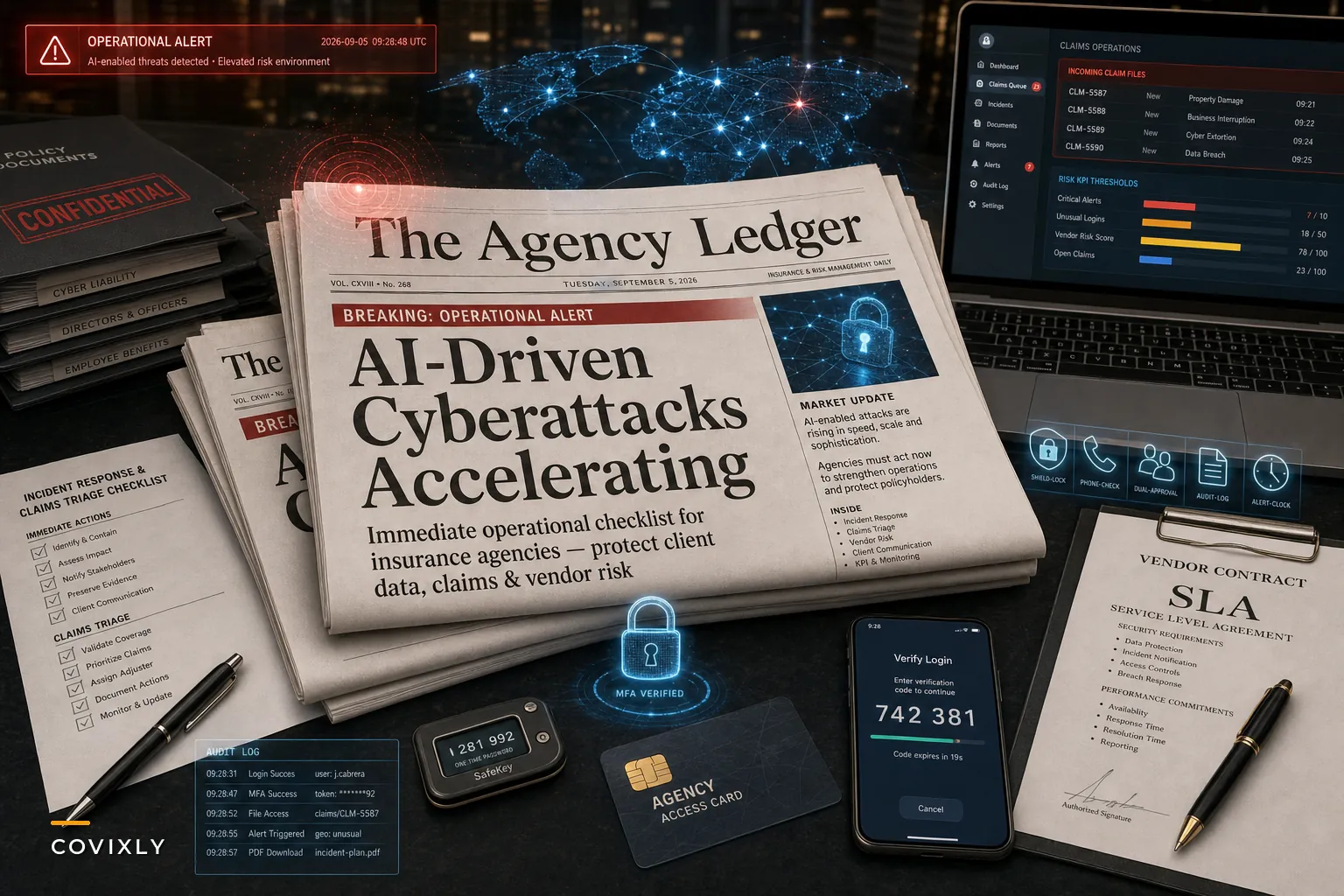

The warning that landed on August 27, 2026 wasn't the usual security-vendor fearmongering. Dozens of major tech companies signed onto a coordinated call for a "society-wide defensive surge" against AI-enabled attacks — and it came one day after Reuters reported a sharp rise in AI-driven ransomware and data-theft incidents hitting U.S. companies and government agencies. When the people building the attack-and-defense tools are openly asking for reinforcements, that's worth paying attention to.
For insurance agencies, the interesting part isn't the headline. It's the operational reality underneath it. Agencies hold some of the richest, most attackable data sets in the small-business world: SSNs, driver's license numbers, VINs, property addresses, medical details on some claims, banking info for premium finance, and carrier portal credentials that open doors well beyond your own walls. You're a soft target sitting next to a very hard target — the carriers — and attackers know it.
So skip the "cybersecurity is important" sermon. You already know that. Here's what's actually changed, where agencies are exposed in ways they don't expect, and a concrete checklist you can start working through this week.
What AI actually changed about the attack, in plain terms
The old phishing model was volume with obvious tells. Broken English, a weird sender address, a fake DocuSign that didn't quite look right. Your CSRs learned to spot it. AI collapsed those tells.
What's different now is personalization at scale. An attacker can scrape a producer's LinkedIn, your agency's public bio pages, a recent press mention about a new carrier appointment, and generate an email that references a real deal, in the right tone, from a spoofed address that looks like your actual MGA rep. The tech-sector letter calling for a collective defensive push exists precisely because this personalization has gotten cheap and fast.
-
Business email compromise around premium and claims payments. A convincing email redirects a premium payment or claims settlement to a mule account. This is the one that generates E&O claims.
-
Credential theft into carrier and comparative rater portals. Once inside, an attacker can pull books of business, mine PII, or issue fraudulent policies and certificates.
-
Vendor-side breaches. Your AMS, document management system, comparative rater, e-signature tool — any one of them getting breached exposes your clients, and you'll be the one explaining it.
The uncomfortable truth: most agencies have spent their security budget on the first shape and almost nothing on the third.
The exposure most agencies underrate: your vendor's incident is your incident
There's a pattern that comes up constantly. An agency runs a reasonably tight internal operation — MFA on email, decent password hygiene, a firewall someone actually configured. Then a mid-tier vendor they've used for six years gets breached, and suddenly the agency is sending breach notifications to thousands of clients over data they didn't even store themselves.
Eliminate paperwork bottlenecks and missed deadlines.
Covixly helps you track, manage, and close every policy and claim with confidence and speed.
- Unified policy & claims management
- Automated client notifications
- Agent task coordination
No credit card required
This usually happens because vendor relationships get treated as "set and forget." You signed a contract in 2021, checked a box that said SOC 2 compliant, and never looked again. Meanwhile that vendor added subprocessors, moved to a new cloud region, and let their security certification lapse. Nobody at your agency knows because nobody's job was to know.
The regulatory piece makes this sharper. Depending on your state and carrier agreements, a vendor breach involving your clients' nonpublic information can trigger your reporting obligations, on your timeline, regardless of how slow the vendor is to admit what happened. If you're not already thinking through the compliance mechanics here, our breakdown on preparing your agency for the AI Incident Reporting Act covers the vendor-risk and reporting side in more depth than I'll get into here.
A quick way to rank your vendor exposure
Not every vendor deserves the same scrutiny. Sort them fast using this rough tiering:
| Vendor tier | What they touch | Review cadence | Minimum requirement |
|---|---|---|---|
| Critical | Bulk client PII, banking data, or writes to carrier systems (AMS, doc mgmt, premium finance) | Quarterly | Current SOC 2 Type II, MFA enforced, breach-notice SLA in writing |
| Elevated | Client contact data, quoting data, e-signatures | Twice a year | Security attestation, documented data handling, subprocessor list |
| Standard | Limited or no PII (scheduling, marketing tools) | Annually | Basic security questionnaire |
The mistake I see repeatedly is agencies applying heavy scrutiny to a marketing tool while their document management vendor — the one holding scanned licenses and loss runs — hasn't been reviewed since onboarding.
The internal gap: your claims and payment workflows are the real target
Attackers don't care about your data in the abstract. They care about moving money and stealing information they can monetize. That means your highest-risk workflows are the ones where money changes direction or where PII gets handled in bulk.
Think about a typical claims payment or premium refund. Somewhere in that flow, someone updates a payee, confirms an account number, or approves a wire. If that confirmation happens over email — "hey, the insured's bank changed, here's the new routing number" — you have a hole. AI-generated impersonation is aimed squarely at exactly that kind of message.
A workflow that's actually resilient looks like this:
-
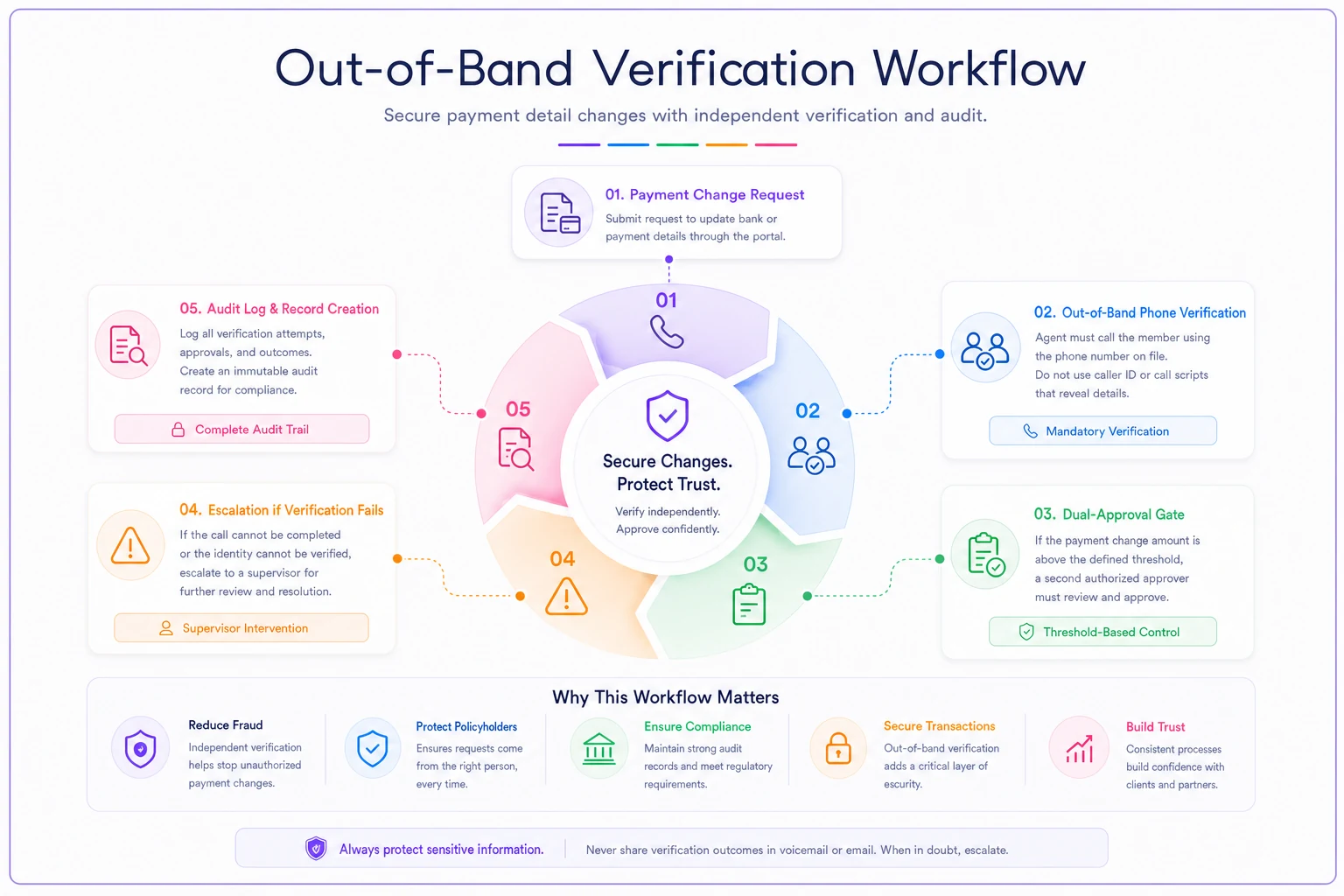
Any change to payment details (bank account, mailing address for a check above a threshold, payee name) triggers a mandatory out-of-band verification — a phone call to a number already on file, not the number in the email.
-
The person requesting the change and the person approving it are never the same person for amounts above a set limit.
-
The verification step is logged — who called, what number, what was confirmed.
-
Anything that fails verification routes to a named supervisor, not back to the requester.
Here's a simple visualization of the verification workflow.
None of that requires expensive tooling. It requires that the rule exists and that it can't be skipped when someone's in a hurry at 4:45 on a Friday. That last part is where most controls quietly die.
Where the right systems genuinely help — and where they don't
Technology won't stop a determined attacker who gets a tired CSR to click at the wrong moment. What good operational software does do is remove the seams where mistakes hide.
Centralization matters most here. When client data, claim notes, payment records, and communication history all live in one system with real access controls and audit logs, a few things get easier: you can see who touched what, enforce that payment changes go through a verification step, and actually produce the access trail a regulator or carrier will ask for after an incident. Agencies running data across a dozen disconnected tools, spreadsheets, and inboxes have no realistic way to answer "what exactly was exposed and who accessed it" — which is the first question you'll get in a breach.
Where AI-assisted features in operational platforms earn their keep is in the monitoring nobody has time to do manually: flagging a login from an unusual location, catching that a payee's bank details changed twice in one week, surfacing a vendor whose security attestation is about to expire. That's automation reducing the number of things a human has to remember to check. It's not a magic shield, and any platform that markets it that way should make you skeptical.
Automate expiration alerts for vendor attestations so reviews don't lapse unnoticed.
Where software doesn't help: it won't fix a culture where the owner reuses one password across the AMS and their personal email, or where nobody's accountable for vendor reviews. Tools amplify whatever discipline already exists. If the discipline is zero, the tool multiplies zero.
When aggressive hardening actually makes sense — and when it's overkill
This heavier approach makes sense when: you write commercial lines with larger settlement amounts, you handle premium finance or trust accounts, you have multiple branches sharing systems, or you hold health-related claim data. The blast radius of a breach is large enough to justify real investment.
You can scale it back when: you're a small personal-lines shop, you don't touch payment routing directly, and your carriers process claims payments themselves. You still need the fundamentals, but the elaborate dual-approval machinery may be more than your volume warrants.
Who should not wing this: any agency without MFA on email and carrier portals, full stop. That's not a nuanced judgment call. If a producer can log into a carrier portal with just a password, that's the first thing to fix before anything else.
A real scenario worth learning from
A mid-size commercial agency — around 18 staff, heavy on contractor and habitational risks — got hit through a comparative rater vendor breach. The vendor exposed quoting data that included named insureds, addresses, and prior loss information for roughly 2,600 clients. The agency didn't cause the breach. But because their client data was spread across the rater, two AMS instances from a past acquisition, and a shared drive, it took them nearly three weeks and outside forensic help just to determine whose data was in the exposed set.
Direct notification and remediation costs landed somewhere in the $40k–$55k range, before two E&O claims that came in over the following months. The part that stung most, according to the owner, wasn't the money — it was calling clients and not being able to tell them precisely what was exposed for the first ten days.
Afterward they did three things that actually mattered: consolidated onto a single system with proper audit logging, built the tiered vendor review structure above and assigned ownership to their operations lead, and put out-of-band verification on every payment change. When another phishing attempt hit about eight months later — a spoofed "carrier" asking to redirect a return-premium check — a CSR made the callback, reached a dead number, and shut it down in four minutes. That's the whole game: making the safe path the default path.
The checklist to work through this quarter
You don't have to do all of this at once.
-
[ ] MFA enforced on email, AMS, all carrier portals, and comparative raters — no exceptions, including for the owner
-
[ ] Out-of-band verification required for every payment-detail change, with a logged callback to a number on file
-
[ ] Dual approval on payments and refunds above a defined threshold
-
[ ] Tiered vendor list built, with critical vendors flagged and review dates on the calendar
-
[ ] Written breach-notification SLA obtained from every critical vendor
-
[ ] Subprocessor lists collected for vendors holding client PII
-
[ ] Client data consolidated enough that you can answer "who was exposed and who accessed it" within days, not weeks
-
[ ] Incident-response contacts documented — legal, forensic, carrier E&O, state regulator — before you need them
-
[ ] A short, pre-approved client-communication template ready for a breach notification
-
[ ] Staff trained specifically on AI-personalized phishing, not just generic "don't click links" advice
-
[ ] Access reviews run quarterly to remove former employees and unused carrier logins
But most of these should be checked off within 90 days.
The honest bottom line
The August warnings weren't hype, but the right response for an agency isn't panic — it's boring, durable discipline.
AI made attacks faster and more convincing, which means the sloppy seams in your operations that you've tolerated for years are now more likely to get found and exploited. The agencies that come through this fine won't be the ones with the fanciest security stack. They'll be the ones where the verification call is non-negotiable, where someone actually owns vendor reviews, and where client data is centralized enough that a breach becomes a manageable event instead of a three-week scramble. Start with MFA and payment verification this week. Everything else on the checklist can be sequenced from there.
The August warnings weren't hype, but the right response for an agency isn't panic — it's boring, durable discipline.
AI made attacks faster and more convincing, which means the sloppy seams in your operations that you've tolerated for years are now more likely to get found and exploited. The agencies that come through this fine won't be the ones with the fanciest security stack. They'll be the ones where the verification call is non-negotiable, where someone actually owns vendor reviews, and where client data is centralized enough that a breach becomes a manageable event instead of a three-week scramble. Start with MFA and payment verification this week. Everything else on the checklist can be sequenced from there.
Ready to transform your insurance agency operations?
Join 500+ agencies using Covixly to reduce manual work, improve client service, and grow their book of business.