


When an agency has 400 renewals a month, missing one feels invisible. Nobody notices until the client calls angry about a lapse notice, or a carrier claws back commission, or worse — there's a claim on a policy that quietly went non-renewed six weeks ago. At that point it's not a scheduling problem anymore. It's an E&O problem.
The frustrating part is that most missed renewals at scale aren't caused by lazy CSRs or bad producers. They're caused by scheduling systems that work fine at 80 renewals a month and silently break at 400. The workflow doesn't collapse all at once — it just starts leaking around the edges, and the leaks are hard to see because everything looks busy.
This post is about the specific mechanics of that breakdown, and how agencies with large portfolios actually prevent missed renewals without hiring three more people or living in the activity log.
The failure that hides in "everything got worked"
The mistake that causes more missed policies than any other: treating every renewal as equally urgent and working them in whatever order they surface.
At small volume that's fine. When your team sees 15 renewals for the week, they can eyeball the list, notice the messy commercial account, and handle it first. Human judgment fills the gaps. At 90 renewals a week across three CSRs, that judgment disappears. People work top-down through a list, or worse, they work whatever email came in most recently. The renewals that need the most lead time — the ones with carrier remarketing, loss runs, or a mid-term endorsement mess — end up buried under a pile of easy monoline personal auto renewals that could've been touched in two minutes.
What you end up with is a queue that's technically "worked." Every day the team closes activities. The dashboard looks healthy. But the three accounts that actually needed 45 days of runway got picked up at day 12, the carrier came back with a 30% increase, and now there's no time to remarket. The client leaves, or the policy lapses in the gap.
This usually shows up as a pattern: your lapse and non-renewal problems cluster in the complex accounts, not the simple ones. If you chart which policies get missed and they're disproportionately commercial or multi-carrier, the problem isn't effort. It's that nothing in the workflow forces the hard renewals to the front of the line early enough.
Priority scoring: stop working renewals in arrival order
The fix isn't "work harder" or "get to renewals earlier." It's giving every renewal a score the day it enters the window, so the queue sorts itself by how much runway the policy actually needs — not by when someone happened to open it.
Eliminate paperwork bottlenecks and missed deadlines.
Covixly helps you track, manage, and close every policy and claim with confidence and speed.
- Unified policy & claims management
- Automated client notifications
- Agent task coordination
No credit card required
-
Lead time required — how many days of work this renewal type genuinely needs (a clean personal auto needs 15; a commercial package with loss runs needs 60)
-
Premium / revenue weight — a $40k commercial account and a $600 renters policy should not compete equally for attention
-
Remarketing likelihood — flagged if the renewal quote came back above a threshold increase, or if the carrier is exiting the class
-
Client risk signals — prior late payments, recent claims, or a history of shopping
-
Complexity flags — mid-term endorsements, multiple locations, additional insureds, or anything that touched underwriting during the term
You don't need a data science model. A simple weighted number works. The point is that a $35k contractor account with a 28% increase and pending loss runs should score high enough to surface on day one of the window, while a clean auto renewal can safely sit until day 20.
Here's a rough scoring frame agencies can adapt:
| Factor | Low (1) | Medium (2) | High (3) |
|---|---|---|---|
| Lead time needed | Under 20 days | 20–45 days | 45+ days |
| Premium weight | Under $2k | $2k–$15k | $15k+ |
| Remarket likelihood | No flag | Rate increase 10–20% | Increase 20%+ or carrier exit |
| Client risk | Clean history | 1 flag | 2+ flags |
| Complexity | Monoline, no changes | Minor endorsements | Multi-location / underwriting-touched |
A simple visual of how scoring routes renewals:
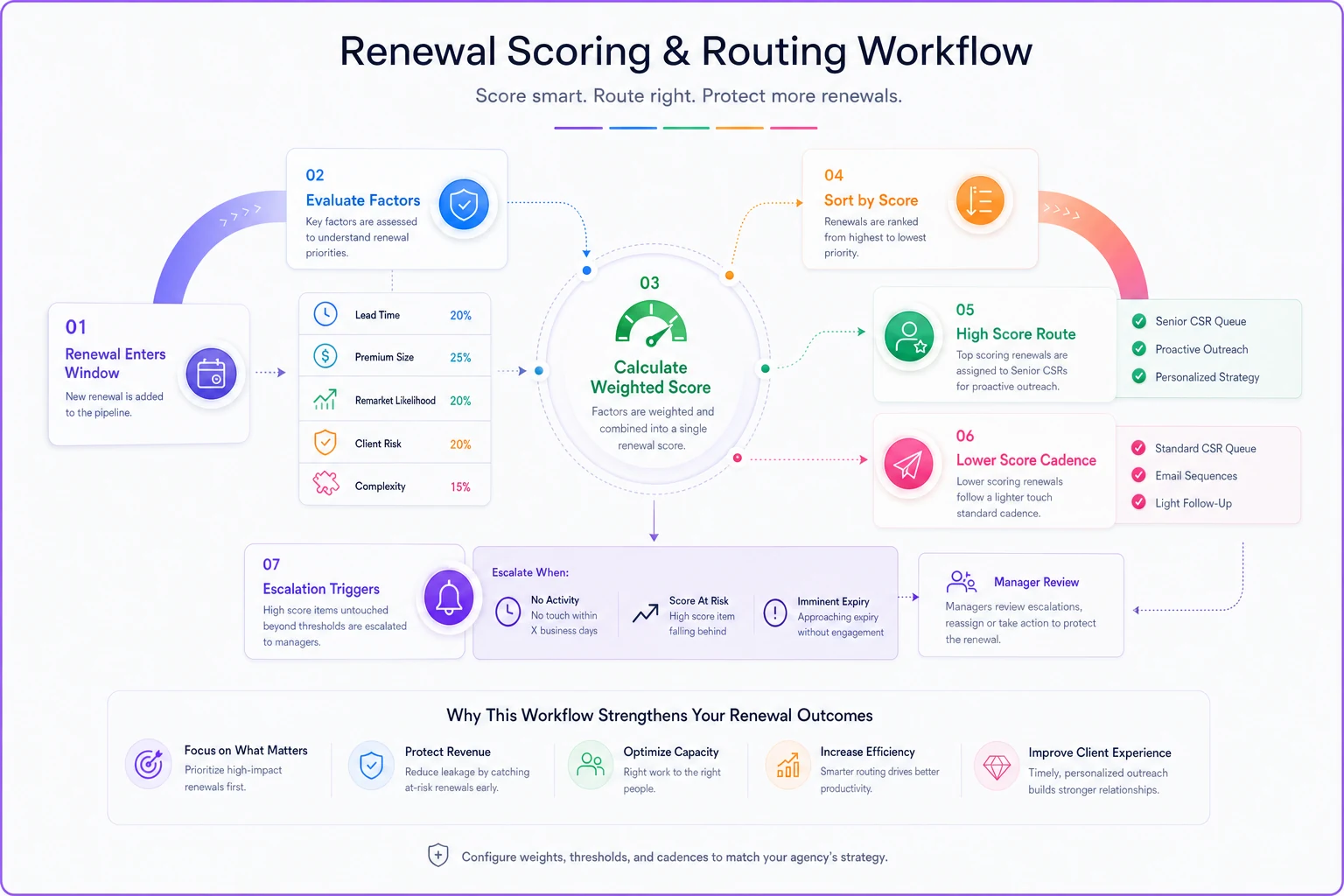
Add the weights, sort descending, work top-down. A renewal scoring 13–15 needs a human on it now. A renewal scoring 5–6 can wait until its cadence trigger fires. The scoring doesn't have to be perfect — it just has to stop your team from spending Monday morning on easy policies while the hard ones age out.
One thing worth stealing from agencies that do this well: the highest-scoring renewals should never be assigned round-robin. Route them to your most experienced person, not whoever's next in rotation. A complex remarket handed to a six-month CSR is a missed renewal waiting to happen.
Batch processing windows: the second lever most agencies never pull
The other thing that breaks at scale is when work happens. When renewals get worked continuously — a few here, a few there, interrupted by service calls all day — the queue never gets a clean sweep. Something always slips to tomorrow, and tomorrow has its own pile.
A practical structure looks like this:
-
60-day sweep (commercial and complex only) — every renewal entering the 60-day window gets reviewed for remarketing decisions, loss run requests, and underwriting flags. This is the block where you catch the accounts that need real runway.
-
45-day sweep — remarketing quotes ordered, carrier submissions out, missing documentation requested from clients.
-
30-day sweep — quotes back, options compared, renewal recommendation prepared, first client touch sent.
-
21-day sweep — client follow-up, questions handled, decisions confirmed.
-
10-day sweep — final confirmations, binding, and the escalation list for anything unresolved.
The reason this works better than continuous processing is subtle: a batch window forces a complete pass over every policy in that stage. Nothing gets skipped because the block isn't done until the list is clear. When work is continuous, the list is never "done," so there's no forcing function.
Someone senior has to guard these blocks the same way you'd guard payroll processing.
Agencies that batch by lead-time window instead of by renewal date almost always find hidden remarketing opportunities they were previously missing. When your 60-day sweep is a real, protected block, you catch the 26% increase early enough to actually shop it, instead of discovering it at day 15 when the only option is "eat it or lose the client."
The trap here is scheduling batch blocks and then letting service work eat them. If your 60-day sweep gets interrupted by three certificate requests, it's not a protected window.
Reminder cadences that don't train people to ignore them
Reminders are where scale quietly poisons the well. When a book is large, the system generates so many renewal reminders that CSRs start treating them as background noise. Every renewal pings at 60, 45, 30, 21, and 10 days regardless of whether it needs attention — so people stop reading them.
The fix is tiering the cadence by priority score, not sending the same drumbeat to every policy.
-
High-score renewals get an early, aggressive cadence — first touch at 60 days, follow-ups every week, and a hard flag if any step is late.
-
Medium-score renewals get a standard cadence — touch at 30, follow-up at 21 and 10.
-
Low-score renewals get a light cadence — one automated touch at 20 days, one at 7, and they only escalate if the client doesn't respond.
Reminder fatigue isn't caused by too many reminders overall. It's caused by undifferentiated reminders. When every alert has the same weight, the important ones lose their signal. When your high-priority renewals visually and procedurally stand apart from routine ones, people start trusting the flags again.
There's also a client-facing side to cadence that gets ignored. Sending a renewal notice once and assuming the client saw it is how policies lapse in the payment gap. For anything with payment risk or a coverage change, a client reminder sequence — notice, follow-up, and a final "your policy renews in X days" — cuts a meaningful chunk of the silent non-renewals that happen simply because the client didn't open the first email.
Manager escalation: the safety net that has to be automatic
Priority scoring and batch windows reduce misses. Escalation is what catches the ones that still slip. And most agencies have nothing here — escalation is "the CSR remembers to tell their manager," which at 400 renewals a month is the same as having no net at all.
Escalation has to be a rule, not a favor. The pattern that actually works:
-
Any high-score renewal still untouched at 30 days auto-flags to a manager
-
Any renewal with a remarket rate increase above your threshold escalates for a coverage/pricing decision, not just a CSR judgment call
-
Any renewal inside 10 days with no client response escalates so someone senior can make a call before it lapses
-
Any renewal that misses its batch window entirely surfaces on a daily exception list the manager actually reviews
The point of escalation isn't to punish anyone. It's to make sure the small number of renewals that need a decision above a CSR's pay grade actually reach that decision-maker before the deadline, not after the lapse.
A useful rule for large books: managers should never be manually hunting for at-risk renewals. If a manager is opening the system to look for problems, the escalation design has failed. The problems should come to them, filtered down to the handful that genuinely need attention that day. On a 400-renewal book, a well-tuned escalation list should surface maybe 8–15 accounts a week — not 60.
When this level of structure actually makes sense
Not every agency needs priority scoring and batch windows. If you're running under roughly 100 renewals a month with one or two CSRs, human judgment still fills the gaps well enough, and layering in a full scoring model just adds overhead.
This structure earns its keep somewhere north of 150–200 renewals a month, or once renewal work is split across three or more people, or the moment your book gets complex enough that a meaningful share of renewals involve remarketing and underwriting. That's where arrival-order processing starts leaking policies and no amount of "try harder" closes the gap.
Who should not rush into this: agencies whose data is a mess. If your management system doesn't reliably know a policy's premium, renewal date, or carrier, a priority score built on garbage inputs will confidently sort renewals in the wrong order. Fix the data hygiene first. A scoring model amplifies whatever's underneath it — clean data or dirty data.
A real scenario
A mid-sized agency running mixed personal and commercial lines — around 380 renewals a month across four CSRs — was losing roughly 6–9 policies a month to lapses and rushed non-renewals. Most were commercial accounts that got picked up too late to remarket. The team was working hard; the activity log was full. The renewals just weren't being touched in the right order.
They did three things. First, they scored every renewal on entry and routed the top-scoring accounts to their two senior CSRs. Second, they set a protected 60-day sweep block, twice a week, that no service work was allowed to interrupt. Third, they built an escalation list that surfaced any high-score renewal untouched at 30 days.
Within about two months, missed renewals dropped to one or two a month, and most of those were genuine client decisions to leave rather than lapses caused by the workflow. The bigger surprise was retention on the complex accounts — catching increases at 60 days instead of 15 gave them time to remarket, and a handful of accounts that would've walked over a rate hike stayed because the team had real runway to find a better option. No new hires. Same four people, working the same hours, just in a different order.
Where software carries the load
Everything above can be run manually with spreadsheets and disciplined managers, and plenty of agencies do exactly that. But the scoring, the batch-window triggers, the tiered reminder cadences, and the escalation flags are the kind of repetitive, rules-based work that operational software with AI automation handles far more reliably than a person tracking it by hand.
The practical value isn't flashy — it's that the score gets calculated the moment a renewal enters the window, the batch lists build themselves, the reminders fire at the right cadence for each priority tier, and the escalation list lands on the manager's desk without anyone remembering to build it. On a 400-renewal book, that's the difference between a system that holds under pressure and one that leaks a few policies a month you never even see leaving.
The goal isn't to remove people from renewals. It's to stop asking them to hold the entire queue in their heads, so their judgment goes toward the accounts that actually need it — and nothing quietly ages out while everyone's busy.
Ready to transform your insurance agency operations?
Join 500+ agencies using Covixly to reduce manual work, improve client service, and grow their book of business.